The lowest-cost giveaway can be the hardest to justify if recipients have little reason to keep it. Making a case for premium promotional items isn’t about defending a higher unit cost with big brand-exposure promises. It means showing why an item fits the audience, is useful in context, and supports a specific campaign goal.
Budget pressure is real, and a premium choice needs more than a polished look to make the cut. Usefulness matters: Custom Ink’s May 2026 blog reports that 78% of U.S. consumers keep branded merchandise only when it’s genuinely useful. Treat that as a reminder to consider recipient needs, not as proof that any particular item will deliver a return.
This article offers a fair way to compare options beyond purchase price. You’ll assess audience and event fit, useful life, recipient experience, and total campaign demands, then set measurable goals before ordering in bulk. A custom towel suited to a sports event, for example, makes the trade-offs easier to evaluate. Use the same criteria to build a recommendation stakeholders can review, without relying on vague impressions or assuming premium automatically means better.
Key Takeaways
- Start with the campaign goal and recipient needs, then define “premium” by fit, usefulness, perceived quality, and execution.
- Compare total campaign demands, including customization, distribution, storage, and administration, rather than judging options by unit cost alone.
- Use a consistent framework to compare premium and budget items; a lower-cost option may be the stronger fit for broad distribution or a short-lived event.
- Make a case for premium promotional items with a baseline and a measurable objective established before selecting an item or requesting quotes.
- For a custom towel, match the format and artwork to the event and recipient, and plan specifications carefully so customization supports campaign relevance.
Making a case for premium promotional items starts with the campaign goal
A higher unit cost needs a clear reason that matters to recipients. If the goal is simply to put a giveaway in every attendee’s hand, a premium choice may not be necessary. Start by identifying what the campaign should accomplish, then choose an item that fits the audience, setting, and distribution plan.
A premium promotional item is one whose quality, usefulness, customization, and presentation fit the recipient and campaign purpose, not simply one with a higher price. Promotional merchandise covers a wide range of branded items and marketing uses, so the right choice depends on what the item needs to do.
For a quick overview of common promotional products, watch this video:

What makes a promotional item premium?
Material, finish, customization, usefulness, and presentation all shape perceived quality. Some factors are objective and can be compared directly, such as product specifications, printing method, or included customization. Other judgments are subjective: recipients may differ in what feels attractive, practical, or appropriate. Premium is relative to audience expectations and campaign purpose, so define the criteria before comparing options.
A well-produced item still needs to make sense for its recipient. A branded towel could suit a sports or outdoor event where people have a reason to use one. Consider the towel format, how recipients will carry it, and whether the artwork fits the occasion. The logo alone doesn’t make the item relevant.
Which campaign goals justify a higher-quality giveaway?
Separate the objective before assessing products. A one-time event handout may prioritize broad distribution and simple logistics. An appreciation gift or relationship-building item may call for more considered presentation and closer audience fit. Awareness and participation are different aims, too, and should be assessed using measures that reflect each goal.
- Participation: Match the item to the event activity and recipient.
- Appreciation: Consider whether the item feels suited to the people receiving it.
- Awareness: Decide how you’ll track campaign response instead of assuming an item creates exposure.
Define the goal first. Then compare products against the setting, recipient, intended use, and practical limits of the campaign. That gives stakeholders a clear reason for choosing a higher-quality item without treating engagement or sales as guaranteed outcomes.
Build the value case around usefulness, experience, and total campaign fit
A fair comparison looks beyond the quoted unit cost. Include customization, distribution, storage, and campaign administration, then judge the complete option against its intended audience and use. A premium item may have a stronger case if its format suits the event and recipients can realistically use it. Treat that as a reason to evaluate the item, not a promise of longer use or greater exposure.
Observable outcomes are things you can track, such as distribution, participation, or response; repeat brand impressions are assumptions unless you measure them. Keep that distinction clear in stakeholder discussions. Use past campaign data or recipient feedback where available, and label expectations as estimates rather than presenting them as results.
Assess usefulness and recipient experience
Start with the setting. Can recipients use the item where they receive it? Can they carry it comfortably? Will the branding be clear without getting in the way of the design? Consider whether the presentation feels appropriate and the item suits the audience. A custom towel may fit a sports or outdoor event, while the same format could be less useful in another context. Match the product to the people and moment, not just the logo.
Review feedback from previous campaigns if you have it. Look for comments, redemption or participation data, and other evidence tied to your objective. Without that evidence, describe usefulness as a reason to test an item, not proof of how long recipients will keep it.
Compare the full campaign cost
Request a like-for-like comparison. Hold audience, quantity, design, and campaign goal constant, then check the details that can change the total effort and spend:
- Item and customization: Compare quotes for the product and the requested branding or artwork.
- Distribution and storage: Verify delivery, handling, and any space needed before the event.
- Administration: Account for the time and coordination required to approve artwork, manage the order, and distribute items.
- Requirements and timing: Confirm quantity requirements, artwork specifications, production timing, and other operational constraints directly with suppliers.
Don’t treat a projected cost per impression as a proven return. It depends on assumptions about use and visibility. Instead, compare verified campaign expenses with outcomes you can actually track, such as attendance or responses to a campaign-specific prompt. That makes the case more credible without overstating what the item delivered.
For a concrete reference point, review wholesale custom towel options and consider how format and branding could fit your event’s recipients and logistics.
Premium versus budget promotional items: compare evidence, not assumptions
Compare options against the same audience, quantity, design, and campaign objective. Otherwise, differences in scope can be mistaken for differences in value. Higher spend alone doesn’t prove better campaign performance. The useful question is whether the item’s fit, quality, and practical value justify its place in this specific campaign.
| Factor | Budget option | Premium option |
|---|---|---|
| Audience fit | Can suit a broad audience or general event. | May be tailored to a defined group or occasion. |
| Perceived quality | May meet basic expectations for a short-term need. | May offer a more considered finish or presentation. |
| Usefulness | Can work if recipients need it in the moment. | May be worth assessing for intended use beyond the event. |
| Customization | May use simpler branding or design. | Can allow a more tailored execution, depending on specifications. |
| Fulfillment | Check quantity, timing, and distribution requirements. | Check the same requirements, plus any added planning needs. |
These are comparison prompts, not guaranteed differences. Judge actual product specifications and supplier details, then use campaign evidence to assess results.
When a budget giveaway may be the smarter choice
For a broad-reach event where the main requirement is handing out an item quickly, a simpler option may be the practical fit. Check that it meets the audience’s needs, design requirements, quantity, and schedule. If it does, paying more may add little value to the campaign. Don’t call budget items ineffective without comparing similar audiences, distribution plans, and measurable objectives.
When a premium promotional item may earn its place
A more considered item may deserve evaluation when the audience, brand positioning, or intended use supports it. For a sports event, a custom rally towel can connect the branded item with the occasion and its recipients. That makes it a relevant option to assess, not a universal answer. Compare its specifications and fulfillment needs with alternatives. See the custom rally towels available for sports-event planning.
Making a case for premium promotional items means showing why the added investment fits the campaign, not claiming that a higher-quality giveaway automatically creates more engagement or sales. Use the same decision criteria for both options, and let audience fit and comparable evidence guide the choice.
How to justify premium promotional items to stakeholders
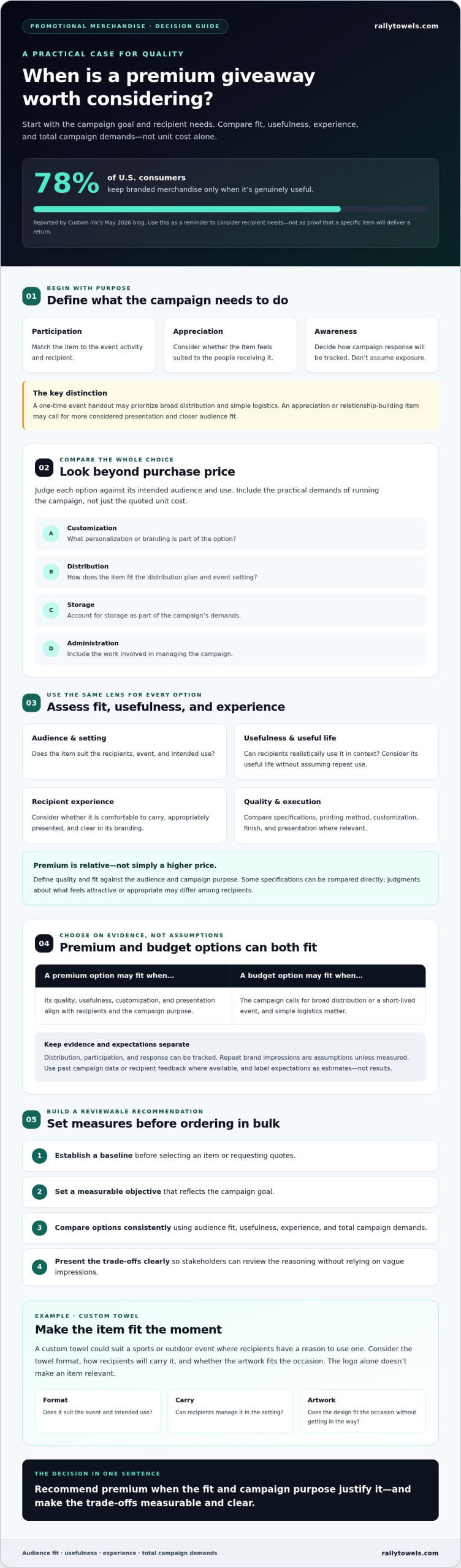
A credible approval request is a short, testable plan, not a claim that a more expensive giveaway will automatically produce more sales. Before requesting quotes, agree on the campaign’s starting point and what success would look like. That gives stakeholders a clear basis for judging the recommendation and evaluating the result.
A practical approval process for premium merchandise
Use this sequence to prepare a focused business case before comparing suppliers:
- Define the audience and objective. Specify who will receive the item and whether the campaign aims to encourage participation, show appreciation, build relationships, or support another goal.
- Set a baseline. Record the relevant starting measure, such as previous event participation or the response rate to an existing follow-up. If no comparable data exists, say so and establish a baseline for this campaign.
- Plan distribution. Document the quantity, how and where items will be distributed, and the timing. Note constraints that could affect delivery or use.
- Choose the success measure. Select an outcome you can collect reliably, such as items distributed, event participation, recipient feedback, or follow-up activity.
- Compare options consistently. Request quotes using the same quantity, design requirements, and schedule. Confirm supplier information rather than relying on assumptions.
- Make the recommendation. Explain why the chosen option fits the audience and objective. Document trade-offs, risks, and any assumptions that still need testing.
This turns making a case for premium promotional items into a decision stakeholders can review. It also clarifies what the team expects to learn, even if the campaign outcome differs from its forecast.
Measure outcomes, then capture what you learn
Choose a collection method before distribution. For participation, define how it will be counted. For feedback, decide when and how recipients will be asked. For follow-up, identify the action being tracked and use a consistent method to record responses. Report what you actually observe, not what you hope the item caused.
Distribution is an input, not a conversion. If items were handed out, that confirms reach at the point of delivery; it doesn’t establish that recipients used them, remembered the brand, or made a purchase. A specific return on investment requires reliable campaign costs and outcome data, plus a defensible method for attributing results to the campaign. Without that evidence, present ROI as unproven.
After the campaign, compare results with the baseline and record recipient comments, operational issues, and lessons for the next order. If custom towels are under consideration, explore wholesale custom towel options as you develop a brief aligned with your event and evaluation plan.
Put the premium-item case into action with a custom branded example
A custom towel shows how the right product can make a premium-item recommendation specific. For a sports event, a rally towel may suit the setting and give organizers a practical canvas for event branding. A beach towel could fit a summer or waterfront campaign instead. Neither format is automatically right. Consider who will receive it, how it will be handed out, and whether recipients have a reason to use it.
Artwork can make an item feel more connected to the occasion, but customization adds decisions that need planning. Keep the design clear and relevant, and verify artwork requirements with the supplier. Also confirm quantity, fulfillment details, and required delivery timing before approval. Making a case for premium promotional items means weighing potential campaign relevance against the specifications and coordination involved, not assuming customization guarantees engagement.
Is a custom towel the right premium item for this audience?
Check the event, recipient expectations, distribution method, and intended use together. For a game or sports gathering, explore custom rally towels as one event-matched option. For a campaign where recipients are likely to use a towel at the beach, custom beach towels may be worth assessing. Compare both with other suitable items using the same goal and audience criteria.
Ask practical questions before settling on the format: Can attendees carry it easily? Does its intended use fit the event? Will the artwork communicate the brand clearly without overwhelming the design? If the item’s purpose or use is unclear, the premium case needs more work.
Turn the recommendation into a supplier-ready brief
Give suppliers enough detail to confirm whether the option fits your campaign and schedule. Include:
- Goal and audience: State what the campaign should achieve and who will receive the item.
- Quantity and distribution: Specify the order quantity and how the items will reach recipients.
- Artwork: Share the design and ask what file or artwork details are required.
- Preferred item and timing: Identify the towel type you’re considering and when the order must be delivered.
- Order details: Ask the supplier to confirm available customization, production details, and fulfillment requirements for your request.
A clear brief makes supplier responses easier to compare and gives stakeholders a concrete recommendation to review. For guidance on a wholesale custom towel project, Discuss your promotional towel project.
Make your next promotional item decision with confidence
Premium merchandise earns consideration when it fits the audience, event, and campaign goal, not simply because it costs more. Compare options using consistent specifications, and weigh usefulness, recipient experience, customization, and fulfillment alongside unit cost. Then set a baseline and choose an outcome you can actually measure, such as participation, feedback, or follow-up.
That’s the foundation of making a case for premium promotional items: a clear rationale supported by campaign evidence, with assumptions identified rather than presented as guaranteed exposure or return. A custom towel can make the decision tangible when its format and artwork suit the event and recipient.
Rally Towels supports branded merchandise planning with wholesale custom towels and custom T-shirts, serving organizations ranging from athletic booster clubs to large corporations. Consider the item that fits your next campaign, and prepare a brief with your goal, audience, quantity, artwork, and timing.
Discuss your promotional towel project and take the next step toward a well-matched campaign. With a clear plan and measurable goals, you can make a confident choice.
Frequently Asked Questions
Are premium promotional items worth the higher upfront cost?
They can be worth considering when their quality, usefulness, and audience fit support the campaign goal. A higher unit cost alone isn’t enough to justify a choice. Compare the full campaign requirements, including customization and distribution, and consider whether recipients have a reason to use the item. Treat longer use or stronger engagement as possibilities to test, not guaranteed benefits. A simpler giveaway may be the better fit for broad, short-term distribution.
How do I make a business case for premium promotional items?
Start by stating the campaign objective, intended recipients, distribution plan, and a measurable definition of success. Set a baseline before selecting an item, then compare options using the same quantity, design needs, and timing. Include confirmed item, customization, and fulfillment details in the evaluation. Making a case for premium promotional items means explaining the rationale and trade-offs clearly, while distinguishing expected benefits from outcomes the campaign can actually verify.
Do premium promotional products generate a better return on investment?
Not automatically. A higher-quality item may be a good fit for a particular campaign, but that alone doesn’t prove a stronger return. To calculate ROI, track campaign costs and a relevant business outcome, then use a defensible method to determine how much of that outcome the campaign influenced. If you only know how many items were distributed, report distribution as reach at delivery, not as evidence of conversions, sales, or profit.
How can I compare premium and budget promotional items fairly?
Compare options for the same audience, campaign objective, quantity, design, and schedule. Review product specifications and confirmed supplier details, then account for customization, distribution, storage, and administration where relevant. Assess audience fit, perceived quality, usefulness, and fulfillment using consistent criteria. A budget option can be effective for broad distribution or a short-lived event need. Don’t label it ineffective, or assume premium is automatically better, without comparable campaign evidence.
Which premium promotional items work well for sporting events?
Choose based on the event, recipient, distribution plan, and likely use. Custom rally towels can be a relevant branded option for games and sports gatherings, especially when the design reflects the event clearly. They aren’t the right answer for every audience or objective. Consider whether attendees can carry and use the item, then compare its specifications and fulfillment requirements with other suitable choices before recommending it.
What should I measure after distributing promotional items?
Measure the outcome you defined before ordering, using a consistent collection method and baseline. Depending on the campaign, this could include distribution, event participation, recipient feedback, or follow-up activity. Record how the data was gathered and what it can reasonably show. Distribution confirms that items were handed out, but it doesn’t prove recipients used them or converted. Capture operational lessons and feedback to guide the next campaign.