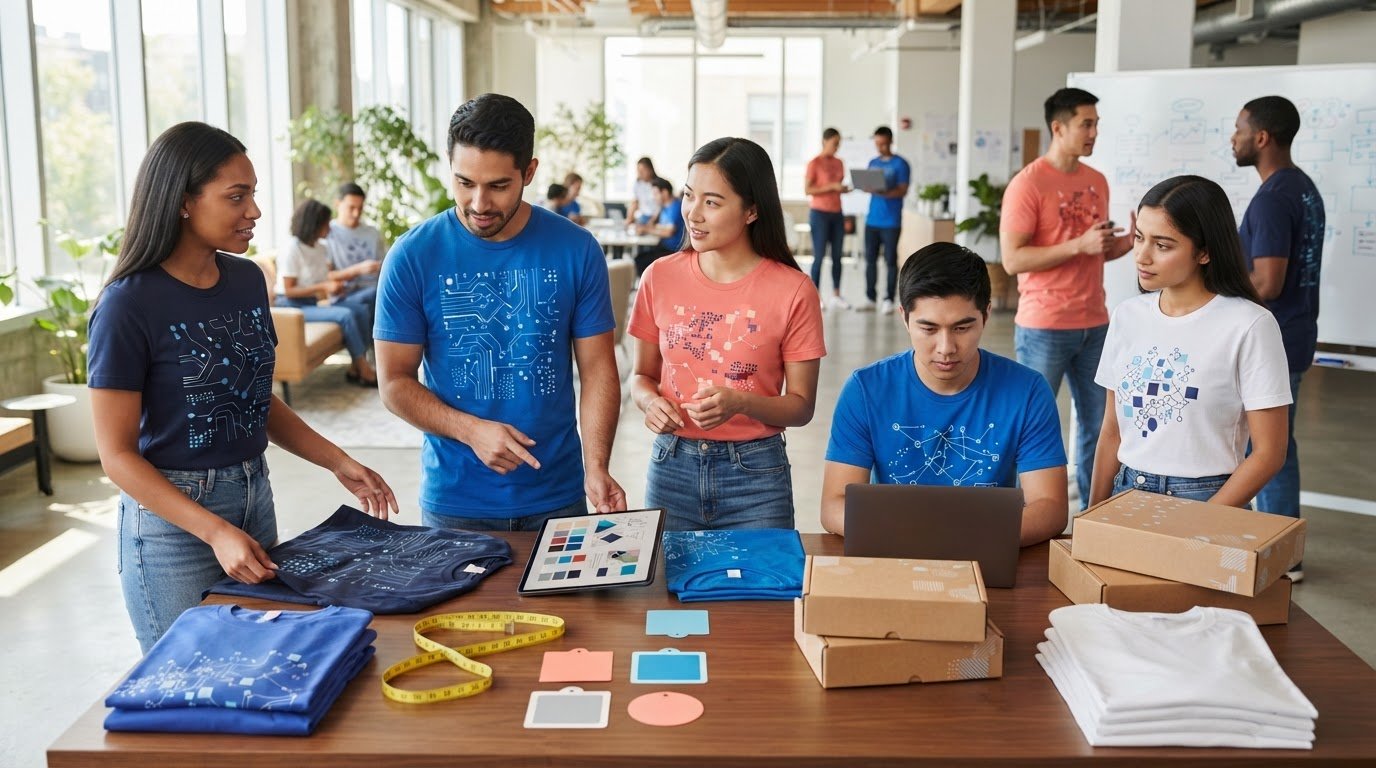
What if the hackathon shirt people keep wearing after the event is also the one that makes every team feel part of the same challenge? The best hackathon custom shirts balance a strong event identity with a design people will want to wear. A shared visual theme can work for participants, organizers, mentors, and sponsors, with small variations to help each group stand out when needed.
It’s easy to get stuck between bold branding and a shirt developers will actually want to wear. Then come the practical details: giving sponsors visibility without crowding the artwork, collecting sizes, and ordering the right quantity before event day. A few clear decisions up front make the design and ordering process easier to manage.
This guide compares shirt approaches, explains how to create a recognizable design for different event roles, and lays out steps for organizing artwork, sizes, and quantities. Whether you’re planning a campus coding sprint or a larger company event, use it to move from an initial idea to coordinated custom apparel.
Key Takeaways
- Choose an apparel approach that gives participants, staff, and sponsors clear roles while preserving a shared event identity.
- Compare hackathon custom shirts for readability, relevance to the event, audience appeal, and sponsor balance.
- Keep artwork recognizable at a glance and clear in event photos, even when viewed from a distance.
- Plan the order in sequence: set the need-in-hand date, estimate attendance, collect sizes, prepare artwork, and approve the final details.
- Rally Towels provides custom T-shirts for coordinated event apparel, serving organizations from small athletic booster clubs to major sports organizations and corporations.
Why Hackathon Custom Shirts Can Do More Than Identify Your Team
Hackathon custom shirts are event apparel personalized with an event name, visual identity, artwork, or message. They help attendees recognize fellow participants, give a diverse group a shared symbol, and serve as a wearable reminder of what people built together. Shirts can also support event operations: recognizable apparel makes it easier for attendees to spot organizers when they need directions or help.
Event apparel can turn a roomful of individual builders into a community with a shared hackathon identity. That purpose sets a coordinated event shirt apart from an individual developer-humor tee. A joke about debugging may delight one person, but an event shirt represents the whole gathering. The strongest designs feel specific to the challenge while still appealing to people with different roles, interests, and senses of humor.
Hackathons vary in format and focus. For background on their structure and different types, see What is a Hackathon? That variety is a useful reminder: let the event’s theme and community shape the shirt instead of relying on generic code jokes.
What makes a shirt feel specific to a hackathon?
Start with a visual idea tied to the event theme, team culture, or build challenge. A sustainability-focused event might use a simple nature-inspired motif; a civic technology challenge could emphasize the city or community it serves. Add the event name, date, or location to give the shirt context as a keepsake. To keep it wearable later, make the main artwork feel lasting and treat dates or yearly themes as supporting details rather than the entire design.
Think beyond placing a logo on a blank field. A recognizable symbol, considered color choices, or a concise message can make the artwork feel intentional. Keep the concept clear enough to register quickly, and avoid squeezing in every schedule detail or sponsor message. One strong idea is easier to understand during the event and more likely to remain appealing afterward.
Who benefits from a coordinated event shirt?
Participants can feel connected to the event without wearing labels that define their role. Organizers can use a related design to be easier to identify, while mentors or volunteers can have a small visual distinction within the same overall identity. Shared artwork brings everyone together; restrained role cues help attendees know whom to approach. This balance makes the apparel useful without turning the room into a set of unrelated uniforms.
For organizers, coordinated shirts support event recognition in busy spaces and create a consistent look in group photos. They can also complement other event-branded items as part of a broader promotional plan. Rally Towels provides custom T-shirts for branded apparel orders, serving clients from small athletic booster clubs to major leagues and Fortune 500 companies. Explore custom wholesale T-shirts as one way to put a hackathon identity on event apparel.
Hackathon Custom Shirt Options: Match the Apparel to the Audience
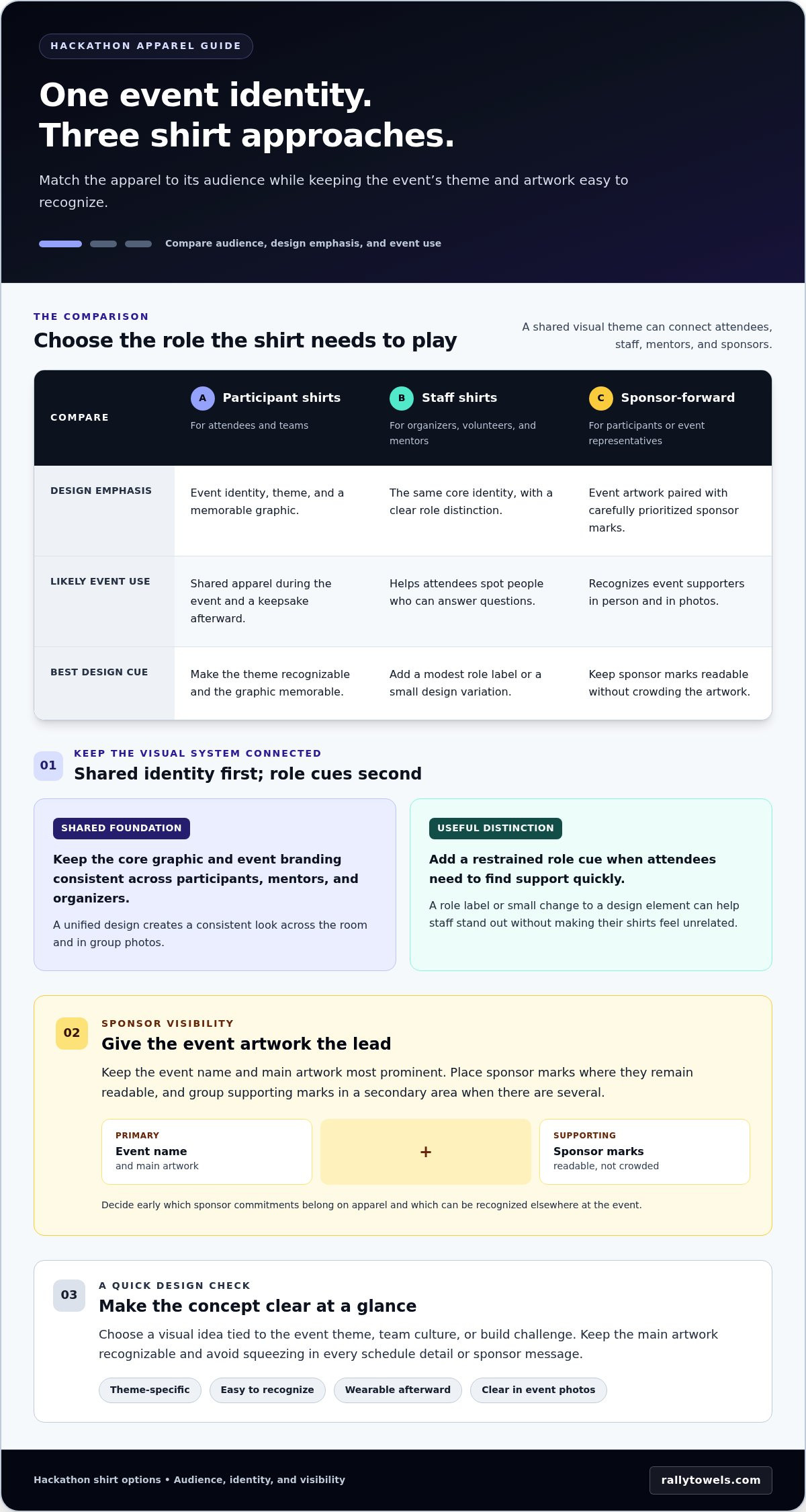
The right shirt approach depends on who will wear it and what the apparel should do. Participants may want a memorable event keepsake, while staff need to be easy to spot. Sponsors need recognition, but their marks shouldn’t compete with the event identity. Compare the options before settling on one design or several related variations.
| Option | Audience | Design emphasis | Likely event use |
|---|---|---|---|
| Participant shirts | Hackathon attendees and teams | Event identity, theme, and a memorable graphic | Shared apparel during the event and a keepsake afterward |
| Staff shirts | Organizers, volunteers, and mentors | Same core identity, with a clear role distinction | Helping attendees identify people who can answer questions |
| Sponsor-forward designs | Participants or event representatives | Event artwork paired with carefully prioritized sponsor marks | Recognizing event supporters in person and in photos |
Participant shirts versus organizer and mentor shirts
One shared design works well when the main goal is to make the whole event feel connected. Participants, mentors, and organizers can wear the same artwork, creating a consistent look across the room and in group photos. This approach also keeps the event identity front and center.
A role distinction is useful when attendees need to find support quickly. Keep the core graphic and event branding consistent, then add a modest variation, such as a role label or a small change in a design element. This gives staff a recognizable cue without making their shirts look unrelated to participant apparel. Choose the simplest distinction that solves an actual on-site need.
Sponsor visibility without overwhelming the design
Sponsor recognition works best with a clear hierarchy. Give the event name and main artwork the strongest visual presence, then place sponsor marks where they remain readable without crowding the design. If there are several sponsors, don’t treat every logo as the headline. Group supporting marks in a secondary area to acknowledge contributors while keeping the shirt easy to understand at a glance.
Decide early which sponsor commitments belong on apparel and which can be recognized elsewhere at the event. This helps prevent the shirt from becoming a crowded logo collection and lets the artwork retain value as a keepsake. For an apparel order built around your event identity, explore custom wholesale T-shirts.
Choose one unified design when simplicity and shared identity matter most. Add role cues when they make event support easier to find, and keep sponsor details secondary to the event’s visual story. Rally Towels also offers promotional products for event branding, giving organizers another way to carry a consistent identity across event materials.
How to Compare Hackathon Shirt Designs Before You Commit
A strong concept can still fall flat if the event name is hard to read, the artwork feels unrelated to the challenge, or sponsor marks overwhelm the design. Before approving hackathon custom shirts, review each concept against the same four checks: readability, event relevance, audience appeal, and sponsor balance. This framework helps organizers compare ideas consistently instead of choosing on personal taste alone.
Review the design in a mockup at approximately its finished size. A graphic that looks crisp when enlarged on a screen may lose detail on a shirt. View the mockup from a short distance, then shrink it to a thumbnail to see what remains clear. Consider event photos too: can someone recognize the main visual or read the event name in a group shot?
- Readability: Is the event name or main message easy to make out quickly?
- Event relevance: Does the concept reflect the challenge, theme, or community?
- Audience appeal: Could participants with different roles see themselves wearing it after the event?
- Sponsor balance: Are sponsor marks visible without taking over the design?
Evaluate artwork for clarity and wearability
Give the design one clear focal point, such as the event name or a distinctive visual idea. Extra decoration can make artwork harder to read, especially at a distance. Use a simple mockup to check contrast between the artwork and shirt color, and review the image at its intended placement and approximate finished scale. Then ask whether the design will still feel appealing after the event.
For example, a small cluster of related symbols may communicate a build challenge more clearly than a detailed illustration packed with tiny labels. Keep secondary information secondary. If the event date is included, make sure it doesn’t compete with the central artwork or dominate the shirt’s identity.
Balance event identity, developer culture, and sponsors
Coding references and developer humor can add personality, but they should fit the event’s audience. A niche joke may appeal to one team and confuse others, while a broad theme can help participants feel included. Keep the event concept visually dominant, and place sponsor marks where they can be seen without competing with it. Before approval, proofread names and dates and check each supplied logo or artwork file against the intended design.
Make the final review practical. Show the mockup to people who represent different parts of the event, such as a participant, an organizer, and a sponsor contact. Ask each person what they notice first and whether anything is difficult to read. If their answers vary widely, simplify the layout or strengthen the visual hierarchy. Approve the artwork when the event identity, key details, and sponsor recognition work together at a glance.
Plan Hackathon Shirt Orders Around Sizes, Artwork, and Event Dates
A smooth shirt order starts with the event date, not the first design idea. Work backward from the day shirts need to be in hand, leaving room for registration changes, artwork review, and approval of the final order details. As custom apparel and promotional specialists like A1 Promotions Ltd. often emphasize, there’s no universal production timeline to rely on, so build the schedule around the order’s requirements and leave time for decisions to be reviewed.
Use this sequence to organize hackathon custom shirts and keep key details from slipping until the last minute:
- Set the need-in-hand date. Choose when shirts must be ready for packing, distribution, or event setup. Use that date to organize the remaining decisions.
- Estimate attendance. Review registrations and note how the expected headcount may change. Keep participant estimates separate from staff, mentor, volunteer, and sponsor allocations.
- Gather sizes. Set a response deadline that gives your team time to collect, check, and consolidate size requests before finalizing the order.
- Prepare artwork. Assemble event branding, approved sponsor marks, final wording, and any role-specific variations in one shared location.
- Approve the details. Review the artwork, quantity breakdown, size information, and other order details together before giving final approval.
Collect attendance and size information
Registration counts are a working estimate, not a guaranteed attendance list. Track confirmed registrations separately from expected walk-ins or late additions, and update the estimate at planned checkpoints. A response deadline for sizes helps prevent late requests from disrupting the count. Keep participant sizes distinct from staff and sponsor quantities so each group’s needs remain visible.
When deciding whether to include a reserve, consider your event’s registration patterns, how close you are to capacity, and whether you can distribute remaining shirts later. A small, considered reserve may make sense for one event, while another organizer may prefer to base quantities closely on confirmed responses. There’s no single percentage that fits every hackathon. Record how you arrived at the final count so the team can make a deliberate choice.
Prepare artwork and keep approvals moving
Put the approved event name, date, logo files, sponsor marks, and final text in one place. Assign one person to collect edits and circulate each updated proof, rather than letting conflicting versions move through separate email threads. During review, check spelling, logo use, color contrast, placement, and any differences between participant and staff artwork. Ask reviewers to approve the same version after all requested corrections are resolved.
Build review time into the schedule. Artwork changes can affect other decisions, so don’t treat approval as a quick final glance. Confirm that the approved proof and quantity breakdown match the order details you intend to submit. A clear record helps organizers catch discrepancies before they create confusion.
Once your attendance estimate, size breakdown, and artwork checklist are organized, discuss your custom shirt order with Rally Towels.
Get Hackathon Custom Shirts Through Rally Towels
Rally Towels provides custom T-shirts as branded apparel for events like hackathons. Organizers can bring their event identity, audience needs, and design direction together in a coordinated shirt order. The company serves a broad range of clients, from small athletic booster clubs to major leagues and Fortune 500 companies.
A clear starting brief helps turn an early concept into a focused apparel plan. You don’t need every design detail settled before beginning the conversation. Share what the shirts should accomplish, who will wear them, and what event information or sponsor recognition needs to appear. That context helps keep the main identity consistent while accounting for different event roles.
What to bring to a custom shirt discussion
Gather the core information your team has already established. A concise brief can include:
- Event details: The event date and estimated headcount, with participant, staff, mentor, volunteer, and sponsor groups separated where useful.
- Size plan: The status of your size collection, its response deadline, and how you’re handling registrations that may change.
- Artwork and wording: Event branding, approved sponsor logos, the exact event name, and any message or date you want included.
- Design direction: A short description of the visual concept, intended atmosphere, and any colors or references that matter to the event.
- Role variations: A note on whether organizers or other groups need a visible distinction while keeping the event’s core identity connected.
These details make it easier to discuss the complete order instead of focusing only on a graphic. If attendance is still shifting, label quantities as estimates and explain what could change. If sponsor artwork or wording is awaiting approval, note that as well. Clear notes help your team keep decisions organized as the event plan develops.
Turn your hackathon concept into coordinated apparel
The shirt should reflect the people attending and the experience you want the event to create. A university coding sprint may call for a different visual tone than an internal company innovation event, but both benefit from an identity that connects participants and organizers. Keep the central idea recognizable, then make role differences or sponsor details supporting elements.
Rally Towels offers custom T-shirts alongside promotional products, giving organizers a way to carry event branding into apparel and other giveaways. For hackathon custom shirts, bring the artwork, audience breakdown, size plan, event date, and any open decisions into the discussion. A useful brief doesn’t have to be elaborate. It should make the shirts’ purpose and the choices still in progress easy to understand.
Ready to move from concept to order planning? Start planning custom hackathon shirts with your event details.
Make Your Hackathon Identity Ready to Wear
A shirt can help make your event feel tangible before the first team starts building. Treat the design as part of the experience: something that welcomes attendees, reflects the spirit of the challenge, and gives people a reminder to take with them. With a clear vision, hackathon custom shirts can connect the event identity to the people bringing it to life.
Bring your event concept, audience, and artwork direction into one brief. You don’t need every detail perfected. A focused starting point makes it easier to shape an apparel plan that fits the gathering and feels like yours.
Rally Towels provides custom T-shirts as part of its promotional product offerings and serves organizations of different sizes. Plan custom hackathon shirts with Rally Towels and give your event identity a wearable expression.
Frequently Asked Questions
Can hackathon shirts work for both in-person and virtual participants?
Yes, a shared shirt design can connect in-person and virtual attendees, though distribution needs a separate plan. For remote participants, decide whether shirts will be shipped, picked up through a local event partner, or offered as a digital design they can use independently. Set expectations clearly in registration information, including whether remote attendees can receive a physical shirt and how they should provide delivery details.
Should hackathon shirts include a QR code?
A QR code can be useful if it leads to a stable, mobile-friendly destination, such as the event schedule or project gallery. Treat it as an optional extra, not the only way to find important information. Test a printed-size mockup from a normal viewing distance and scan it with different phones before approval. Keep a short readable URL nearby as a fallback.
What artwork file should organizers prepare for custom hackathon shirts?
Share the highest-quality original artwork available, ideally an editable vector file or a large, clean image, plus a reference mockup showing intended placement. For custom garment decoration methods like DTF printing, providers such as Transfers by MoreTranz similarly emphasize high-resolution vector assets to ensure fine lines and colors transfer cleanly. Include separate logo files rather than screenshots, and provide the exact wording in a text document to reduce transcription errors. Keep a copy of the editable master so later revisions don’t require rebuilding the artwork.
Can a hackathon shirt design be reused for a future event?
Yes. Build a reusable core identity, such as the event name treatment or a recurring symbol, and keep edition-specific details separate. For example, preserve the main graphic while updating a year, challenge theme, or host department. Save the final approved artwork and a note about the changes made. This creates continuity across events without making each year’s shirt feel like a duplicate.
How can organizers make hackathon shirts inclusive for different attendees?
Use language and imagery that welcome beginners, experienced developers, mentors, and nontechnical contributors alike. Avoid jokes or visuals that assume a particular gender, background, skill level, or role. Make size selection straightforward and private, and let people state their preferences without having to explain them publicly. Inclusive design starts with considering who might feel left out before artwork is finalized.
What should go on the back of a hackathon shirt?
Keep the back purposeful and uncluttered. Options include a short event URL, a concise theme line, or a compact list of participating teams if names are approved for public display. Avoid turning the back into a dense block of text that’s hard to read in photos. If the front already carries several visual elements, a simple back treatment can give the design room to breathe.