

Did you know the average promotional product delivers a cost-per-impression of just $0.006? That is a massive win compared to the $5.26 average CPC for LinkedIn Ads in 2026. If you have struggled with calculating ROI on swag in the past, it is likely because you lacked the hard data to back up your marketing spend.
We know the frustration of facing a skeptical CFO who sees “waste” where you see brand opportunity. It’s difficult to track a physical item to a digital lead, and high waste rates from low-quality items only make your budget harder to defend. You need a defensible strategy that turns every giveaway into a measurable, high-performing asset.
This guide delivers the exact formulas and auditing frameworks you need to prove financial impact to any executive. You will learn how to use the “Utility-to-Impression” ratio to slash your cost-per-acquisition while driving massive brand loyalty and employee retention. Stop guessing and start winning with a data-driven report that proves your promotional strategy is a profit center.
Key Takeaways
- Master the exact formulas for calculating ROI on swag to turn your promotional budget into a defensible profit center.
- Compare the long-term visibility of physical assets against the fleeting nature of digital clicks to maximize your 2026 marketing reach.
- Follow a five-step auditing framework to track physical distributions and link them directly to demo requests and sales leads.
- Leverage the “Longevity Multiplier” by selecting premium, durable products that remain in use for years rather than ending up in a landfill.
- Bridge the gap between “hard” financial returns and “soft” metrics like brand sentiment to build a complete impact report for your executive team.
Beyond the ‘Landfill’ Myth: Why Swag ROI is Your Most Powerful 2026 Metric
In 2026, the era of “cheap” promotional giveaways is officially dead. Swag ROI is the measurable financial return generated by high-quality, branded physical assets. It is no longer enough to just hand out items and hope for the best. You need a strategy that treats every physical product as a precision marketing tool designed to drive revenue. Finance teams have stopped looking at “cost-per-unit” and started demanding a “cost-per-outcome” analysis. If you want your budget approved, you must prove that your branded merchandise is a mandatory investment, not a discretionary expense.
To better understand the logic behind these professional calculations, watch this helpful video:

The 2026 market has shifted toward “sustainable utility.” Consumers are smarter and more selective than ever. Research shows that 78% of U.S. consumers keep promotional items because they are useful. If your giveaway is durable and high-quality, it stays in the recipient’s home or office for years. This creates a “longevity multiplier” that digital ads simply cannot match. When calculating ROI on swag, you are measuring the long-term impact of a physical touchpoint that builds real, human connections.
The 2026 CFO Mindset: From Discretionary to Mandatory
Finance teams are auditing every dollar. They want to see conversion metrics, not vanity metrics like “impressions” that never turn into sales. You must frame your promotional strategy as a Customer Retention Tool. Use The Swag ROI Formula to translate your marketing efforts into the language of the boardroom. When you show that a high-quality item reduces churn or increases lead quality, you move from a “nice-to-have” budget to a mandatory one. Focus on the outcome, not the item.
Identifying Your Key Performance Indicators (KPIs)
Success starts with the right goals. You cannot measure what you haven’t defined. Consider these critical KPIs for your next campaign:
- Lead Generation: Track how many new demo requests or sign-ups follow a major event or direct mail campaign.
- Employee Retention: Measure how premium “culture swag” impacts internal morale and reduces expensive turnover.
- Customer Lifetime Value (CLV): Use physical touchpoints to stay top-of-mind, increasing the total value of every client relationship.
By focusing on these metrics, you build a defensible, data-backed budget that any executive will respect. High-stakes organizations like professional sports leagues already use this model to drive massive engagement. You can do the same by choosing high-impact items like custom rally towels that recipients actually value and keep.
The Swag ROI Formula: How to Calculate Hard and Soft Returns
To win in the boardroom, you must speak the language of profit. The core formula for calculating ROI on swag is simple: (Net Profit – Cost of Investment) / Cost of Investment x 100. This calculation gives you a definitive percentage of your success. However, your “Cost of Investment” is more than just the invoice from your supplier. You must account for hidden variables like administrative hours and logistics. For example, the July 2026 USPS shipping changes introduced a $200 fee for packages exceeding 130 inches in combined length and girth. Always calculate the total landed cost to ensure your reporting is 100% accurate.
Product-market fit is another critical factor. Use the “Redemption Rate” to measure how many people actually claimed or used your item. If you distribute 1,000 items and only 50 people engage with the digital call-to-action, your strategy needs an immediate pivot. High-quality items drive higher redemption rates because recipients view them as valuable assets rather than disposable junk. If you want to see how elite organizations handle high-volume distribution, you can explore our wholesale options to find products that recipients actually keep.
Hard ROI: Tracking Direct Revenue and Leads
Stop guessing about your impact. Start tracking. By placing unique QR codes on high-visibility items like custom towels, you create a direct digital bridge from a physical event to your sales pipeline. Every scan is a measurable data point. You can attribute new sales to specific event giveaways by using unique promo codes for different shows or regions. This allows you to calculate a concrete “Cost Per Lead” (CPL). When you compare this CPL to your digital spend, you often find that physical touchpoints convert at a much higher rate because they bypass the noise of a crowded inbox.
Soft ROI: Measuring Brand Equity and Sentiment
Soft ROI captures the long-term value that hard numbers might miss. Use post-event surveys to measure brand recall and favorability. Research shows that 89% of consumers can recall the advertiser on a promotional product they received in the last two years. This is the “Reciprocity Effect” in action. When you give a high-quality gift, you lower sales resistance and build immediate trust. Track social media “unboxing” videos or event photos featuring your gear to measure earned media value. These organic impressions are powerful endorsements that amplify your reach far beyond the initial recipient.
Cost-Per-Impression: Why Durable Promotional Products Win Over Digital Ads
Digital advertising is a treadmill that never stops. The moment you stop paying for clicks on LinkedIn or Google, your brand disappears from view. When calculating ROI on swag, you’re looking at a completely different asset class. High-quality promotional products provide a permanent advertisement in your customer’s physical world. While a digital ad might cost you dollars per click, the average promotional product delivers a Cost-Per-Impression (CPI) of just $0.006. That’s a massive advantage when you consider the rising costs of digital CPMs across every major platform.
Durable items like stadium giveaways create a “High-Visibility” factor that digital banners can’t touch. Imagine thousands of fans waving branded towels in a packed arena. Each towel generates hundreds of impressions during the game and thousands more once it’s taken home. This is “Pass-along Utility.” A golf towel used at a local club or a beach towel at a public park acts as a roving billboard, earning impressions from people who aren’t even in your direct database yet. This organic reach is the secret weapon of high-energy branding.
The Longevity of High-Quality Materials
Quality isn’t just a preference; it’s a financial strategy. Cheap, throwaway items destroy your ROI because they end up in the trash within minutes. To maximize your “Longevity Multiplier,” you need products that pass the Daily Use test. This is why dye-sublimated towels are such a powerful choice. Unlike standard screen printing that can crack or fade, dye-sublimation embeds the ink into the fabric. The result is a vibrant, durable product that looks new after dozens of washes. A towel kept for five years yields ten times the ROI of a disposable pen that runs out of ink in a week. High-stakes organizations like the NBA and NFL trust this model because it ensures their brand stays in the fan’s home for the long haul.
Digital CPM vs. Physical CPI
In 2026, digital ad inflation is hitting marketing budgets hard. Many businesses are seeing their cost-per-conversion climb as platforms become more crowded and expensive. Physical swag provides a “permanent” ad space in the customer’s home or office that you only pay for once. When calculating ROI on swag, try using the “Cost-Per-Month-of-Ownership” metric. If you distribute a premium item that costs a few dollars but stays on a client’s desk for two years, your monthly cost is pennies. Compare that to a recurring monthly digital spend of $5,000. Physical assets win on endurance every single time.
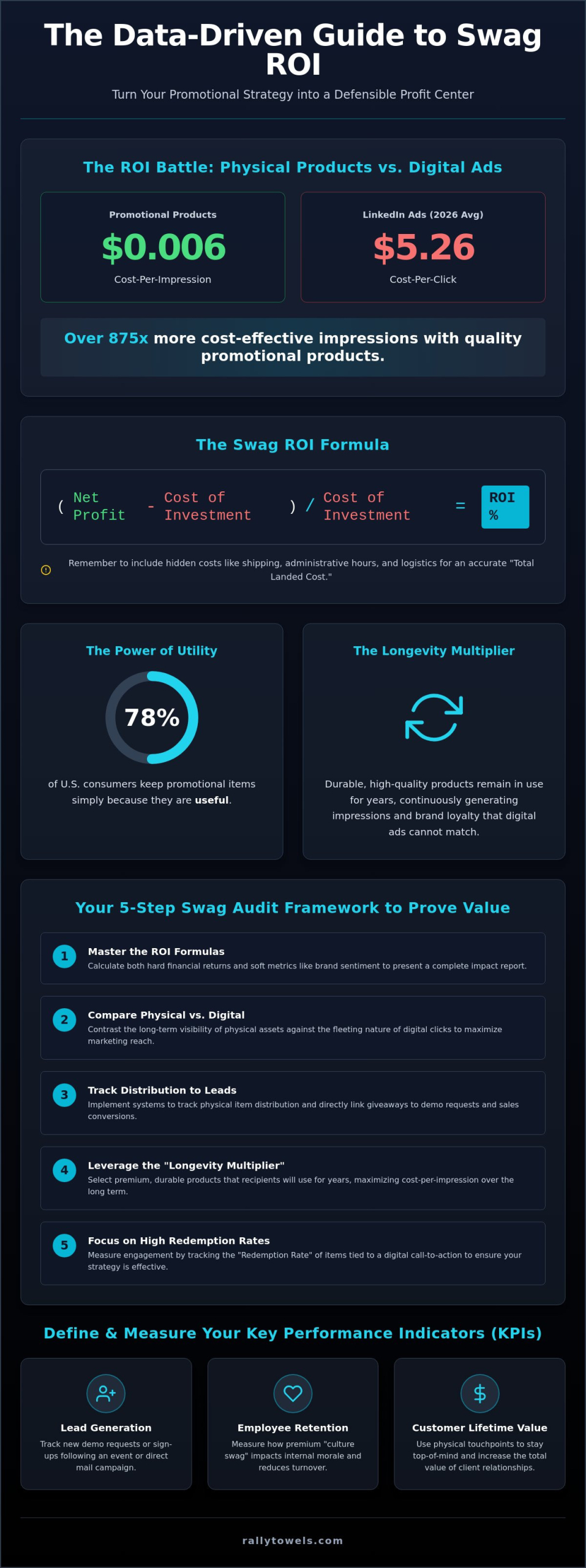
Building Your Swag Audit: 5 Steps to Prove Value to Your CFO
Stop guessing. Start auditing. If you want to master calculating ROI on swag, you need a repeatable process that withstands executive scrutiny. This is not just about counting boxes in a warehouse. It is about tracking every physical asset from the production line to the customer’s hand. Follow these five steps to build a report that justifies every dollar of your spend.
- Step 1: Define the Outcome. You cannot hit a target you have not set. Are you looking for 500 new demo requests or a 15% increase in event booth traffic? Define this number before you sign a single purchase order.
- Step 2: Track Distribution. Record exactly who gets what and when. Use your CRM to tag leads who receive high-value items at trade shows or through direct mail.
- Step 3: Monitor Engagement. This is where the tech comes in. Use the QR codes and landing pages we discussed earlier to track real-time engagement. Watch your social media mentions for organic “unboxing” content.
- Step 4: Calculate the Total Cost of Ownership (TCO). Factor in the product price, shipping fees, and staff time for distribution. Remember the 2026 USPS fee increases for oversized packages. Accuracy here builds trust with Finance.
- Step 5: Present the Outcome-Per-Dollar Metric. Divide your total spend by your successful outcomes. If you spent $5,000 to get 100 high-quality demo requests, your cost-per-outcome is $50. That is a winning number.
The ‘Red Flag’ Metrics Finance Will Question
Your CFO will look for waste. An “Unused Inventory” rate higher than 10% is a major red flag. It suggests you over-ordered or lacked a distribution plan. You can defend your budget by proving that the “cheapest” option often has the lowest ROI. A $0.50 pen that breaks immediately is 100% waste. Conversely, you can justify wholesale custom towels by showing tiered savings and a 5-year utility life. High-stakes organizations like the NBA don’t buy in bulk just to save money; they do it to ensure every fan leaves with a durable brand reminder.
The Swag Audit Report Structure
Keep your final report punchy and visual. Start with an Executive Summary that leads with the “Bottom Line” numbers. Follow this with your “Efficiency Ratio”—how your spend compared to active engagement. Finally, provide clear recommendations for the next fiscal quarter based on the data you collected. If a specific product drove 80% of your leads, double down on it. Position yourself as a profit-focused leader who uses physical assets to drive digital growth. Ready to secure your next budget? Start your bulk strategy now at Rallytowels.com.
Strategic Sourcing: How High-Quality Rally Towels Maximize Your Marketing Budget
Manufacturing quality is the single most important factor in your long-term success. If your promotional product falls apart after one use, your financial return effectively drops to zero. When calculating ROI on swag, you must account for the physical endurance of the item. High-quality rally towels create high-energy brand associations that last for years. This is the “ROI of Spirit.” You aren’t just giving away fabric. You are providing a tool for fan engagement that recipients value, use, and keep.
Customization techniques also dictate your final return. While screen printing is a solid choice for many campaigns, dye sublimation is the gold standard for durability. Sublimation embeds your logo directly into the fibers. It won’t crack, peel, or fade in the wash. This keeps your brand looking professional for the entire life of the towel. It’s the reason why the NBA and NFL use these specific promotional assets. They need high-visibility products that look as good on TV as they do in a fan’s home five years later. Social proof matters, and the biggest names in sports trust this model.
Bulk Ordering for Maximum ROI
The math of wholesale is simple. As your order volume increases, your unit cost drops significantly. This directly slashes your cost-per-impression. Smart marketing leaders manage their inventory for year-round events rather than buying for single shows. They purchase for the entire fiscal year to lock in the lowest possible price and ensure consistent brand presence. Strategic distribution is the final step. Don’t waste premium gear on low-intent leads. Get the right towel to the right VIP or high-value prospect to ensure every dollar works toward a conversion.
Partnering with a Pro-League Manufacturer
The “Rally Towels Difference” is about more than just fabric. It’s about a commitment to high standards that Fortune 500 brands demand. We are a premier manufacturer for major professional leagues because we deliver on speed and volume without sacrificing quality. Choosing USA-made options also protects your brand’s reputation and ensures faster turnaround times. Don’t settle for “good enough” when you can have pro-grade assets that dominate your market. Ready to boost your event ROI? Get an instant quote from Rally Towels today!
Dominate Your Next Event with Data-Backed Branding
You now have the definitive blueprint for calculating ROI on swag like a seasoned pro. Stop treating your promotional budget as a gamble. By focusing on high-utility items and tracking every physical touchpoint, you prove that physical branding is a mandatory profit center. You’ve seen how durable materials and smart auditing frameworks turn a simple giveaway into a multi-year lead generator. High-stakes organizations don’t settle for “cheap” because they know quality equals longevity.
We bring over 20 years of manufacturing expertise to every single order. It is why we are the trusted supplier for the NFL, NBA, and NHL. We provide the fastest turnaround times in the industry because we understand that your major events don’t wait. You deserve a partner that moves as fast as your market does.
Boost Your Event ROI with Custom Rally Towels. Get a Quote Now!
Take total control of your marketing impact. Win your next budget meeting with confidence and show your team what real results look like.
Frequently Asked Questions
How do you calculate the ROI of promotional products?
You calculate the return by subtracting the total cost of investment from the net profit and dividing that result by the cost of investment. Multiply by 100 to get your final percentage. When you are calculating ROI on swag, you must include every expense, such as shipping fees and the staff hours spent on distribution. This total landed cost gives you the accuracy needed for a professional audit.
What is a good redemption rate for a corporate swag program?
A redemption rate between 15% and 25% is a strong benchmark for most targeted corporate campaigns. If you distribute premium, high-utility items like custom cooling towels at a high-energy event, your engagement will likely climb much higher. Always use unique promo codes or digital tracking to get an exact number for your specific program.
How do I track if my swag is actually being used?
Track usage by integrating digital touchpoints like scannable QR codes or unique URLs directly into the product design. You can also monitor social media platforms for organic unboxing videos or event photos featuring your gear. High-quality items stay in use because they provide value, so monitoring these digital signals helps you measure the physical life of the product.
Is it better to buy cheap swag in bulk or high-quality items in smaller quantities?
High-quality items always provide a better return because they avoid the waste associated with cheap giveaways. Low-quality items often end up in the trash immediately, which results in a 100% waste rate for those units. Focus on durable, high-visibility assets that recipients will keep and use for years to ensure your brand stays top-of-mind.
Can I use QR codes on towels to track ROI?
You can absolutely use QR codes on towels to create a direct link between physical distribution and digital conversion. High-resolution dye-sublimation ensures the code remains scannable and vibrant even after repeated use. This makes calculating ROI on swag much easier by providing real-time data on landing page visits and demo requests generated by your stadium giveaways.
What are the most effective promotional items for ROI in 2026?
Apparel and high-utility items like custom towels are the top performers for brand recall this year. Research shows that 45% of consumers prefer T-shirts, while 40% want hoodies. Items that solve a problem or enhance an experience, like cooling towels at a summer sporting event, generate the highest levels of customer loyalty and long-term visibility.
How do I justify a swag budget to my CFO?
Justify your budget by presenting a “Cost-Per-Outcome” report rather than a simple list of unit costs. Compare the incredibly low cost-per-impression of physical goods to the inflated CPMs of digital advertising. When you prove that high-quality physical assets lower your total cost-per-acquisition, you transform the conversation from a discretionary expense to a mandatory investment.
What is the average cost-per-impression for a custom towel?
The average promotional product delivers a cost-per-impression of just $0.006. This is significantly more efficient than most digital platforms in 2026. A durable custom towel used at a stadium, gym, or beach can generate thousands of organic impressions over its lifetime, making it one of the most cost-effective tools in your entire marketing arsenal.