
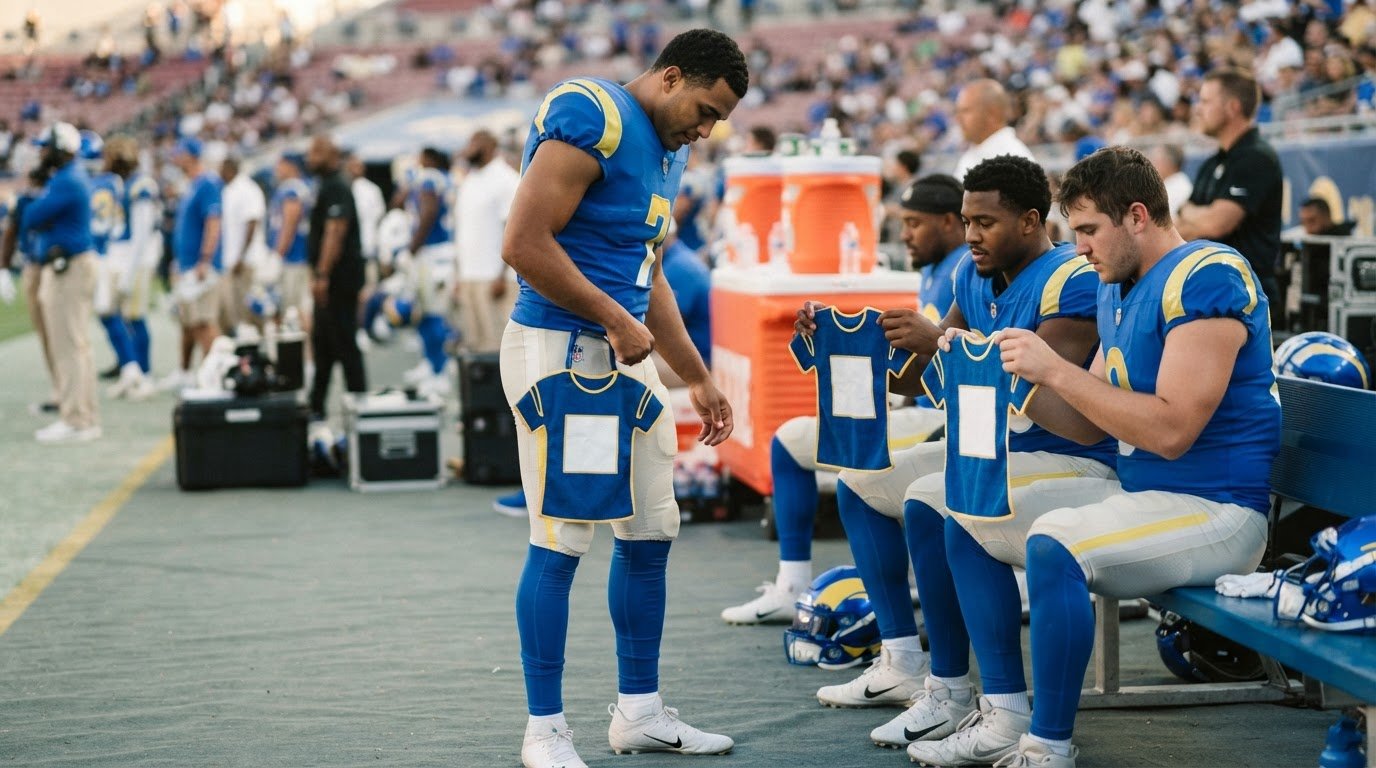
One towel per player isn’t always enough for game day. For a 50-player roster, one game towel and one sideline towel per player, plus a full second set, comes to 200 towels. Player number towels also come in different bulk pack sizes: quarterback towels are often packed by six, while football sideline towels are usually sold by the dozen.
Player number towels should do more than display a number: their intended use matters too. A game towel needs to be easy to reach during play, while a sideline towel serves team needs between plays and a locker-room towel suits a different setting. This guide explains how pack quantities affect an order and how game, sideline, and locker-room towels differ. You’ll get a clearer idea of what to plan for when outfitting a roster and choosing towels for game day. Get a free quote for your project.
Key Takeaways
- Plan quantities around how many towels each player needs and whether you want replacement sets, rather than relying on pack size alone.
- Choose game, sideline, and locker-room towels for their different roles and settings.
- A waistband placement keeps a towel accessible while leaving room for movement; its position doesn’t indicate a player’s assignment.
- For high-school game towels, the NFHS size range is 4 x 12 inches to 18 x 36 inches. NCAA college game towels must be at least 4 x 12 inches.
- Towels absorb surface moisture, while gloves provide grip and protection; a waist hand warmer helps keep hands warm.
Bulk order quantities and pack sizes
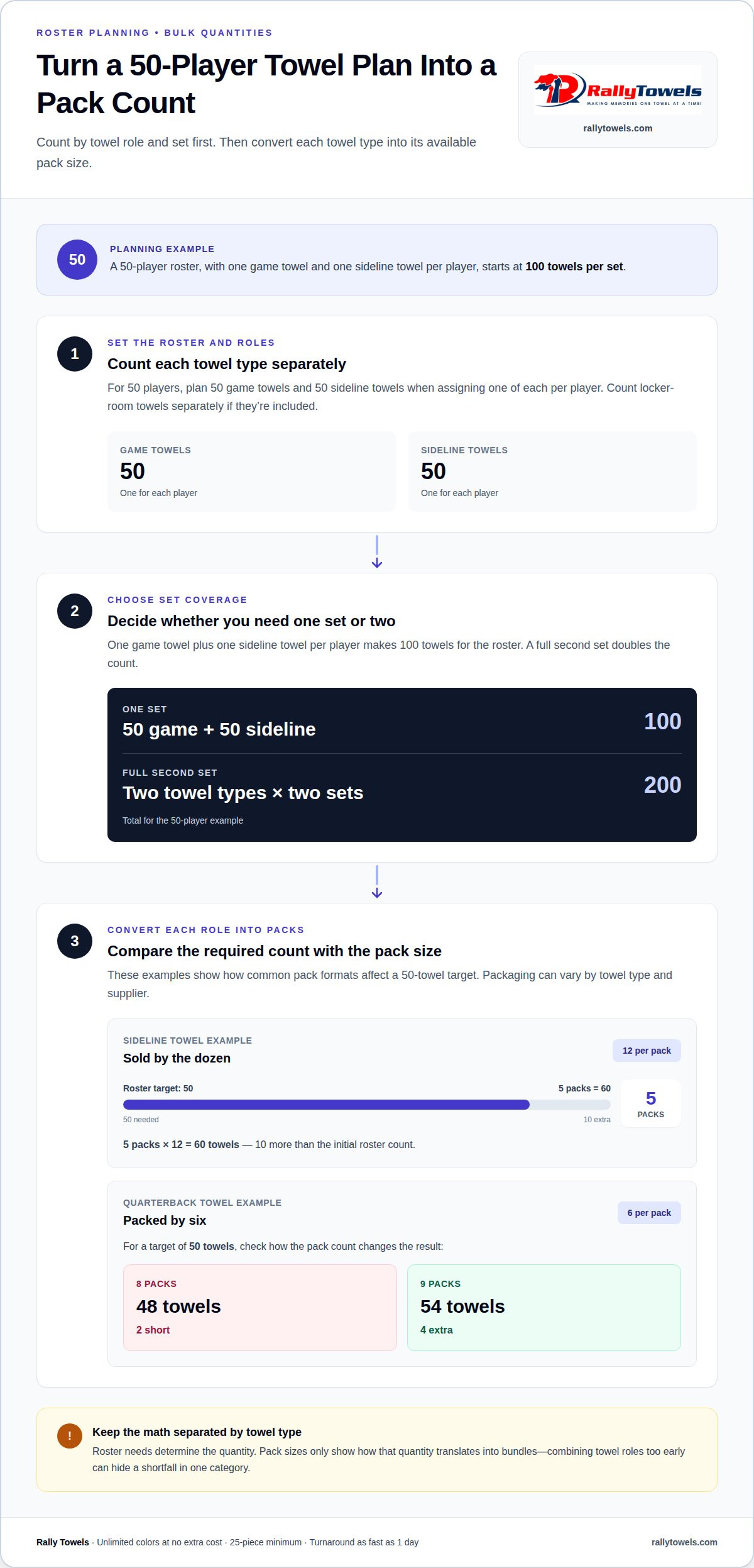
Plan the roster total before translating it into packs. A roster plan should account for both game and sideline towels for each player. Ordering a full second set brings the total to 200 towels. That example separates the quantity needed by players from the number of towels bundled together for sale. It also gives coaches and equipment managers a clear starting point for estimating the order.
Pack sizes vary by towel type. Wholesale quarterback towels may come in packs of six, while football sideline towels are often sold in bulk by the dozen. These are common packaging formats, not a standard for every towel. Since a pack of six and a dozen contain different quantities, count the towels in each package before translating a roster requirement into an order.
For example, one sideline towel per player for a 50-player team requires 50 towels. If the available format is a dozen per pack, five packs provide 60 towels. That leaves 10 towels beyond the initial roster count. Those extra towels may help cover distribution needs, but they don’t replace a plan for separate game or locker-room towels.
A six-towel pack creates a different calculation. If a team needs 50 quarterback towels and buys only in packs of six, eight packs provide 48, which falls short. Nine packs provide 54, exceeding the target by four. Use this arithmetic as a planning illustration, rather than assuming every supplier packages every towel type this way.
Separate towel roles in the count. A game towel is assigned for player use during play; sideline towels support needs on the sideline. Locker-room towels serve a different setting and should be counted separately if they’re part of the order. In the 50-player example, a game towel and a sideline towel create 100 towels per set, not 50. A full second set doubles that figure to 200.
- Roster: Count the players receiving towels. A 50-player roster starts with 50 of each towel type assigned one per player.
- Role: List game, sideline, and locker-room towels separately so each quantity has a clear purpose.
- Sets: Decide whether the order covers one set or a full second set. The 50-player example reaches 200 with two towel types and two sets.
- Packaging: Convert each towel type into its pack format. Six-count quarterback packs and dozen-count sideline packs need separate calculations.
Keep the math by towel type, not just by total. In the 50-player example, 50 game towels and 50 sideline towels make one 100-towel set. If both types are ordered as a second set, the overall count becomes 200, but the pack calculations still depend on each type’s packaging. Combining the totals too early can hide a shortfall in one category or leave extra pieces in another.
Pack quantities help with estimating, but they don’t determine what a team needs. The roster count, the number of towel roles, and whether you want one set or two drive the quantity. Once those decisions are clear, pack sizes show how the required total fits into available bundles. This helps teams plan a bulk order without confusing the number of packages with the number of players being outfitted.
How does a professional supplier design player number towels to attach and wear comfortably?
A towel should stay accessible without getting in a player’s way. Football towels are typically tucked into the waistband, making them easy to reach between plays while allowing movement. When planning the design, consider where the number will sit, how the towel will hang, and whether the graphic will remain visible when worn. A number centered on a flat towel may shift out of view when the fabric is tucked, so placement matters as much as the artwork.
Start the design process by deciding how the towel will be used. A towel intended for a player’s waistband should be easy to reach and manageable during movement. A sideline towel has a different purpose, so its design doesn’t necessarily need to prioritize wearability. Use the intended role to guide the layout. For example, place the player number where it remains visible above the waistband, not near the section tucked into clothing.
Next, consider how the graphic will read on fabric. The number should stand out from the background and be easy to recognize at a glance. If the design includes a player name or team mark, leave those elements enough space too. The selected artwork and colors will guide the layout. A large single number, for example, may need a different arrangement from a number paired with a name and emblem.
Wear position also affects comfort. A towel tucked into a waistband should hang without obstructing movement or becoming a distraction. NFL requirements for towels state that placement must not interfere with gameplay or create a safety issue. That makes the intended position a practical design consideration, not just a styling choice. A professional supplier can account for how the towel will be worn when preparing the graphic.
The wearing method described here does not call for a special attachment system. Players typically tuck football towels into their waistbands. Focus the design on making the towel practical in that position instead of adding unsupported clips or fasteners. A clear brief helps: specify whether the towel is for waistband wear, sideline use, or another purpose, and provide the number and artwork to include.
- Use: Identify whether the towel is meant for waistband wear or sideline use.
- Number: Provide the player number and any accompanying name or emblem.
- Placement: Let the supplier arrange the graphic for visibility in the intended position.
- Movement: Keep the towel positioned so it doesn’t interfere with play.
A towel’s location doesn’t identify a player’s assignment or position. The number serves as a visual identifier, while the towel remains a practical piece of equipment. For example, a towel worn at the waist shouldn’t be taken as evidence that the player has a particular role. Keeping these functions separate helps the designer focus on legibility and wear.
For teams ordering personalized towels, consistency across the roster can simplify distribution and recognition. Apply the approved number layout to each player’s design, while allowing for each number and any name included. A two-digit number, for example, needs a balanced layout that doesn’t crowd nearby artwork. The final design should suit the player’s actual wearing position, not just look clear in a flat preview.
Comfort depends on how the towel hangs and where it’s tucked; visibility depends on graphic placement. A professional supplier brings those considerations together using the customer’s intended use and supplied artwork. To explore custom towel design options, start with the way players will wear and use the towels.
What materials and sizes are best for player number towels?
The right size depends first on where the towel will be used. Game towels, sideline towels, and locker-room towels serve different settings, so their dimensions aren’t interchangeable. For high-school football, NFHS game towels must measure at least 4 x 12 inches and no larger than 18 x 36 inches. NCAA college game towels must also measure at least 4 x 12 inches. Those requirements give teams a clear starting point for game-use sizing.
Sideline towels are typically larger than game towels. Football sideline towels commonly measure 20 x 40 inches or 22 x 44 inches. These dimensions suit a team-use towel kept on the sideline, rather than one tucked at a player’s waist. A listed example is a white, 100% cotton sideline towel measuring 20 x 40 inches. It weighs 5 lb per dozen, which works out to roughly 366 GSM.
Considering material and size together makes it easier to assess a sideline towel. Its stated construction and weight give organizers concrete details for comparing it with another option. Still, don’t treat a sideline specification as a recommendation for a game towel. The purposes differ, and an oversized sideline towel may not suit a player’s waistband or game use.
Practice hand towels commonly measure 15 x 25 inches or 16 x 27 inches. Locker-room towels are larger, commonly measuring 24 x 48 inches or 24 x 50 inches. These categories help clarify the choice: a practice hand towel supports use during training, while a locker-room towel is sized for that separate setting. A roster order that includes both needs distinct size selections for each role.
For game towels, start with the applicable rules and the towel’s intended placement. NFHS requirements set both a minimum and maximum size for high-school game towels. NCAA rules provide the minimum size stated above. Sideline and locker-room dimensions describe common towel formats, not substitutes for game-towel requirements. Keep these categories separate to avoid choosing a towel based only on its name or appearance.
- High-school game towel: NFHS requires a minimum of 4 x 12 inches and a maximum of 18 x 36 inches.
- College game towel: NCAA requires a minimum of 4 x 12 inches.
- Sideline towel: Common dimensions are 20 x 40 inches or 22 x 44 inches.
- Practice hand towel: Common dimensions are 15 x 25 inches or 16 x 27 inches.
- Locker-room towel: Common dimensions are 24 x 48 inches or 24 x 50 inches.
The number design also needs to fit the chosen towel area. A narrow game towel leaves less room for a number and additional artwork than a larger sideline towel. Use the supplied dimensions to plan a layout that fits the fabric. For example, a towel close to the game-size minimum calls for a simpler arrangement than a broad locker-room towel.
Material selection should follow the towel’s role, too. The 20 x 40-inch cotton sideline example provides a clear reference point for that category. Its stated weight helps describe the towel, but it doesn’t determine whether its size fits game use. Consider the intended setting, required dimensions, and design space together rather than choosing by material alone.
For a team comparing options, use a simple decision sequence: identify the setting, apply the relevant game rule where applicable, then select dimensions that suit that use. A 20 x 40-inch sideline towel and a 24 x 48-inch locker-room towel belong to different categories. Matching size to purpose helps the final design look considered and function in its intended setting.
There’s room for a player number, so keep it proportionate to the usable area and avoid crowding the towel’s edges. Consider how the towel will be carried and handled when choosing the layout. The number should be easy to identify without taking over the surface. Choose materials and size to suit the towel’s purpose, and make sure the number treatment fits the available space.
For NFL use, players may not discard loose towels or other wiping materials on the playing field. Consider how the towel will be managed during play, not just its dimensions or appearance. Keep the player number on the towel rather than adding loose marking pieces, and ensure the finished design suits its intended use.
Rally Towels
Rally Towels helps teams turn custom towels into player identifiers, promotional giveaways, or stadium giveaways. Choose custom rally towels, screen printed or full-color dye sublimated, or jersey-shaped rally towels in 17×18 with long sleeve, short sleeve, or tank top designs. Share the player numbers, artwork, and intended use to guide the design.
Orders have a 25-piece minimum, unlimited colors at no extra cost, and turnaround as fast as 1 day. Double-sided printing is available, and pricing depends on quantity. These options suit teams planning a coordinated order, whether the towels are for players or game-day distribution.
If you’re planning custom towels for your team, contact Rally Towels to discuss your design.
Make Your Team’s Look Count on Game Day
A player number can do more than identify a uniform. On a custom towel, it can carry a team’s visual identity from the field to the stands. Consider how the design should represent the player and connect with the wider game-day atmosphere. That direction gives the artwork a purpose beyond decoration.
Rally Towels offers promotional and stadium giveaways, including custom rally towels in screen-printed and full-color dye-sublimated formats. A coordinated design can make player number towels part of a memorable team presentation, whether they’re for players or game-day distribution.
As you plan your order, bring together the number artwork, intended use, and overall team look. A clear creative direction can turn a practical towel into a distinctive piece of team identity. Keep the design focused on what you want players and fans to recognize.
Get a free quote from Rally Towels and discuss your design. Give your team a look it can wear with pride.
Frequently Asked Questions
What are player number towels in sports?
Player number towels are sports towels customized with a player’s number, pairing a practical item with a personalized team design. The number can help distinguish an individual player’s towel from shared sideline towels, while the towel itself remains useful during a game. Teams may coordinate the number artwork with other visual elements, such as a name or team mark, to create a unified look across personalized gear.