

A meaningful employee gift does more than mark an occasion. Gifts that make employees feel valued reflect what people appreciate and how they work, whether they’re remote, in the office, hybrid, or in the field.
People want their contributions noticed, not just another item handed out on a calendar date. Choose something useful and personal, then pair it with a clear message of appreciation. Get a free quote for a custom employee gift.
Explore practical gift ideas for different work settings and occasions, including ways to make a company logo feel thoughtful rather than generic. You’ll also find ideas for making appreciation part of your culture, beyond holidays and major milestones.
Key Takeaways
- Match recognition to the person, occasion, and contribution so the gift feels thoughtful rather than routine.
- Choose gifts that suit how employees work, and make remote delivery and personal messages part of the plan.
- Build appreciation into everyday culture with timely, specific recognition instead of saving it for holidays.
- Set a clear gifting approach and gather employee feedback to make future recognition more meaningful.
- According to the Internal Revenue Service, businesses can generally deduct up to $25 per recipient per year for employee gifts.
1. What are the best employee appreciation gifts to boost morale?
The best employee appreciation gifts connect a specific contribution to a gesture the recipient can use or enjoy. A meaningful note, a choice of gifts, or a team celebration can all work. Explain what the employee did and why it mattered. That connection makes gifts that make employees feel valued feel personal, not like routine company handouts.
Match the gift to the occasion. A snack basket can mark a first work anniversary, while a team meal can celebrate a demanding project’s shared result. A personal milestone may call for an individual gesture. Apply the same principle to company-wide wins: name the achievement and recognize the people whose work helped deliver it.
Recognition should reflect company culture, not contradict it. If collaboration is a stated value, acknowledge employees who share knowledge or support teammates. If the company values customer care, recognize a specific example of thoughtful service. Choose a value, describe the behavior that demonstrated it, and connect the gift to that behavior. A branded item can reinforce belonging, but the message should explain why the employee is being recognized.
Timing and consistency matter. Recognize an accomplishment soon after it happens, while the contribution is clear. If a gift isn’t ready, deliver it promptly rather than saving every gesture for the holidays. A recurring practice, such as recognizing notable contributions at team meetings, helps make appreciation consistent. Keep the message specific so employees understand why their work mattered.
What makes a gift feel genuine? Personalization and a clear connection to the recipient’s contribution help. Recognition tied to job performance should reflect the achievement, not just the employee’s title or tenure. For example, celebrate an employee who resolved a difficult customer issue by naming the actions that made the outcome possible. A thoughtful message can make even a modest gift more meaningful and lasting.
Are employee appreciation gifts taxable in the United States? Tax treatment depends on the gift and its circumstances, so don’t assume every employee gift is tax-free. According to the Internal Revenue Service, businesses generally may deduct up to $25 per recipient per year for employee gifts; that business deduction limit alone doesn’t answer the recipient’s tax treatment.
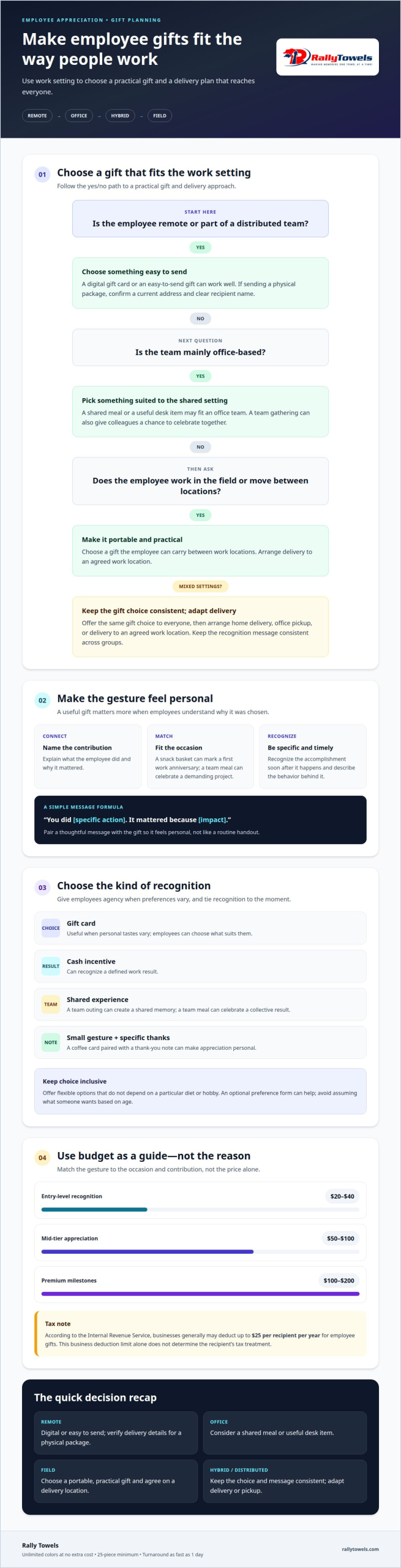
What are the best employee appreciation gifts by budget? For entry-level recognition, consider the $20-$40 range; mid-tier appreciation can use $50-$100, while premium milestones may call for $100-$200. Choose the gesture based on the occasion and contribution, not the price alone. What gifts should employers avoid? Skip impersonal items with no clear use, gifts that ignore individual preferences, and wellness gestures that imply employees must solve workplace burnout themselves.
2. Gift ideas for remote, in-office, hybrid, and field teams
Start with where employees work and how they’ll receive their gifts. For remote staff, choose something easy to send or offer a digital gift card. For office teams, a shared meal or useful desk item may suit the setting. Field employees may appreciate a portable, practical gift they can carry between work locations.
Hybrid teams need options that don’t make one group feel like an afterthought. Offer the same gift choice to everyone, then arrange delivery or pickup to suit each person’s work setup. Remote employees might receive a package at home, while office-based colleagues collect theirs at a team gathering. Keep the recognition message consistent.
A gift card works well when personal tastes vary because employees can choose what suits them. Cash incentives can recognize a defined work result, while an experience such as a team outing creates a shared memory. Small gestures count, too: pair a coffee card with a specific thank-you note about someone’s effort. The note makes the appreciation personal.
Choose gifts employees can use: practical, durable, easy to distribute, and adaptable to different preferences. A handwritten message from a manager can explain why the gift was chosen. For a distributed team, a digital option avoids sending something that doesn’t suit an employee’s needs. A curated set of choices keeps selection manageable without making it feel impersonal.
Don’t assume age predicts what someone wants. Gen Z and millennial colleagues, like employees in other generations, have individual tastes. Ask about preferences through a simple optional form, or offer choices such as food, useful items, and experiences. This gives employees agency without asking them to disclose personal details they’d rather keep private.
What are inclusive employee gifts for diverse teams? Offer flexible choices, avoid gifts that depend on a particular diet or hobby, and make them easy to receive across remote, office, hybrid, and field settings. A gift card with several redemption options and a personal thank-you note can make a thoughtful combination.
Before choosing an employee appreciation gift, use a quick check: identify the team’s work setting, consider individual preferences, then choose a delivery method that reaches everyone. Connect the gift to company culture, not just a logo or event. A branded item can support team identity when it’s useful and paired with genuine recognition.
3. Choosing gifts for remote and distributed teams
A distributed team needs a gift plan that works across locations. Start by mapping who works remotely, who shares an office, and who travels between sites. Then choose a format that reaches each group. A digital gift can arrive by email, while a physical package needs a current address and a clear recipient name.
Separate the gift decision from the delivery decision. The appreciation gift might be the same for everyone, but the delivery route can vary. Remote employees can receive it at home, office employees can collect it at work, and field staff can receive it at an agreed work location. Keep the recognition message consistent across all groups.
Before arranging physical deliveries, gather only the details needed to send each gift. Use a secure form for names, addresses, and delivery instructions, then limit access to the coordinators. Avoid putting sensitive personal details in shared spreadsheets. For employees who move frequently, confirm the best delivery address through the company’s usual communication channel.
Consider dietary needs and personal preferences, especially when a gift includes food. A snack box might suit one employee but not another with dietary restrictions or different tastes. Offer a non-food alternative or let recipients choose from a few options. Make participation optional, and don’t ask employees to explain private health or religious information.
Practical employee appreciation gifts should fit the workplace routine. A remote employee may value something useful during the workday, while a field employee may prefer an item that’s compact and easy to carry. Avoid bulky packages that create storage problems or gifts tied to hobbies employees haven’t shared. A flexible gift card gives recipients more control.
Make the personal touch travel with the gift. Add a message that names the contribution, such as helping a teammate meet a deadline or improving a customer handoff. For digital gifts, include the note in the same communication rather than relying on a separate announcement. That way, appreciation doesn’t disappear behind an automated redemption email.
Include remote colleagues in a hybrid team gathering. A manager can read the recognition message aloud during a video call and send the gift separately. If the group celebrates in person, share the same message with distributed staff through the meeting channel. This makes recognition visible without requiring everyone to work in one location.
Plan the sequence: choose inclusive options, collect delivery details, prepare individual messages, and coordinate arrival with the recognition moment. A simple tracker can record each recipient, gift format, delivery method, and message status. This helps gifts reach remote colleagues with the same care as those handed over at work.
4. Building a culture of gratitude
A culture of gratitude shows up in everyday work, not just at annual celebrations. Managers can make recognition part of weekly routines by naming specific contributions during team check-ins. For example, thank an employee who documented a process that helped colleagues handle customer requests. That detail shows why the work mattered and gives everyone a clear example of valued behavior.
Consistency matters more than a single grand gesture. Set a recurring reminder for managers to notice contributions, and encourage peers to recognize helpful work, too. A short, personalized message can acknowledge a quiet achievement, such as welcoming a new teammate or catching an error before delivery. Public praise suits employees who welcome it; a private note gives others a choice.
Recognition can connect individual effort to a shared purpose. If a company values learning, celebrate someone who shares a useful skill with colleagues. If service matters, recognize an employee who followed through on a customer concern. Naming the value and the action makes company culture visible and helps everyone understand what positive contributions look like in practice.
Research connects quality recognition with employee outcomes. A 2024 Workhuman and Gallup study tracking 3,400 employees found that employees receiving quality recognition were 45% less likely to have left their job by 2024. A 2024 Work Institute study found that employees who feel appreciated are 5 times more likely to stay with their employer and 2.5 times more likely to go above and beyond in their roles. Recognition should support fair management, not replace good working conditions.
Make appreciation accessible across teams and work styles. A manager might send a personal note after a remote employee’s project contribution, while a team meeting can acknowledge a shared win. Gift cards offer recipients choice, but the accompanying message should explain the reason for recognition. Ask employees whether they prefer public or private praise, and use their feedback to shape future gestures.
A calendar reminder can help, but gratitude shouldn’t depend on one annual event. Employee Appreciation Day falls on the first Friday in March each year. Use it as one opportunity, then show appreciation throughout the year. A simple practice works: notice a contribution, describe its impact, and recognize the person in a way they value. This makes employee appreciation gifts part of a broader, positive culture.
5. Corporate gifting strategy
A strong corporate gifting strategy starts with a clear purpose. Decide whether the gesture recognizes a project, welcomes a new hire, or marks a service milestone. Set selection criteria before choosing gifts. A team celebration, for example, can focus on shared effort, while an individual gift can reflect a specific contribution.
Plan the budget around the occasion, recipient count, and delivery needs. A project celebration for one department may call for a different approach than a company-wide thank-you. Include packaging and distribution, especially when employees work remotely. Keep the value consistent for comparable achievements, and explain differences using clear, fair criteria.
How much should employers spend on employee appreciation gifts? Set a per-person limit that fits the company’s budget and the occasion, then apply it consistently to comparable recognition. A thoughtful note, coffee card, or shared experience can all work. The connection to the employee’s effort matters more than the price.
According to the Internal Revenue Service, businesses generally may deduct up to $25 per recipient annually for employee gifts. This is a business deduction limit, not a complete explanation of how every gift is taxed. Keep gift records with the recipient, occasion, and amount, then route tax questions through the company’s normal accounting process.
Choose a process that’s simple to repeat. A manager can submit the employee’s name, the reason for recognition, and a suggested gift category. A designated reviewer can check the request against the budget and recognition guidelines. For a team win, document the shared result and include everyone whose work contributed, not only the most visible employees.
Use employee feedback to refine the program. After each gifting cycle, ask whether recipients found their gifts useful and whether delivery worked. A short, optional survey can show whether employees prefer gift cards, practical items, or experiences. Review responses before the next cycle and adjust choices without turning appreciation into a popularity contest.
Track participation and follow-through, not gift value alone. Record whether managers recognized contributions promptly and whether remote employees had the same opportunities as office teams. Pair gifts with regular communication, growth opportunities, and public acknowledgment when appropriate. A gift can support morale, but it can’t replace fair workloads or meaningful workplace support.
Write down the program’s purpose, approval steps, budget limits, and delivery plan. Share the guidelines with managers before the next recognition occasion. This makes the process easier to apply consistently while leaving room for a personal message that explains why each employee’s work mattered.
Rally Towels
Rally Towels helps businesses make employee appreciation tangible with promotional giveaways and stadium giveaways. For a lasting team gift, custom stadium fleece blankets are dye sublimated, while custom rally towels can feature screen-printed or full-color dye-sublimated designs.
Orders have a 25-piece minimum, unlimited colors at no extra cost, and turnaround as fast as 1 day. Choose a design that reflects your company culture and gives employees a useful reminder of team milestones or shared achievements.
To discuss a branded employee gift, contact Rally Towels for a free quote.
Make your next recognition moment count
Choose an upcoming occasion on your company calendar and decide what you want employees to remember. A project finish, team gathering, or company milestone can be an opportunity to recognize contributions in a tangible way. The strongest gestures connect a useful item to a specific message, so employees understand why their effort matters.
For branded employee recognition, Rally Towels offers promotional giveaways, stadium giveaways, and custom rally towels printed with screen printing or full-color dye sublimation. These options can help carry a shared message into team events and everyday routines. Choose gifts that make employees feel valued by pairing the item with appreciation that’s personal and tied to their work.
Start planning your next recognition moment with a clear purpose and a message your team will remember. Get a free quote from Rally Towels about employee gifts and take the next step toward celebrating your people.
Frequently Asked Questions
What are the best employee appreciation gifts to boost morale?
The best gifts connect recognition to something employees find useful or enjoyable. For a team finishing a demanding launch, a shared meal can celebrate the group’s effort, while a practical item may suit an individual achievement. Add a short message naming the contribution. This makes the gesture more memorable than distributing identical items without explaining why they were chosen.
Are personalized gifts better than generic employee gifts?
Personalized gifts feel more thoughtful when the detail reflects the recipient, rather than simply adding a name. A notebook paired with a message about an employee’s mentoring, for example, links the item to their contribution. Generic gifts can still work for shared celebrations, especially when recipients have choices. Relevance, usefulness, and sincere recognition make the difference.
What Makes an Employee Gift Worth Giving?
An employee gift is worth giving when it suits the recipient and has a clear reason behind it. Consider usefulness, personal preferences, and the moment being recognized. A new employee might appreciate a welcome note and a practical first-week item. A colleague completing a major assignment may value a message that names their work. The thought and context matter as much as the object.
What do you get for staff appreciation?
Choose a staff appreciation gesture that fits the group and occasion. A team lunch can recognize a shared achievement, while a book or desk accessory may suit someone’s known interests. If preferences differ, offer a gift card or several options. Include a message that identifies the contribution being celebrated, so the gift feels connected to people’s work rather than routine distribution.
What is a good thank you gift for a colleague?
A good thank-you gift for a colleague is modest, appropriate to your relationship, and paired with specific appreciation. A coffee card can suit someone who helped prepare a presentation, while a handwritten note may be enough after a quick favor. Keep workplace policies and team norms in mind. Avoid gifts that feel overly personal, create pressure to reciprocate, or single someone out uncomfortably.
What personalized gifts do employees appreciate most?
Employees often appreciate personalization that reflects their interests or contribution. A message recognizing a colleague’s patient onboarding support adds meaning to a useful everyday item. For a team gift, customization can highlight a shared project or company milestone without making the design too personal. If you don’t know someone’s preferences, offer a choice instead of guessing at their hobby, style, or favorite product.
Are experiences or physical gifts better for employee recognition?
Neither format is always better; the occasion and recipient should guide the choice. A group outing can create a shared memory after a team milestone, while a physical gift may suit an individual accomplishment or someone who prefers a keepsake. Consider accessibility, schedules, and whether participation feels optional. A personal note explaining the recognition makes either gesture feel more considered.
What are thoughtful gifts for remote and hybrid employees?
Thoughtful gifts for remote and hybrid employees are easy to receive and flexible to use. A digital gift card avoids coordinating a package, while a mailed item can feel special when delivery details are handled carefully. Include a personal message through the same channel as the gift. For hybrid teams, keep the recognition message consistent whether colleagues receive gifts at home or in the office.