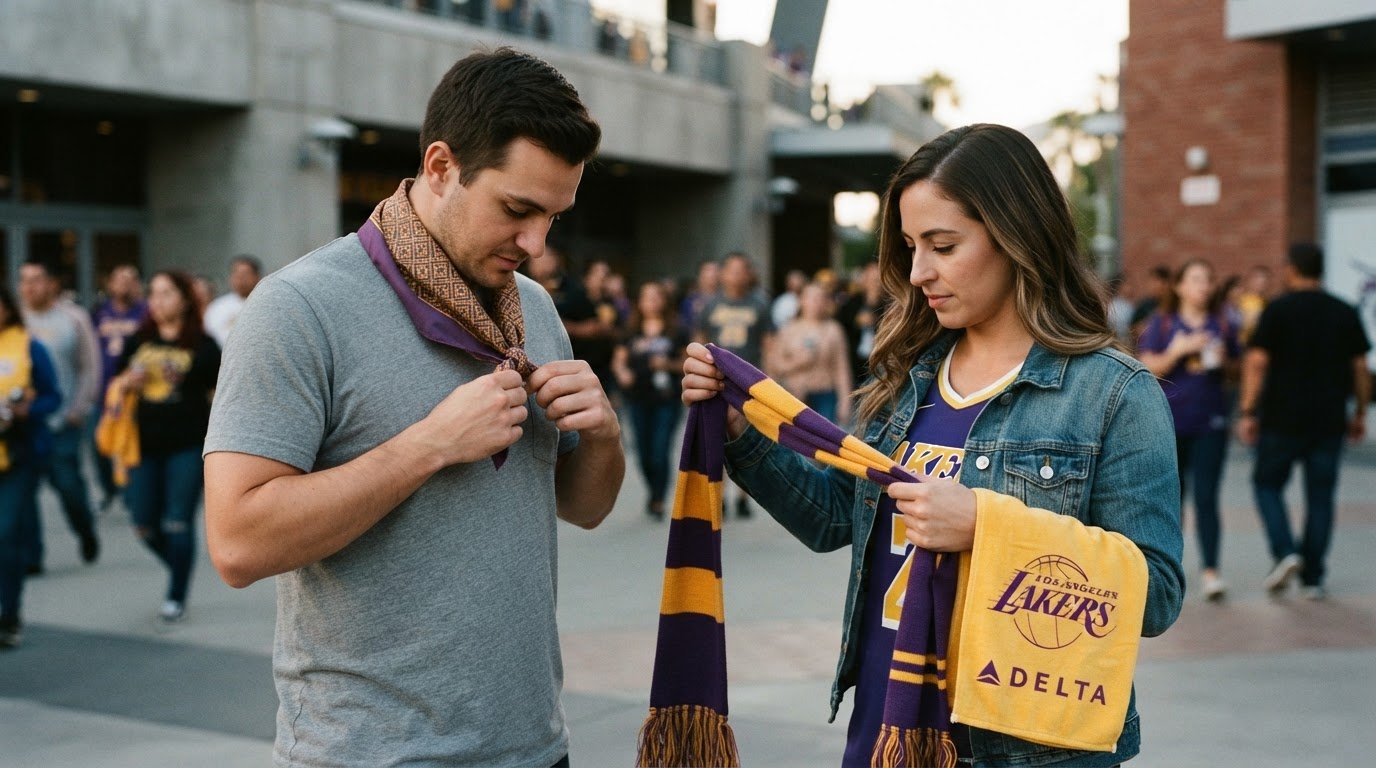
The best team giveaway isn’t always classic fan gear. Custom printed bandanas can display team colors in a flexible format, while fan scarves offer a familiar, easy-to-spot look in the stands.
Both can bring a group together, but the right choice depends on how people will wear and use them. You’ll learn how each option can be styled for teams and events, what to consider when comparing their look and feel, and how washing and edge finishing can affect wear over time. Get a free quote as you consider the best fit for your event.
Key Takeaways
- Bandanas offer flexible styling, while fan scarves create a coordinated, easy-to-spot look for teams and events.
- Compare fabric, printing method, and edge finish to understand how they can affect appearance, washing care, and fraying.
- Consider what materials and inks are used when weighing environmental claims about a printed accessory.
- Plan artwork carefully, especially when a design includes logos or other recognizable branding.
- For team giveaways, custom rally towels offer unlimited colors at no extra cost, a 25-piece minimum, and turnaround as fast as 1 day.
Are there eco-friendly custom bandana printing options?
Some printing options are described as lower impact, but “eco-friendly” can refer to different parts of a bandana. For a team order, assess the fabric, ink, printing method, and edge finish separately. A cotton bandana printed with water-based ink is one example, but that label alone doesn’t describe every material or production choice.
Water-based inks are described as containing non-toxic, lead-free ingredients and no heavy metals. They’re also described as containing no ozone-depleting chemicals, aromatic hydrocarbons, or volatile solvents. These details can help you compare ink options, but they don’t establish that the entire bandana, its packaging, or its manufacturing process is environmentally preferable.
Fabric is another part of the decision. Most bandanas offered are made from 100% cotton, which is described as breathable and able to absorb sweat. Digital or direct-to-film (DTF) printing may have fabric requirements, so check that the selected bandana is compatible. That makes fabric composition especially relevant when comparing a digital-print option with another method.
Check what “eco-friendly” means in a specific product claim. Does it refer to the ink, the fabric, or both? Is the claim about a printing method or the finished accessory? These distinctions matter for team orders. An ink description doesn’t tell you whether the bandana is cotton, just as a cotton description doesn’t identify the ink.
- Ink: Water-based inks are described as free from heavy metals and volatile solvents.
- Fabric: Check whether the material is 100% cotton, especially for digital or DTF printing.
- Print method: Match the method to the artwork and bandana material.
- Coverage: Decide whether the design needs a focused print or broader coverage.
- Edges: Consider how the edge finish may affect washability and fraying.
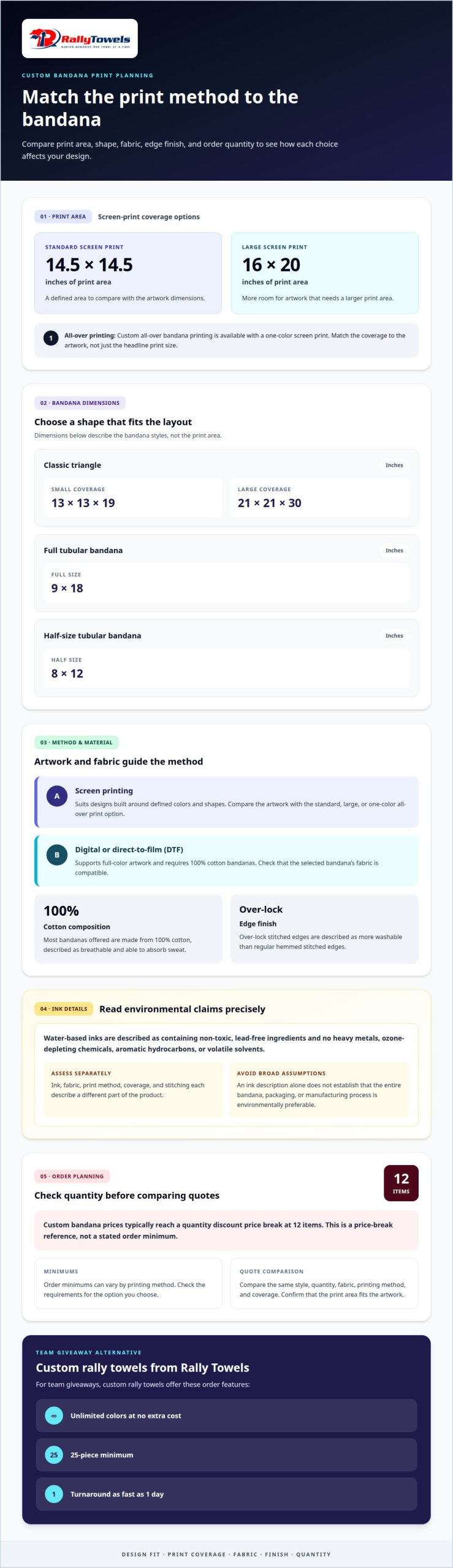
Coverage can shape the design decision. Standard screen printing uses a 14.5-inch by 14.5-inch print area, while large screen printing uses a 16-inch by 20-inch area. All-over custom bandana printing is available with a one-color screen print. A one-color design may suit a simple team mark; detailed artwork may call for a different printing approach.
Bandana shape also affects the usable design area. A classic triangle style lists small coverage at 13 × 13 × 19 inches and large coverage at 21 × 21 × 30 inches. A full tubular bandana measures 9 × 18 inches, while its half-size option measures 8 × 12 inches. These measurements help match the artwork to the item’s form.
Consider the edges if the accessory will be washed and reused. Over-lock stitched bandana edges are described as more washable than regular hemmed stitched edges. This comparison doesn’t promise a specific lifespan, but it offers a practical construction detail to weigh alongside the fabric and ink, especially for bandanas intended for repeated event use.
Finally, treat environmental language as a set of specific claims, not a blanket guarantee. Compare the named ink ingredients, fabric composition, print method, coverage, and stitching. For example, a 100% cotton bandana with water-based ink and over-lock stitched edges lets you assess several distinct features, rather than relying on a broad label alone.
What should I compare when choosing a custom bandana printer?
When comparing custom printed bandanas, start with the printing method. Screen printing suits designs built around defined colors and shapes. Digital or direct-to-film (DTF) printing supports full-color artwork and requires 100% cotton bandanas. Match the method to the artwork, fabric, and quantity you need. This first comparison can eliminate options that don’t fit your design.
Next, compare the print area with the artwork dimensions. Standard screen printing uses a 14.5-inch by 14.5-inch area. Large screen printing uses a 16-inch by 20-inch area. All-over printing is available with a one-color screen print. A compact crest may fit a standard area, while larger lettering can benefit from more room.
Bandana shape affects the artwork layout, too. A classic triangle lists small coverage at 13 × 13 × 19 inches and large coverage at 21 × 21 × 30 inches. A full tubular style measures 9 × 18 inches; its half-size option measures 8 × 12 inches. Check that the design fits the selected shape and keeps its key details visible.
Order minimums can narrow the choices before production. Order minimums can vary by printing method, so check the requirements before choosing an option. Order minimums can vary by printing method, so check the requirements for the option you choose. These differences matter for a small group, replacement pieces, or a broad team distribution. Compare the method’s minimum with the actual quantity you plan to order.
Quantity can also affect the quote. Custom bandana prices typically reach a quantity discount price break at 12 items. Estimate the full distribution before settling on a count. For example, include players, staff, and event guests in the planning. A useful comparison keeps quantity, bandana style, printing method, and coverage consistent across each quote.
Compare what each quote includes, not just the headline total. Check that it specifies the bandana style, fabric, printing method, print area, and quantity. Confirm that the quoted coverage matches your artwork. A quote for a standard print area isn’t directly comparable to one for a larger or all-over design.
- Method: Match screen printing or digital and DTF printing to the artwork.
- Coverage: Compare print area and bandana shape with the design layout.
- Minimum: Make sure the order quantity fits the method’s requirements.
- Quote: Compare the same style, quantity, and coverage for each option.
Compare artwork requirements, too. Fine details, multiple colors, and small lettering may call for a different approach than a bold, single-color mark. Consider how the design will read at its final size. For example, a long team name needs enough room to remain legible on a triangular layout. A printer’s stated print area helps you assess that.
Construction matters for accessories intended for reuse. Over-lock stitched edges are described as more washable than regular hemmed stitched edges. Compare the edge finish with the fabric and printing method. For custom printed bandanas used repeatedly at events, this detail helps you assess construction as well as appearance.
Make a side-by-side comparison using the same design and order details. Record the artwork, fabric, shape, print area, method, and quantity for each option. This gives your team a practical basis for choosing a printer and avoids comparing offers based on different specifications. If your event also requires branded merchandise such as custom printed shirts or embroidered apparel, resources like shdesignzone.com can help you coordinate apparel decoration alongside your accessories. You can then choose an option that better fits your design and distribution plan.
What copyright or trademark rules apply to custom bandana designs?
For a team bandana, include copyright and trademark questions in your artwork planning. A design may combine a school name, mascot drawing, sponsor mark, slogan, and photograph, each from a different source. Identify who supplied each element and what approval your project has before preparing the final layout.
Start by listing the design’s individual elements. Note whether each was created by your team, supplied by an organization, or sourced elsewhere. For example, a coach may provide a mascot illustration while a school supplies its crest. Tracking each element’s origin helps keep the artwork and project approvals organized.
Review names and logos carefully. A school crest, sponsor mark, or recognizable team symbol may identify an organization. Don’t assume that changing its colors or placing it beside an event slogan makes the design suitable for every project. Ask the organization responsible for the mark which uses its approval covers.
A practical review can follow these steps:
- List the elements. Include names, logos, photos, slogans, illustrations, and fonts.
- Record each source. Note who created or supplied every file.
- Document project approval. Keep written approval with the artwork when an organization provides it.
- Review the finished layout. Compare the final design with the approved version.
- Keep project records together. Save source files, approvals, and final artwork in one place.
Make approval requests specific to the intended use. Describe the bandana design, event, and planned distribution. For example, a school may approve a crest for a student event, while a sponsor promotion uses a different layout. Keep the response with the relevant file so the design team knows which artwork it covers.
Treat artwork from outside sources just as carefully. If a freelancer creates an illustration, record the agreed project use. If the design includes a stock image or font, retain its source and relevant usage information. These records help your team track where each element came from and what was reviewed.
Be cautious with designs that closely resemble another group’s identity. A hand-drawn version of a familiar mascot, for example, may still look connected to that group. Instead of relying on a small disclaimer or a color change, consider using original team lettering, event colors, or artwork created specifically for the occasion.
Review the whole composition, not just each image in isolation. A sponsor mark beside a school crest may suggest a relationship the creators didn’t intend. A team symbol combined with an event name can also create a different impression than either element alone. Keep the design consistent with the project’s purpose and recorded approvals.
Before sending the final file to production, compare it with your project records. Check names, logos, photographs, slogans, and illustrations individually. If the layout has changed since approval, pause and resolve the mismatch with the relevant organization or artwork source. For complex copyright or trademark questions, seek guidance from a qualified legal professional.
Rally Towels: Custom rally towels (screen printed and full-color dye sublimated)
Rally Towels gives teams another customizable option when bandanas don’t fit the event. Its custom rally towels are available with screen printing or full-color dye sublimation. Choose a printing method that suits the artwork and the look you want for your team giveaway or stadium event.
Team orders have a 25-piece minimum, unlimited colors at no extra cost, and turnaround as fast as 1 day. Jersey-shaped rally towels are another option, in long sleeve, short sleeve, and tank top styles. These formats give teams distinctive giveaway choices without relying on a bandana design.
Contact Rally Towels to discuss your team’s event or request a free quote.
Make Your Team Design Ready for the Crowd
Choose an accessory that fits how your group will use it, then build the artwork around that purpose. For custom printed bandanas, make the design distinctive and use artwork your team has permission to reproduce. A clear design brief helps align the look, distribution, and event experience.
If you’re considering another team giveaway, Rally Towels offers promotional and stadium giveaways, including custom rally towels with screen printing or full-color dye sublimation. Choose a format that suits your event and the design you want to put in fans’ hands.
Get a free quote from Rally Towels for your team giveaway, and take the next step with a clear plan.