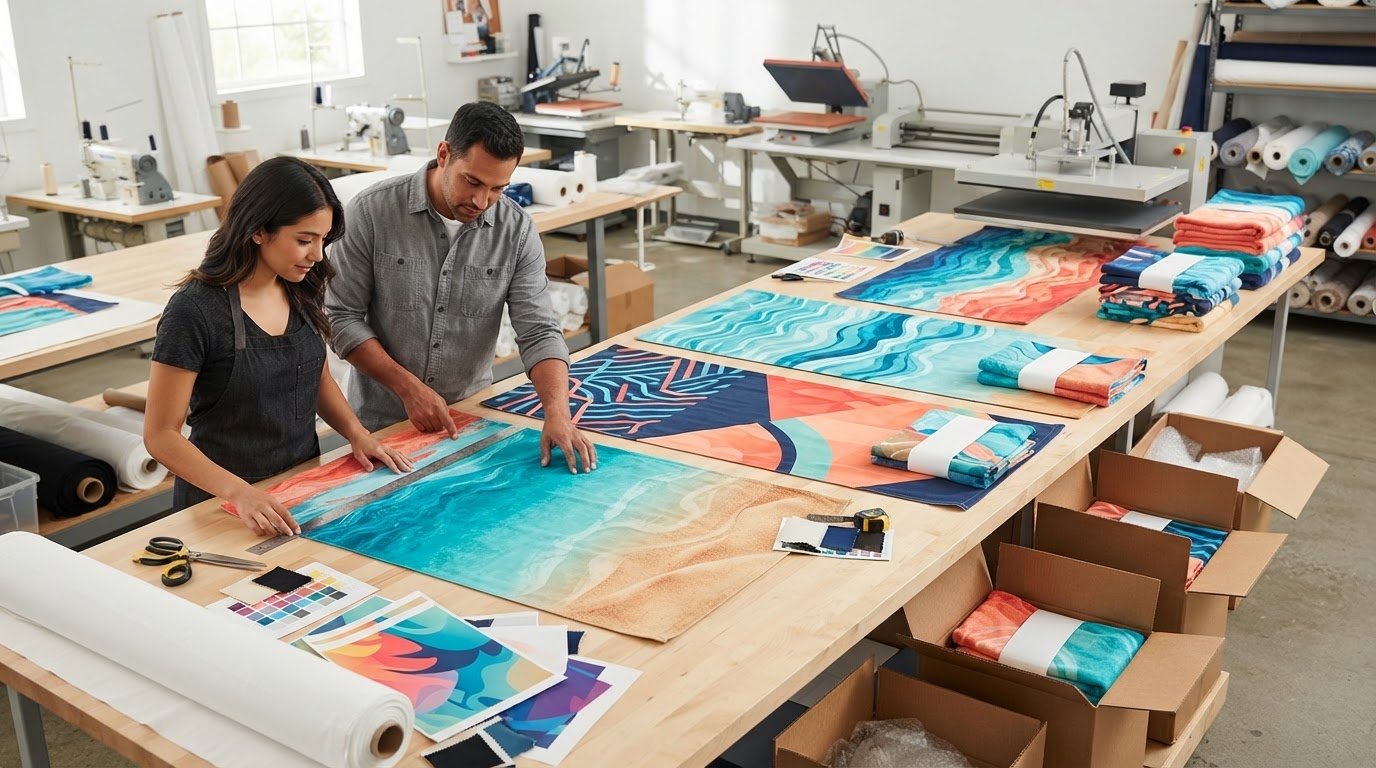
The design does more than decorate a towel. Bulk dye sublimated beach towels are made by preparing artwork for polyester fabric, transferring the printed design, then completing production, labeling, packaging, and shipping. A strong order starts with artwork that accounts for print coverage and the towel’s finished edges.
You already know a bold, full-surface design can make a custom towel stand out. The challenge is getting that design from a file to a finished bulk order without overlooking the details that affect the result. This guide explains how artwork preparation, sublimation, towel production, labeling, packaging, and shipping fit together.
Follow the process from design setup through delivery, with practical pointers for planning your order and choosing the right specifications for your project. You’ll see what each stage contributes, where production decisions matter, and how to prepare for a smoother custom towel order.
Key Takeaways
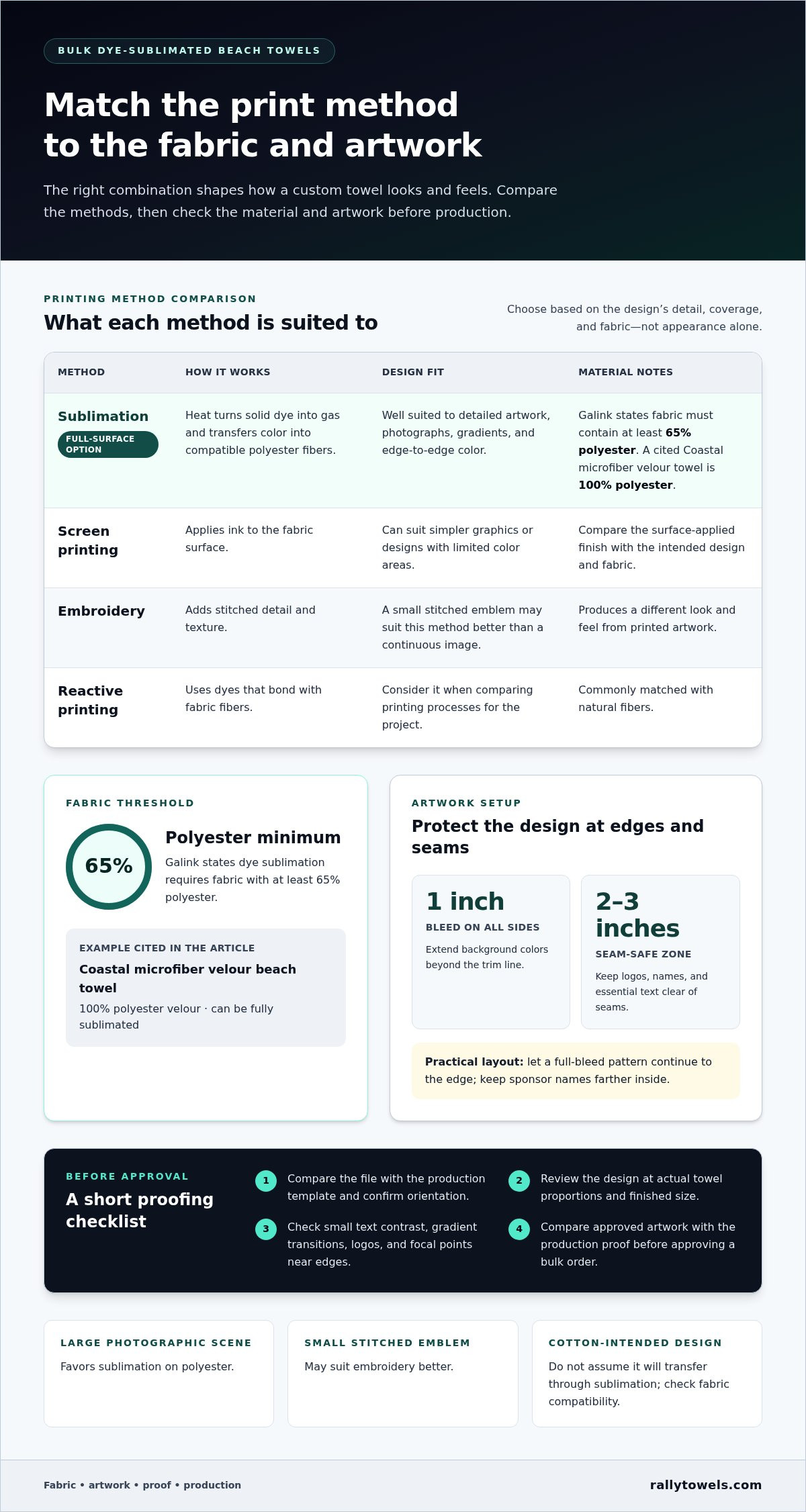
- Build bleed and seam allowances into the artwork. Galink recommends a 1-inch bleed on all sides and a 2-3-inch seam safe zone for full-surface printing.
- Choose artwork colors and placement with the finished towel in mind, especially near edges and seams.
- Match the fabric to the printing method. According to Galink, dye sublimation requires fabric with at least 65% polyester.
- Plan production details as one workflow, from towel specifications and labels to packaging and shipment.
- Use the design to make the towel memorable, then tailor the layout to its purpose, audience, and distribution.
Artwork file, bleed, and color specifications
A print-ready design starts with the finished towel dimensions and printable area. Plan bleed, seam clearance, and color placement before preparing the final file.
For a visual walkthrough of design transfer, watch this video:

Artwork File Preparation
Set up the artwork around the towel’s final shape, not just its central graphic. According to Galink, full-surface towel printing calls for a 1-inch bleed on all sides and a 2-3-inch seam safe zone. Extend background colors into the bleed, while keeping logos, names, and essential text clear of seam areas.
Before exporting, compare the file with the production template and confirm its orientation. A landscape logo may sit naturally across a horizontal towel, while vertical text may need repositioning. Check that fonts remain readable at the finished size and keep important details clear of the edges.
- Keep background artwork beyond the trim line.
- Place logos and text inside the seam-safe area.
- Review the design at actual towel proportions, not only on a screen.
For example, a full-bleed wave pattern can continue to the edge, while a sponsor name stays farther inside. This separation helps preserve the visual hierarchy if hems or seams affect the finished layout.
Full-Color Design Options
Full-color printing supports artwork that combines photographs, gradients, detailed illustrations, and several brand colors. Edge-to-edge coverage lets the design fill the towel rather than sit inside a small printed panel. For a custom full-color beach towel, decide which elements should dominate from a distance and which details reward a closer look.
Choose colors from the artwork’s palette and use them consistently across logos, backgrounds, and supporting text. A navy logo against a pale field, for example, can stand apart from surrounding patterns. Strong contrast also makes important wording easier to read.
Review colors carefully before finalizing the artwork, since screen previews and printed fabric can look different. Check gradients for smooth transitions and make sure small text contrasts with its background. If the design includes a photograph, crop it to suit the layout and keep faces and focal points clear of the edges.
Consider the viewing distance as well. Large color blocks and simple shapes read clearly across a beach or event space, while fine details work best as supporting elements. A balanced layout gives the custom full-color design impact without crowding its central message.
Dye sublimation printing
Dye sublimation transfers printed dye into polyester fabric using heat, making the fiber content central to print results. A microfiber velour towel can support this method, while cotton-heavy fabric calls for a different printing approach.
Print quality depends on the fabric surface, artwork, and production setup. For care, follow the towel’s care label; before ordering in bulk, review written warranty and return terms for coverage, exclusions, and the process for reporting defects.
Printing Method and Fabric Compatibility
Dye sublimation turns solid dye into gas under heat, transferring color into compatible polyester fibers. The Coastal microfiber velour beach towel for sublimation printing is made of 100% polyester velour fabric and can be fully sublimated. Galink states that sublimation requires fabric with at least 65% polyester and suits full-surface, edge-to-edge printing on polyester, velour, or microfiber beach towels.
Compare the method with the design and material. Screen printing applies ink to the fabric surface and can suit simpler graphics or limited color areas. Embroidery adds stitched detail and texture, rather than a continuous image. Reactive printing uses dyes that bond with fabric fibers and is commonly matched with natural fibers. Each method has a different look, feel, and production process.
For bulk beach towels, align the design with the fabric before approving production. A large photographic scene or gradient favors sublimation on polyester. A small stitched emblem may suit embroidery better. A design intended for cotton should not be assumed to transfer through sublimation; Galink’s stated polyester threshold offers a practical starting point for evaluating the material.
Print Quality and Color Durability
Sublimation can reproduce detailed artwork and broad color fields across polyester fabric. Because the dye enters the fibers, the print doesn’t create the raised surface associated with some surface-applied inks. Results still depend on the source file, fabric texture, and heat transfer. Microfiber velour’s pile can affect how small details appear, so review fine lettering and intricate marks at the intended size.
Color durability isn’t a substitute for care. Follow the sewn-in or supplied care instructions, and avoid assuming every towel shares identical washing guidance. Before approving a bulk order, compare the approved artwork with the production proof, including logos, gradients, and color contrast.
For quality, warranty, and return decisions, read the written terms before purchase. Look for the inspection process, covered defects, exclusions, reporting steps, and whether custom-printed goods have different return conditions. Keep the approved proof and order details with your records. To review how dye-sublimated towels are produced, consider the method alongside your fabric and artwork requirements.
Towel production, labeling, packaging, and shipment
A bulk order moves through several linked stages, from fabric selection to final delivery. Plan towel dimensions, labeling, packaging, and the event date together.
Product Options and Dimensions
Compare towel dimensions with the way recipients will use and carry them. The Coastal microfiber velour beach towel for sublimation printing measures 30 by 60 inches. That format gives artwork a broad printable surface, while still folding for distribution. Other beach towel options can differ in fabric, finish, and intended use, so match each specification to the project.
Write the selected size and fabric into the order details before production. This helps keep the artwork layout, finished towel, and packing plan aligned. For example, a design created for a 30 by 60-inch format needs a corresponding print layout. A smaller or differently shaped towel may require repositioning its logo or background elements.
- Record the selected dimensions and fabric.
- Match the artwork file to the finished towel shape.
- Plan how recipients will receive or use each towel.
Production and Sample Timing
Production timing depends on the approved artwork, selected towel specifications, order volume, and finishing steps. A sample, if included in the project, can help assess fabric feel, print placement, and color before the full run. Allow time for artwork approval and revisions when planning the production schedule.
Shipment planning also affects the target delivery date. Packaging choices, destination, and the shipping method shape the final schedule. Set the event date first, then work backward through artwork approval, production, labeling, packing, and dispatch. This gives each stage a clear place in the order plan.
Labeling should make distribution straightforward. Decide what information recipients or event staff need to identify each towel, such as a brand name, event name, or size. Keep required label details consistent across the order. If multiple designs or destinations are involved, group the instructions clearly so the finishing and packing stages follow the intended plan.
Choose packaging to suit how the towels will be stored, transported, and distributed. Individually wrapped towels may suit direct handouts, while grouped units can simplify delivery to event teams. Keep the packaging plan aligned with labels, destination groups, and any artwork variations.
Before shipment, compare the finished order with its approved specifications. Confirm the towel dimensions, design version, label details, and package grouping. A clear packing list can help receiving staff sort deliveries by event, location, or design. For a multi-location campaign, prepare destination instructions before dispatch so each shipment follows the correct allocation.
Custom dye-sublimated towel design
A successful custom towel order connects the artwork, towel type, and purpose of the promotion. Rally Towels offers custom beach towels and dye-sublimated towels for organizations planning bulk orders.
Start with the towel’s purpose. A beach giveaway, employee gift, and event merchandise may call for different artwork priorities. A sponsor-focused design, for example, should make the sponsor name easy to spot, while a resort design might give more space to a landscape image. Decide on the main message before adding secondary details.
Wholesale custom sublimated towels make a large print area available for brand graphics, photographs, and full-color patterns. Design the composition for the towel’s actual proportions. The Coastal microfiber velour towel measures 30 by 60 inches, giving designers a clear format for planning image placement. A horizontal logo, for instance, may suit that shape better than a narrow vertical layout.
Bulk towel customization works best when every design choice has a purpose. Select the artwork and towel type as connected decisions, then clearly organize different versions for event names, team marks, or campaign graphics. Use clear file names so the approved design is easy to identify.
- Set the design hierarchy: choose the logo, message, or image recipients should notice first.
- Fit the artwork to the towel: review the full composition at the intended dimensions.
- Separate design versions: use clear names for each approved graphic.
- Match customization to distribution: plan whether every towel shares one design or uses distinct versions.
Before production, review the complete layout rather than just the digital image. Check that the logo is legible, the image crop retains its focal point, and the colors remain distinct. A crowded design can lose impact even when every requested element is present.
For a bulk order, keep one approved master file and record its matching towel size and design version. This gives the production team a clear reference if revisions occur. It also helps event organizers track which artwork belongs to each destination or distribution group.
Choose the towel type and design method to suit the project. Before approving production, compare the design proof with the requested message, layout, and final artwork. This review helps keep the custom design aligned with the campaign, from the first towel handed out to the last.
Sublimated beach towel designs
A strong beach towel design uses the available surface, not just a small logo area. Build the layout around one clear focal point, then use supporting colors, patterns, or imagery to reinforce it. A coastal event could pair a simple event name with a wave illustration, keeping both visible from a distance.
Start with the recipient and setting. A resort giveaway might use a scenic photograph, while a sports event could emphasize a team mark and season identity. Put the primary message where it is easy to find, then make smaller details support rather than compete with it.
Think in zones. A central logo can anchor the composition while a border or repeated pattern adds movement. Alternatively, an all-over graphic can create one continuous visual. A beach scene might blend sand, sky, and water across the towel, with a sponsor mark placed apart from the main image.
Use color to support recognition and readability. Apply the brand palette consistently and check that logos contrast with the background. A dark mark over a dark ocean image can disappear, so place it on a lighter field or in a clearer area. Keep fine details secondary if they may be hard to distinguish on the fabric.
- Choose one focal point: feature a logo, event name, or image first.
- Limit competing elements: use secondary copy only when it adds useful context.
- Check orientation: make sure names and logos read correctly when the towel is held or laid flat.
- Review the full composition: inspect how borders, backgrounds, and imagery work together.
Artwork style can also express the campaign. A clean geometric pattern suits a modern brand, while hand-drawn shells can give a beach event a relaxed character. A photo-based design offers a different impact, but its crop should preserve the subject. Keep faces, landmarks, and important text away from areas likely to be trimmed or obscured by construction.
Before approving a production proof, compare the layout with the original brief. Confirm the spelling of event names, logo proportions, image placement, and any sponsor marks. If an order includes multiple designs, identify each version clearly, such as “staff,” “attendee,” or “VIP.” This makes the intended artwork easier to follow during production and distribution.
Make the design memorable by giving every element a job. A strong composition can turn a practical beach item into a keepsake, especially when the artwork connects to a specific event or place. Start planning your custom towel design with the message, audience, and visual direction in mind.
Rally Towels: Custom Rally Towels
Rally Towels helps organizations create custom towels for events, promotions, and team gatherings. Choose Beach Towels for a large-format design or Custom Dye-Sublimated Towels for artwork intended for compatible polyester fabric. Rally Towels also offers Custom Rally Towels and Custom Wholesale Cooling Towels. Rally Towels has an award-winning customer service department, and orders include free shipping.
Bring your artwork direction, intended use, and distribution plan together when shaping the order. Clear specifications help match the design and towel type to the audience receiving it.
For a custom towel project, contact Rally Towels to discuss your design and order needs.
Make Your Next Campaign Stand Out
Give the towel a role beyond the day it’s handed out. For a brand launch, event, or seasonal promotion, connect the design to a moment recipients will remember. Choose an image and message that feel relevant to your audience rather than filling every part of the fabric. A focused creative direction can make bulk dye sublimated beach towels part of a larger campaign.
Rally Towels offers Custom Beach Towels alongside Custom Rally Towels and Custom Cooling towels, giving organizers options for different settings and uses. Bring your campaign goal, preferred towel type, and artwork direction together as you plan the order. That gives the conversation a clear starting point and helps align the product with how you intend to distribute it.
Contact Rally Towels about your order and take the next step toward a custom towel that fits your campaign. Your next standout giveaway starts with a clear idea.
Frequently Asked Questions
What is the minimum order quantity for bulk dye sublimated beach towels?
Rally Towels requires a minimum of 25 pieces for a custom order. Plan the quantity around your distribution list, including event staff, recipients, and any reserve stock. If the order includes multiple designs, specify how the pieces should be divided among versions. That gives the order a clear quantity and design breakdown before production planning begins.
How much do custom dye sublimated beach towels cost per unit at different quantities?
Rally Towels provides pricing after a quote request, based on the specific project. Quantity, towel type, artwork, and customization choices shape the quote. To compare order sizes, prepare the quantities you’re considering and request pricing for each; then compare the resulting per-unit amounts alongside the full project specifications. This makes it easier to weigh order volume against the towel and design you need.
What towel sizes, fabrics, and weights are available for dye sublimation?
A concrete sublimation option is the Coastal microfiber velour beach towel, made from 100% polyester velour and measuring 30 by 60 inches. For planning, connect the dimensions and fabric to the artwork and intended use. Weight affects the towel’s feel and how it packs for distribution, so include your preferred hand and packing needs in the product specifications.
What artwork file requirements and design options do towel printers support?
For full-surface towel printing, Galink recommends a 1-inch bleed on all sides and a 2-3-inch seam safe zone. Extend background artwork through the bleed, and keep essential logos or text within the safe area. Full-color designs can include photographs, gradients, and brand graphics. Before approval, review the artwork at the finished towel proportions and check that small text remains legible.
How long does production and shipping take for bulk sublimated beach towels?
Production timing depends on artwork approval, towel specifications, order volume, and finishing steps. Build the schedule around those stages, then allow for packing, dispatch, and delivery to the destination. Rally Towels orders include free shipping. For event planning, set the required arrival date first and work backward through approvals and production so the order timeline has clear milestones.
How do dye sublimated beach towels compare with screen-printed or woven custom towels?
Sublimation transfers dye into compatible polyester fabric, making it suitable for detailed, full-surface artwork. Screen printing applies ink to the fabric surface and can suit simpler graphic layouts. Woven designs are formed through the fabric’s yarn pattern, creating a different texture and look. Choose based on the artwork: photographs and gradients favor sublimation, while a simple emblem may suit another method.
Are samples available before placing a bulk towel order?
Sample availability depends on the project. An artwork proof can help confirm the layout, spelling, and image placement before production. A physical sample offers a separate way to assess fabric feel, scale, and print appearance. Review the digital design first, then use any sample to evaluate how the selected material and artwork work together.