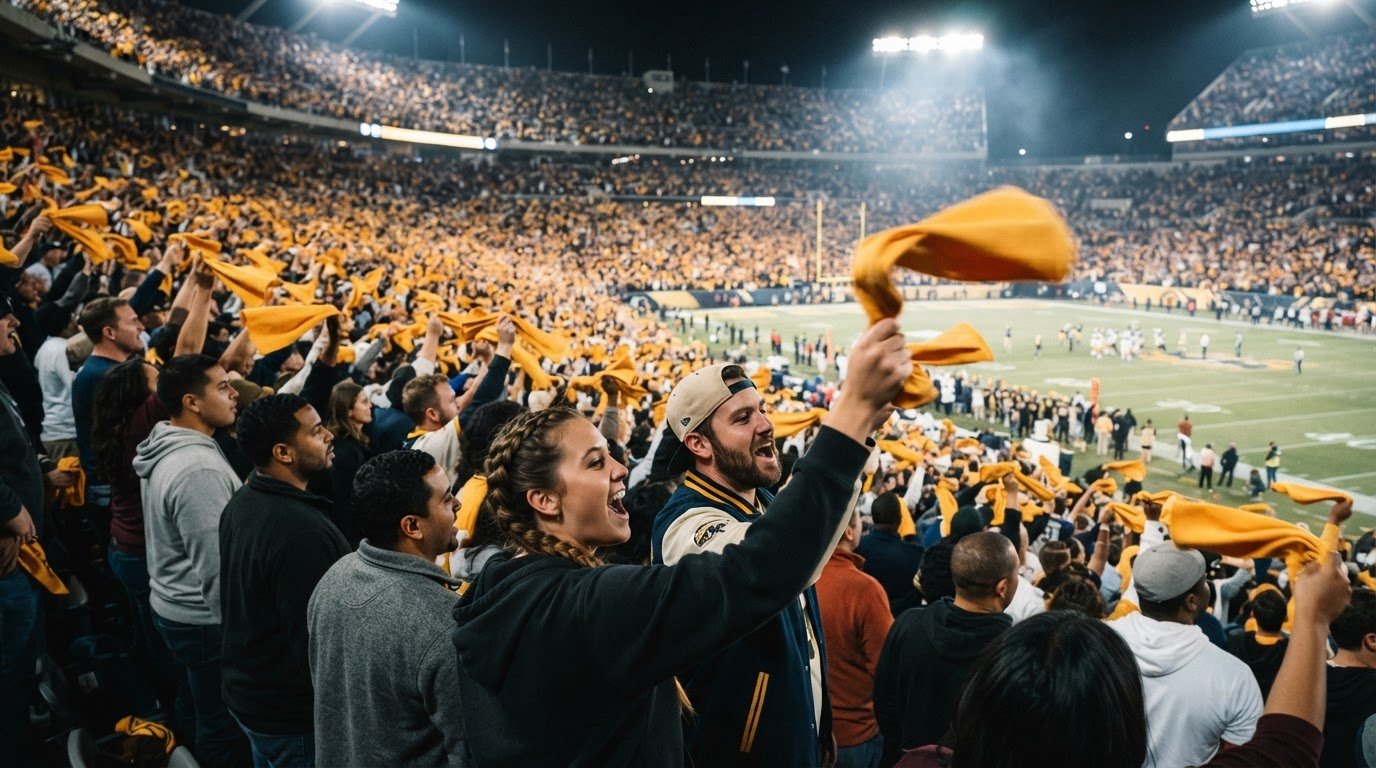
Fans wave rally towels together to show support and turn a sea of seats into a coordinated display of team spirit. That’s why rally towels are handed out on game day: they give fans a simple way to join the action. The modern tradition took off when the Pittsburgh Steelers’ Terrible Towel was introduced on December 27, 1975.
The appeal is easy to see: a towel is simple to wave, and a crowd moving in unison makes its support visible. Rally towels have become a familiar sight at college sports, American football, and Major League Baseball games.
Here, you’ll learn what rally towels are, how fans use them during games, and how traditions differ across sports. You’ll also see why teams distribute them and what makes them part of the game-day experience, rather than just another giveaway.
Key Takeaways
- Learn what sets rally towels apart from everyday towels and how their game-day tradition took shape.
- See how coordinated crowd displays turn a simple giveaway into a visible expression of team support.
- Compare how college programs, American football teams, and MLB clubs make the tradition their own.
- Discover why towel color and design can matter in baseball stadiums.
- Explore how custom rally towels can bring a team or event identity into fans’ hands.
What is a Rally Towel?
A rally towel is a small towel fans wave to show support for a team. It turns individual cheers into a shared stadium display, especially when a crowd moves together. Unlike a regular bath towel, it’s designed mainly for team spirit and event promotion, so it’s usually smaller and less absorbent. Fans can wave, twirl, or hold one up during a game.
Rally towels, pom-poms, and foam fingers all help fans show enthusiasm, but each works differently. Fans wave or twirl towels, shake pom-poms for a burst of movement, and point foam fingers toward the action. Each gives spectators a visible way to join the excitement, while towels also provide a simple surface for team or event designs.
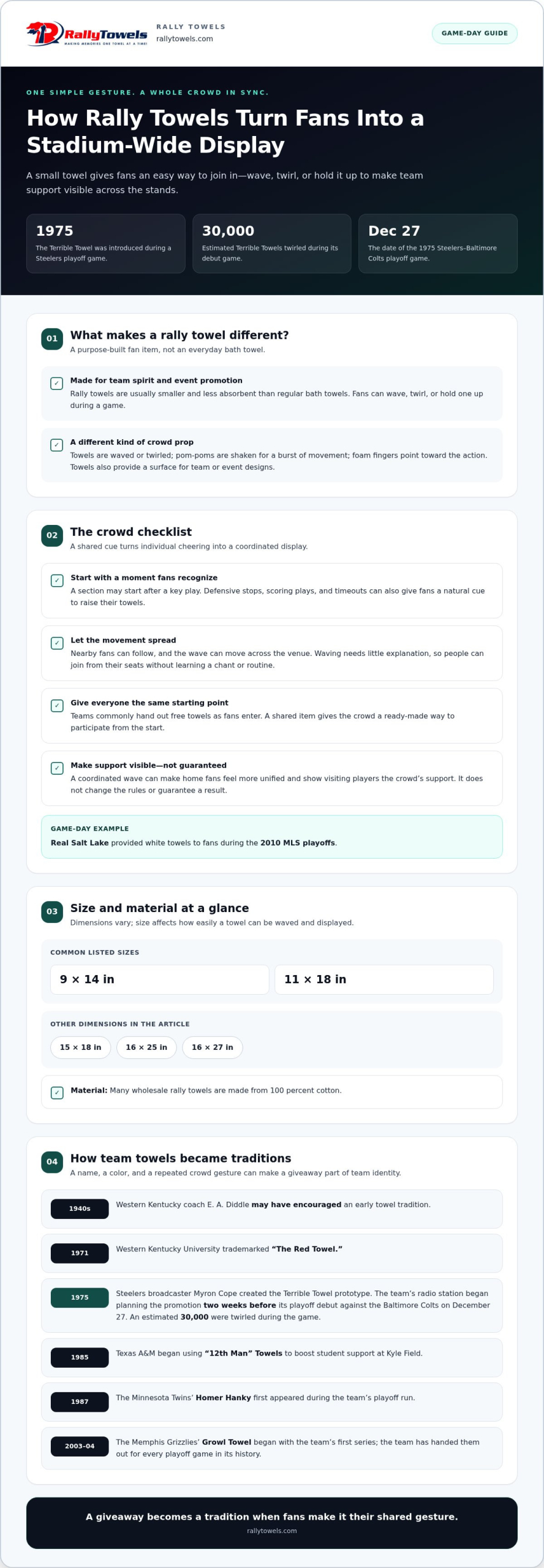
Materials and dimensions vary by towel. Many wholesale rally towels are made from 100 percent cotton. Common listed sizes include 9 by 14 inches and 11 by 18 inches, while other typical dimensions include 15 by 18, 16 by 25, and 16 by 27 inches. Size affects how easily a towel can be waved and displayed.
The best-known modern origin story begins with Pittsburgh Steelers radio broadcaster Myron Cope. He created the prototype for the Terrible Towel in 1975. Cope’s idea gave Steelers fans a distinctive, easy-to-use item for showing their support together. Its name and recognizable gesture helped turn a simple towel into an enduring team symbol.
The Terrible Towel was introduced during the Steelers’ NFL playoff game against the Baltimore Colts on December 27, 1975. The team’s radio station had started planning the promotion two weeks before the game. The towel was designed to draw fans into the event, transforming a giveaway into a coordinated display in the stands.
The crowd’s response made the debut memorable. An estimated 30,000 Terrible Towels were twirled during that playoff game. The image of fans moving together helped establish the towel’s connection to Steelers supporters. It also showed how an uncomplicated object could become part of the game-day experience, rather than just something fans took home.
Other US sports traditions developed their own identities. Western Kentucky coach E. A. Diddle may have encouraged an early towel tradition in the 1940s, and Western Kentucky University trademarked “The Red Towel” in 1971. The Minnesota Twins’ Homer Hanky first appeared during the team’s 1987 playoff run, offering another example of a named fan towel.
The Memphis Grizzlies have handed out their Growl Towel for every playoff game in team history, beginning with their first series in 2003-04. These examples show how teams adapted the rally towel into a recognizable symbol. The particular name or tradition may differ, but the purpose remains clear: give fans an easy way to show team support together.
How fans use rally towels at sports events
Rally towels turn individual cheers into a crowd-wide display. Fans wave or twirl them together, making team support visible across the stands. The gesture is easy to copy, so anyone can join in without knowing a chant or learning a routine.
A coordinated towel wave depends on shared timing. One section may start after a key play, and nearby fans can follow. As more people join, the movement spreads across the venue. That’s why rally towels work as a simple visual cue: everyone can take part in the same response.
Game-Day Towel Handouts
Teams commonly give rally towels to fans as they enter a stadium. As a giveaway, the towels are free to recipients. This lets fans join the crowd display without bringing their own and gives everyone the same item to wave during the event.
For example, Real Salt Lake provided white towels to fans during the 2010 MLS playoffs. A shared towel can make a team’s supporters easier to spot in the stands. The distribution also gives fans a ready-made way to participate from the start, rather than waiting until a chant or other cue begins.
Building Home-Field Advantage
Rally towels help create home-field advantage by giving home fans a visible, shared way to support their team. When supporters wave together, they can make the crowd feel more unified and show visiting players how strongly the home team is backed.
Fans can raise towels after a defensive stop, a scoring play, or a timeout. These moments provide natural cues for a section to join in. The display doesn’t change the rules or guarantee a result, but it gives supporters an active role in the stadium atmosphere.
Twisting a towel overhead creates more movement than holding it still. When fans repeat that action together, the stands become a coordinated display. Understanding why rally towels matter also means seeing their value beyond one play: a giveaway can become a keepsake that reminds fans of a team, game, or playoff experience.
The format is practical for crowds. Unlike a complicated routine, waving a towel needs little explanation, and fans can participate from their seats. At an MLS playoff game or another live event, that simple action connects individual supporters through a shared gesture. The team provides an object to rally around; fans give it meaning through how they use it.
College rally towel traditions
College rally towels connect game-day support with school identity. Texas A&M began using “12th Man” Towels in 1985 to boost student support at Kyle Field. The name ties the towel to the idea of fans supporting the players as an additional presence. It gives students a recognizable way to express school spirit together.
That shared identity matters on a campus, where traditions can carry meaning beyond one game. At Texas A&M, the “12th Man” name makes the towel more than a generic giveaway. The words identify the school’s fan culture, while the towel gives supporters an easy way to take part visually.
College programs can also build traditions around a color or a distinctive name. Western Kentucky University trademarked “The Red Towel” in 1971, making the towel’s identity closely tied to the school. That example shows how a simple object can become a recognizable symbol when fans encounter it repeatedly at school events.
At Kyle Field, the 12th Man Towels were introduced specifically to encourage student support. A towel gives students a shared object to wave during a game, rather than leaving each person to cheer in a different way. The movement becomes most visible when fans act together, linking the stands through a common gesture.
For college teams, the timing and setting of a towel tradition help shape its meaning. Texas A&M’s 1985 introduction connects the practice to a particular school and venue, Kyle Field. When a named towel appears in that setting, students can associate it with their team, fellow fans, and the experience of attending games.
Western Kentucky’s Red Towel offers another model: a school-linked name can help a tradition stand apart. Trademarking the term in 1971 formalized that identity. For fans, a named towel is easier to recognize and discuss than an unnamed giveaway, especially when the name reflects the institution’s own spirit.
These examples show two ways college towels can represent a program. Texas A&M’s “12th Man” Towels emphasize student support, while Western Kentucky’s “The Red Towel” centers a school-specific symbol. Both turn a practical item into a visible expression of belonging, giving supporters a simple part to play in game day.
College traditions gain meaning through repetition, too. At Texas A&M, fans can connect the towel’s name with Kyle Field and the support it was introduced to encourage. At Western Kentucky, the Red Towel identity links the school and its supporters. The towel’s role is clear: it helps fans show they belong to the team community.
Rally towels in American football
American football brings rally towels into both professional and college game settings. A towel gives fans a simple way to make their support visible, whether they’re in an NFL stadium or at a bowl game. Its role is straightforward: cheering becomes a shared action that supporters can join without learning a new chant or carrying special equipment.
The Pittsburgh Steelers’ Terrible Towel is a landmark example in professional football. Its 1975 introduction connected a distinctive fan gesture with an NFL playoff game. The story shows how a towel can become associated with a team and its supporters, rather than remaining just another game-day item.
College football offers a separate example. TCU gave rally towels to fans in Pasadena for the Rose Bowl against Wisconsin, played on January 1, 2011. That setting illustrates how a team can bring a coordinated display to a major event away from its usual home venue.
For fans, waving a towel is easy to understand and repeat. One supporter lifts it, others follow, and a section can create a unified movement. At an American football game, that shared gesture gives fans a visible way to respond to a big play or encourage their team during a tense stretch.
The TCU example also shows why a towel suits a bowl-game occasion. The Rose Bowl brings teams and supporters together in Pasadena, and TCU’s distribution gave fans a shared item for the event. A recognizable towel can connect individual supporters to the same team, even when they’re gathered outside their regular stadium.
In the NFL, the Steelers’ Terrible Towel shows how a game-day gesture can become part of a team’s identity. Fans can bring it into the stands and use it repeatedly, so its meaning comes from the team connection and shared action. The result is a visual symbol supporters recognize.
Football’s stop-and-start rhythm gives fans moments to react between plays. A towel can be lifted or waved during those moments, adding movement to cheers from the stands. At a TCU bowl game or a Steelers playoff contest, the crowd’s coordinated display makes its support apparent without changing how the game is played.
These examples show two sides of the tradition. The Steelers illustrate a towel associated with an NFL team, while TCU’s Pasadena handout shows how a college team can use one at a major bowl event. In both settings, fans use the towel to make support a shared, visible part of football game day.
Rally towels in Major League Baseball
Major League Baseball’s postseason has given rally towels a prominent role in the stands. In 2010, five of the eight teams in the MLB postseason had rally towels, showing how widely the tradition had entered baseball’s biggest games.
By 2010, only three MLB teams had not adopted the rally-towel tradition. The 2006 World Series was the most recent World Series before 2010 in which both teams had rally towels. Together, these milestones show how postseason towel displays became familiar across different clubs.
Baseball also brings a special consideration: the color of a fan giveaway. In 2016, Major League Baseball adopted a rule prohibiting white in-stadium rally towels because they could confuse hitters. That makes color more than a design choice in a baseball setting. A distinct team color can help fans stand out while avoiding white towels in the stands.
The Minnesota Twins’ Homer Hanky is one of baseball’s best-known examples. It first appeared during the team’s 1987 playoff run, giving Twins fans a recognizable rally item. The Hanky returned as part of the team’s story during its 1991 World Series victory.
The tradition evolved with the Twins. Their 2019 Homer Hanky was a small red terrycloth towel, a format that preserved the name while giving the rally item a specific look. The example shows how a team can maintain a familiar symbol while adapting its presentation for a new season.
Other clubs established their own timelines. The Houston Astros began using rally towels in the 2015 season, followed by the Arizona Diamondbacks in the 2017 season. These examples illustrate how the practice continued to reach teams beyond earlier postseason traditions.
For fans, a baseball rally towel serves as both a crowd signal and a team marker. When supporters wave together, the stands become a coordinated display. A club-specific color or name helps distinguish that crowd from its opponent, while the towel gives individual fans an easy way to join in.
For event organizers planning a baseball giveaway, the MLB color rule is a useful design consideration: avoid white towels in the stands. Team identity, visible color, and a clear design can help make the giveaway feel connected to the game. Plan custom rally towels for your team event.
Rally Towels: Custom Rally Towels
Rally Towels is a natural next step for teams and event organizers planning a coordinated fan giveaway. Custom Rally Towels create a game-day item connected to your team or event, giving supporters a shared way to show their enthusiasm in the stands.
For other settings, consider Custom Beach Towels or Custom Cooling towels. Dye sublimated Towels provide another way to bring a design to a towel. The right option depends on the event and how fans will use it.
Explore the options for your next event, or visit Rally Towels to learn more.
Plan a Game-Day Giveaway Fans Can Own
As you plan your next event, start with the fan experience you want to create. Consider how a giveaway can reflect the team, bring supporters together, and feel connected to the occasion. A clear design direction helps turn a simple item into a memorable part of game day.
Why rally towels matter goes beyond the moment fans wave them. A well-chosen giveaway can carry your event identity into the stands and give supporters a shared way to participate. Rally Towels offers Custom Rally Towels, Custom Beach Towels, and Custom Cooling towels for different event needs.
Choose the option that fits your audience and the setting, then shape the design around your team or event. If you’re ready to explore ideas for a fan giveaway, contact Rally Towels today. Make your next event feel like it belongs to your team and its supporters.
Want a giveaway that stands out? Teams are switching to jersey-shaped rally towels and light-up LED rally towels for big games and night events.
Frequently Asked Questions
How Are They Used Today?
Fans use rally towels to make team support visible during live games and postseason events. A spectator can wave one after a big play, hold it up during a rally, or join a coordinated crowd display. Teams also use them as giveaways that bring team colors or event identity into the stands. The towel gives fans a simple, repeatable way to participate.
What are rally towels and what are they used for?
Rally towels are small towels designed mainly for fan support and promotion, rather than for drying off like standard towels. Fans wave or twirl them to show allegiance, while teams use them as memorable event giveaways. Their compact format makes them easy to hold in the stands. For example, a fan can raise one during a key play without needing special equipment.
Why do sports fans wave rally towels?
Fans wave rally towels to show support together and make their enthusiasm visible across a venue. A synchronized display can help supporters feel part of the same crowd, even when seated in separate sections. The action is easy to follow: one fan starts waving, and nearby fans can join in. At a close game, that shared gesture gives the crowd a clear way to respond.
When and where did rally towels originate?
The modern rally-towel prototype dates to 1975, when Pittsburgh Steelers broadcaster Myron Cope created the idea behind the Terrible Towel. It debuted during a Steelers playoff game against the Baltimore Colts on December 27, 1975. An earlier towel tradition may have taken shape at Western Kentucky in the 1940s under coach E. A. Diddle, so the history includes more than one early influence.
Which sports teams first popularized rally towels?
The Pittsburgh Steelers helped popularize the modern rally towel through the Terrible Towel, introduced in 1975. Western Kentucky also has an early connection: coach E. A. Diddle may have encouraged a towel tradition in the 1940s. Later examples show how the idea spread across sports, including the Vancouver Canucks’ tradition beginning in 1982 and the Minnesota Twins’ Homer Hanky in 1987.
How did the Terrible Towel become famous?
The Terrible Towel became famous through a memorable Steelers playoff debut and the fans who adopted its waving ritual. On December 27, 1975, an estimated 30,000 towels were twirled during Pittsburgh’s game against the Baltimore Colts. That dramatic crowd display tied the towel to Steelers support and gave the team a recognizable visual tradition that fans could repeat.
How are rally towels used at sporting events today?
At games today, fans wave or twirl rally towels during important moments, creating a moving display in the stands. Teams may hand them out as fans enter, giving spectators a shared item before play begins. Designs and colors can reflect a team or event. In baseball, color choices also matter: a 2016 MLB rule prohibited white in-stadium rally towels because they could confuse hitters.