
The shirt color that looks best on its own may not work for your print. Knowing how to choose a custom t-shirt printing service means weighing color contrast alongside fabric, fit, print style, and order size so the finished shirts suit the people who will wear them.
It’s natural to focus on the design first. But the shirt underneath affects how that design looks and feels, and whether one option works for your whole group. This guide will help you choose materials, styles, colors, and print options to match your audience, budget, and order needs, including when a mix of styles or colors makes sense.
For custom T-shirts from Rally Towels, unlimited colors come at no extra cost. The minimum order is 25 pieces, and turnaround can be as fast as 1 day. Use the steps ahead to make practical choices before placing your order.
Key Takeaways
- Choose shirt colors and print colors together so the design stays clear and easy to see.
- Decide whether your group needs one shirt style or a mix that suits different wearers and uses.
- Keep artwork simple when cost control matters, and match the print method to the design’s detail.
- Compare shirt materials by feel, fit, and how well they suit the occasion and audience.
- Plan your quantity and delivery needs early, then use a complete quote to understand the order’s cost.
Can I mix shirt styles and colors in my order?
An order can combine shirt styles and colors when the printer can manage each variation. Compare quotes using the same quantities, decoration, and shipping details, and review applicable setup charges and rush options. Get any charges and reprint or cancellation terms in writing.
- Set the mix before requesting quotes. List each shirt style, color, and size separately, then give the printer the quantity for each. For a family reunion, you might choose one color for adults and another for youth sizes. Ask whether each variation counts toward an order minimum and whether changing garments affects the print setup or schedule.
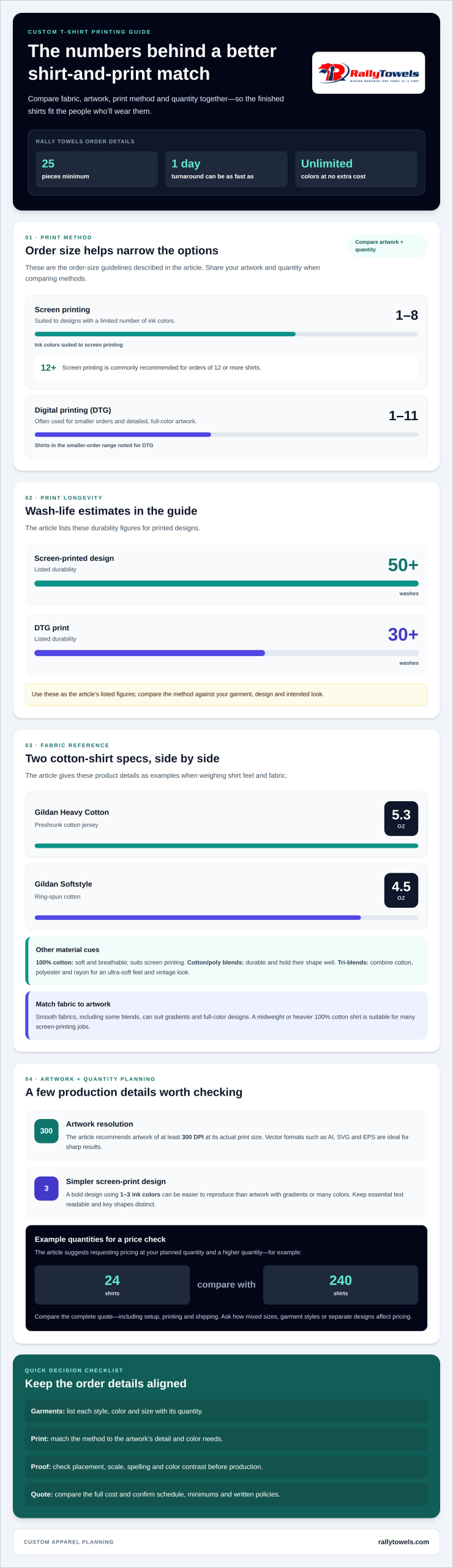
- Match the fabric to the print and feel. A 100% cotton T-shirt feels soft and breathable, and suits screen printing. Cotton/poly blends are more durable and hold their shape well. Tri-blends combine cotton, polyester, and rayon for an ultra-soft feel and vintage look. Gildan Heavy Cotton is 5.3 oz preshrunk cotton jersey; Gildan Softstyle is 4.5 oz ring-spun cotton. Comfort Colors can suit a washed, vintage appearance.
- Compare decoration methods against the artwork. Screen printing suits designs with 1-8 ink colors, and is commonly recommended for orders of 12 or more shirts. Digital printing, or DTG, is often used for smaller orders of 1-11. Screen-printed designs are listed as durable for 50+ washes, while DTG prints are listed at 30+ washes. Embroidery stitches a design into fabric rather than printing it, so compare its look and garment compatibility separately.
- Compare printers by order size and timing. A local print shop may handle direct conversations about a mixed order, while an online platform may organize selections through a digital order form. Either way, request the schedule for each style and color, not just the full order. A listed standard turnaround for screen printing, DTG, and embroidery is 2 weeks; rush timing and shipping can change the delivery plan.
- Read guarantees before paying. Compare written policies for print defects, garment issues, cancellations, and reprints. Check whether the terms cover every style and color in your order, and whether a replacement would use the same garment and decoration. A digital proof helps confirm the artwork and placement before production, but it is separate from a guarantee about the finished shirts.
Reducing costs through bulk orders and simpler designs
Align the order quantity, print method, artwork, and fabric before production to manage costs while preserving the design’s impact.
-
Match Printing Methods to the Order
Share the quantity and artwork so the printer can recommend a suitable method. Screen printing is commonly recommended for orders above 24 units, especially with designs limited to 1-3 ink colors. Digital printing can suit detailed, full-color artwork, while embroidery creates a stitched finish rather than a printed image. Compare the method against the design, garment, and intended look, not quantity alone.
For detailed artwork, ask how the fabric affects the result. Smooth fabrics, including some blends, can suit gradients and full-color designs. A midweight or heavier 100% cotton shirt is a suitable choice for many screen-printing jobs. If your design began in Adobe Express, send the print-ready artwork file and intended placement. Vector formats such as AI, SVG, and EPS are ideal for sharp results; artwork should be at least 300 DPI at its actual print size.
-
Simplify Designs to Reduce Costs
Review the artwork and remove details that don’t contribute to recognition. A bold logo with 1-3 ink colors can be easier to reproduce with screen printing than a design with gradients or numerous colors. Fewer colors can also simplify the production setup. Keep essential text readable and key shapes distinct, especially when the design will appear on several shirt colors.
Ask the printer for a digital proof before production. Review the placement, scale, spelling, and color contrast on the selected garment. If you need design assistance, provide the logo, brand colors, and intended message, then request a proof showing the proposed layout. Approve the final version only after checking every detail. Late artwork changes can disrupt the order and require another review.
-
Check Minimums and Price Breaks
Request pricing at your planned quantity and at a higher quantity, such as 24 and 240 shirts. In screen printing, the setup cost can remain fixed for a job using three screens, whether it covers 24 or 240 shirts. That means the setup is spread across more pieces in the larger order. Ask how mixed sizes, garment styles, or separate designs affect the quantity used for pricing.
Compare the complete quote, including setup, printing, and shipping, rather than focusing only on the per-shirt amount. Ask which price breaks apply to your exact design and garment, and whether all pieces must share the same artwork. Confirm the minimum, reprint policy, and cancellation terms before paying. This gives you a clearer basis for deciding whether a larger order offers worthwhile savings.
Selecting shirts based on audience, budget, and use
Start with who will wear the shirts, where they’ll wear them, and when they’re needed. Match the apparel, fit, and artwork to those practical needs.
- Define the audience and fit. For a school or community event, consider offering unisex and youth sizes so more attendees can find a comfortable fit. Unisex shirts are common and generally work well for different wearers. Women’s-cut shirts often have shorter sleeves and a more fitted shape, so include them if that style suits the group. For a family reunion, decide whether one shared fit or a mix better serves your relatives.
- Choose a shirt for its intended use. Match the garment’s weight and feel to the occasion. A 6 oz T-shirt has more structure and body than a lighter shirt, which can suit a substantial everyday look. For an event where a soft hand feel matters, compare lighter options such as Gildan Softstyle, made from 4.5 oz ring-spun cotton. Ask the printer to match the garment to the activity and wear expectations.
- Balance budget with the look you want. Gildan Softstyle is a budget-friendly blank with a smooth printing surface, making it one option when cost and a clean print matter. For a washed, vintage appearance, consider Comfort Colors. Compare the garment itself, not just the design mockup: fabric, style, and print detail all affect the finished feel. Keep the intended use in view when choosing a blank.
- Match artwork to the blank. A detailed logo or fine lines need to read clearly against the selected shirt color and fabric. Bold artwork can work across a broader range of garments, while a vintage design may pair naturally with a washed-looking blank such as Comfort Colors. Give the printer the final artwork and garment preference together so the proposed print can be assessed in context.
- Set the quantity and timeline together. Estimate how many shirts each audience group needs, including youth and adult sizes, then organize those quantities before requesting a quote. Splitting an order by fit or color can affect its planning. Share the event date and delivery deadline with the printer early, since the production schedule depends on the order details and selected garments. Confirm the garment choices and artwork before approving production.
Shirt color and print contrast
Choose the shirt and ink colors as one design decision. Strong contrast keeps lettering and artwork clear across different garments.
- Identify the design’s most important details. Start with the logo, headline, or image viewers need to recognize first. Black lettering on a dark navy shirt can obscure the message, even if both colors match your brand palette. Compare the actual shirt color with each ink color, and prioritize readability when it conflicts with an exact brand-color match.
- Use light and dark backgrounds deliberately. Lighter-colored T-shirts can give a design a softer feel and let its colors show more naturally. Dark garments may need a white underbase beneath screen-printed artwork, which can affect the print’s texture and cost. For example, white lettering on a black shirt avoids using dark ink that blends into the fabric.
- Check color combinations at the intended size. A logo that looks crisp on a large screen can lose small details when printed on a chest. Review the artwork at its actual print size, not just enlarged on a computer. Check fine lines, small text, and neighboring colors. If the design uses similar shades, increase the contrast between foreground and background.
- Consider how the print method handles color. Screen printing uses ink colors, so simple, high-contrast artwork can translate cleanly onto light or dark shirts. Digital printing can reproduce detailed, full-color artwork, but the garment still affects how the design appears. Ask for a proof on the exact shirt color. A digital preview helps catch contrast problems before production.
- Evaluate the full look, including fabric and finish. Compare the print against the shirt’s texture, not only its color. A washed look, such as Comfort Colors, may suit artwork designed to feel vintage; a bright, sharply defined logo may call for a cleaner contrast. Consider whether the print should stand out entirely or blend into a coordinated design. Approve the color pairing and proof together to support a durable, cohesive result.
Comfort Colors T-shirts are a good option for a washed, vintage look, helping align the garment with the artwork’s style. Highly detailed artwork, gradients, or full-color prints may work better on smoother fabrics such as blends or tri-blends. If those details are central to the design, consider them alongside the shirt fabric rather than treating print color as the only decision.
What are the minimum order quantities and price breaks at custom T-shirt printing services?
- Ask for the minimum that applies to your exact order. A printer’s minimum may depend on the garment, print method, and artwork setup. Get the minimum for the shirt style and decoration you want instead of relying on a general number shown for another product. If your group needs several sizes, ask whether the minimum applies to the combined order or separately to each garment or design.
- Estimate quantities by wearer before requesting prices. Count shirts by size and style, then total the pieces you expect to distribute. For a school event, separate youth and adult sizes; for a staff order, separate each requested fit. Avoid inflating the count just to reach a price break. Unsold shirts can erase savings, especially if the design or event date limits future use.
- Request quotes at useful quantity points. Ask for the total at your planned quantity and at the next available break. A larger order can lower the per-shirt amount because setup and production costs are spread across more pieces. Larger T-shirt orders may receive volume discounts of 20 to 60 percent per shirt, but the break depends on the order details. Compare total spend as well as unit cost.
- Compare complete quotes, not headline figures. Request an itemized total covering printing, setup, shipping, garment choices, and any rush charges. Confirm whether different colors, sizes, or artwork versions change the quote. A low per-shirt figure may not reflect the full order if shipping or setup is separate. Use the same garment, design, quantity, and delivery destination when comparing proposals.
- Read order policies before payment. Review the minimum, cancellation terms, and reprint policy before approving production. Check how the printer handles a defect, an incorrect size, or a change requested after approval. Keep the final artwork, quantities, garment selections, and approved proof together. These details give both sides a clear reference if the finished order differs from the approved specifications.
Ready to plan a custom T-shirt order around your quantity and artwork? Request a quote for your order.
Rally Towels: Custom T-shirts (small part of the business)
Rally Towels produces custom T-shirts for organizations planning branded apparel, promotional giveaways, or stadium giveaways. T-shirts are a small part of the business, but they can complement an event order with other promotional products. They’re a practical fit when your organization wants custom apparel alongside event giveaways.
To start, gather your artwork, preferred shirt colors, estimated size breakdown, quantity, and event timeline. These details help shape a quote around the order you need. If towels are also part of the event, custom T-shirt printing can be considered alongside those giveaway plans.
Contact Rally Towels to discuss your organization’s custom T-shirt project.
Turn your shirt plan into an event-ready order
Turn your design decisions into a clear production brief. Gather the artwork, shirt preferences, size breakdown, and delivery deadline to give the printer a practical starting point for planning an order that fits your organization.
Knowing how to choose a custom t-shirt printing service can also help you create a consistent look across event materials. Rally Towels offers custom T-shirts alongside promotional giveaways and stadium giveaways. For an event where a towel better suits your audience, Rally Towels offers custom rally towels with screen printing or full-color dye sublimation.
Bring your project details together and discuss the right fit for your event. Get a free quote from Rally Towels. Your next organization event can start with a clear plan and a design your group is proud to wear.
Frequently Asked Questions
What factors should I compare when choosing a custom T-shirt printing service?
Compare garment options, print methods, artwork process, minimum order, turnaround, and full quote. Then review how the provider handles mixed sizes, color variations, proofs, and order changes. An organization ordering staff shirts and event shirts, for example, may need different fabrics or artwork placements. Share those details together so the quote and production plan reflect the project, not just a basic shirt estimate.
What are the differences between screen printing, DTG, DTF, and heat-transfer printing?
Screen printing pushes ink through a prepared screen onto the garment and can suit repeated designs. DTG, or direct-to-garment printing, prints artwork directly onto fabric and can suit detailed images. DTF prints a design onto transfer film, which is then applied to the shirt. Heat transfer is a broader category that uses heat to apply a design. Compare finish, fabric compatibility, artwork, and order quantity.
How do print quality, fabric type, and garment quality vary between custom T-shirt printers?
Results depend on the blank shirt, fabric surface, print method, artwork preparation, and production consistency. Compare the exact garment style and fabric content in each proposal, not just a product photo. A smooth surface can help detailed artwork appear clear, while a heavier shirt may feel more structured. Review finished examples for sharp edges, readable small text, even placement, and consistent color.
How much does custom T-shirt printing cost per shirt in the United States?
There isn’t one fixed per-shirt price because the total depends on garment choice, order quantity, print method, design complexity, print locations, and shipping. Ask for an itemized quote using the same specifications for every estimate. Include setup, printing, delivery, and any requested rush handling in the comparison. For a project with several designs or garment styles, request separate totals to see what drives the cost.
What file formats, artwork resolution, and color requirements do T-shirt printers need?
Vector artwork such as AI, SVG, and EPS is ideal for sharp printing. Raster artwork should be at least 300 DPI at its actual print size. Send the final artwork with the intended print dimensions, placement, and shirt color. Include brand color references where exact color matching matters, and review how the design appears on the chosen garment. A proof helps catch sizing, spelling, and contrast issues before approval.
What should I check in customer reviews, samples, and print guarantees?
Look for reviews that describe print consistency, order accuracy, communication, and how problems were handled. Compare published examples that resemble your artwork and garment, especially for fine details or multiple colors. Read guarantee terms carefully: note what qualifies for a reprint, how to submit a claim, and any exclusions. A clear proof and written order specifications also help establish what the finished shirts should match.
How do I choose a local T-shirt printer versus an online printing service?
Choose based on the communication, delivery plan, and order coordination your project requires. A local printer may make direct conversations about artwork or garment choices easier. An online service may offer a streamlined process for a clearly defined design. Either way, compare the complete quote, production schedule, shipping details, proof process, and how the provider manages changes to size counts or artwork.