Imagine opening a massive shipment of 5,000 custom rally towels for a major stadium giveaway only to find the logos peeling off in your hands. It is a total disaster that wastes your budget and kills the energy of your event. You deserve a partner that understands the high-stakes world of bulk distribution and bespoke manufacturing. You already know that inconsistent colors and missed deadlines due to avoidable reprints are unacceptable for your brand. That is why learning how to avoid bad quality screen printing is the most important step you can take before placing your next high-volume order.
This ultimate 2026 guide gives you the power to spot amateur red flags and understand the technical precision required for professional-grade results. We promise to equip you with a clear evaluation checklist so you can choose a wholesale partner with total confidence. You will get a behind-the-scenes look at the latest industry shifts, including new EPR regulations and the impact of fully automatic printing technology. GET READY TO UPGRADE YOUR STANDARDS AND SECURE THE QUALITY YOUR BRAND DEMANDS. Let us dive into the technical failures you must avoid to ensure every towel looks elite and every delivery arrives on time.
Key Takeaways
- Spot the “Big Three” failures immediately by identifying cracking, peeling, and poor hand feel before they ruin your distribution.
- Master the technical balance of ink curing and screen tension required to make logos pop on textured towel surfaces.
- Learn exactly how to avoid bad quality screen printing by verifying a wholesale partner’s ability to maintain precision across 50,000-unit orders.
- Secure professional-grade results for your next stadium giveaway by demanding physical proof of previous high-volume manufacturing success.
- Leverage the power of automatic presses to ensure every custom rally towel in your shipment looks identical and meets elite standards.
Spotting the Red Flags: What Bad Screen Printing Looks Like
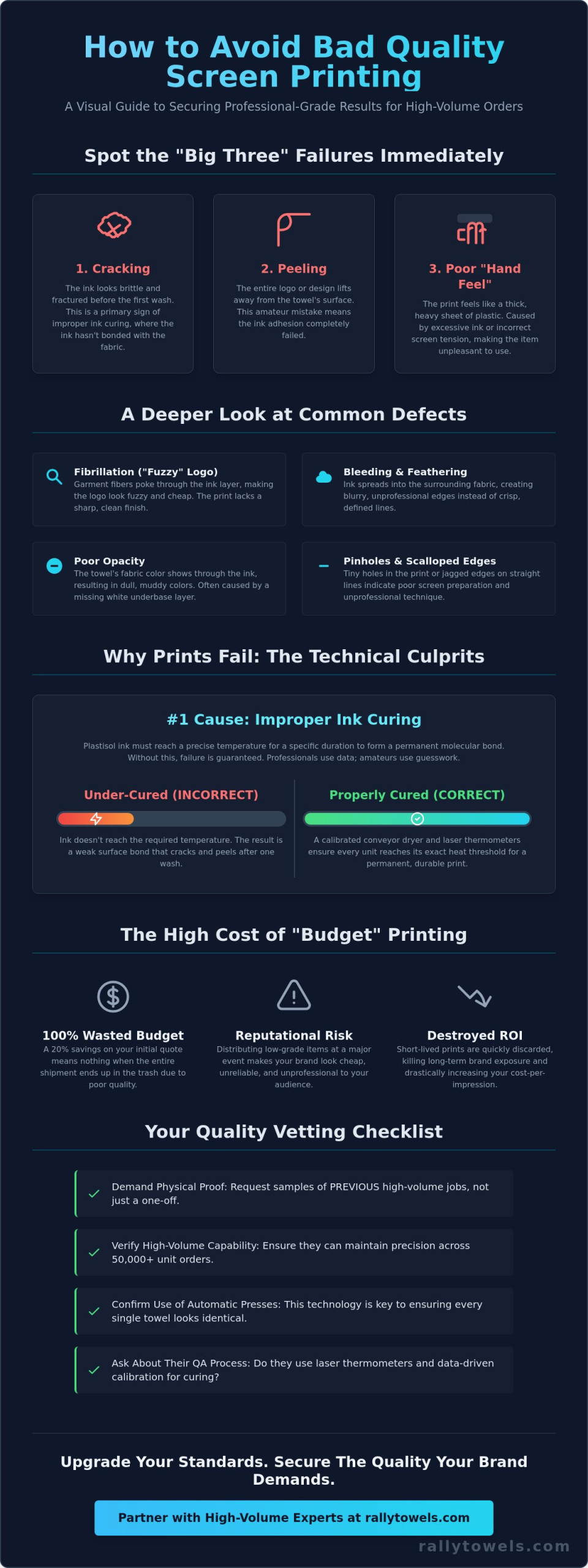
Low-quality production kills your brand’s momentum and wastes your marketing budget. When you receive a shipment of promotional items, you expect professional-grade results that represent your organization’s high standards. Understanding how to avoid bad quality screen printing starts with a physical inspection of the “Big Three” failures: cracking, peeling, and fading. If the ink on your towels looks like it is already breaking apart before the first use, the shop failed the curing process. Peeling happens when the ink does not bond with the fabric; it is a sign of amateur technique that will leave your fans disappointed.
Before you sign off on a massive order for stadium giveaways, you must understand what screen printing is and why technical precision is non-negotiable. Quality printing requires a perfect balance of ink viscosity and dryer temperature. If a printer cuts corners, you will see bleeding and feathering, where the ink migrates into the porous fabric and creates blurry, unprofessional edges. You might also notice fibrillation, which is when garment fibers poke through the ink. This makes your logo look “fuzzy” and cheap, which is the last thing you want for your brand.
Watch this breakdown to see how simple mistakes lead to messy results:

The “Hand Feel” test is another immediate giveaway of poor quality. If the print feels like a thick, heavy sheet of plastic, the printer used too much ink or failed to use the correct mesh tension. High-quality prints should feel soft and integrated into the material. This is especially critical for items like custom rally towels, where the texture of the fabric matters just as much as the visual appeal of the logo.
Visual Warning Signs to Check Immediately
Inspect your samples closely for these specific defects. Check the straight lines of your logo for “scalloped” edges, which suggest poor screen preparation. Hold the fabric up to the light to find pinholes or tiny spots where the ink did not penetrate the surface. You should also verify color opacity. If the color of the towel or garment shows through the ink, the printer did not use a proper underbase. This results in dull, muddy colors that lack the “pop” required for elite corporate events.
The Hidden Cost of Budget Printing
A 20% savings on your initial quote might look good on paper, but it leads to a 100% loss when your gear ends up in the trash. Poor quality creates a massive reputational risk. If you distribute low-grade promotional items at a major event, your brand looks cheap and unreliable. Short-lived prints also destroy your ROI. A high-quality print provides years of brand exposure; a bad one increases your cost-per-impression because the item is discarded after one wash. Demand excellence to ensure your brand stays in the hands of your audience.
The Technical Culprits: Why Most Screen Prints Fail
Technical precision is the backbone of high-volume manufacturing. When you look past the initial design, the shop floor is where your brand is either built or broken. Knowing how to avoid bad quality screen printing means looking past the visual and into the chemistry of the dryer. Most failures happen because a printer lacks the discipline to maintain their equipment or the patience to calibrate their process. You need a partner that treats every stadium giveaway like a high-stakes professional contract. Precision matters. Speed matters. Reliability is everything.
Ink curing is the most common point of failure in the entire industry. If the ink does not reach the correct temperature for the required amount of time, it will never stay on the fabric. Plastisol curing is the molecular bond between ink and fiber. Without this bond, your logo is just sitting on top of the loops, waiting to wash away. Professional shops use laser thermometers and calibrated conveyor dryers to ensure every single unit reaches the exact heat threshold. If your printer relies on “gut feeling” instead of data, your order is already at risk.
Under-Curing vs. Over-Curing
Under-cured ink is a disaster for your ROI. It looks fine in the box, but it disappears in the first laundry cycle because the molecules never fused. Over-curing is just as dangerous. Excessive heat scorches the fabric and makes the ink brittle. This leads to immediate cracking as soon as the material stretches. You want a balanced cure that remains flexible and vibrant for the life of the product. To ensure your next project meets these standards, reach out to wholesale partners who prioritize technical calibration.
Screen tension and mesh count are the silent killers of crisp detail. A loose screen causes “ghosting,” where the mesh moves during the print stroke and creates a blurry double image. This is why high-volume orders require rigid, high-tension frames that stay perfectly still. Mesh count also matters. Using a low mesh count for a fine-line logo results in jagged edges and ink blobs. Conversely, using a high mesh count for a high-opacity design on a dark towel leads to dull, thin colors. The right tool must match the specific job every time.
Registration and Alignment Mastery
Registration errors are what make a multi-color logo look shifted or misaligned. If you see white gaps between colors or overlapping ink where it should be clean, the registration is off. Elite shops use micro-registration hardware to lock in every color with surgical precision. Multi-color prints also require a “flash” cure between layers. This semi-dries the first color so the second color can sit on top without muddying. This process takes more time, but it is the only way to achieve professional-grade results that stand out in a crowded stadium.
Material Matters: Screen Printing on Towels vs. Apparel
Most buyers think screen printing is a universal process. They assume a shop that prints t-shirts can handle a massive order of stadium giveaways without a hitch. This is a dangerous mistake. Printing on a flat, stable t-shirt is child’s play compared to the “Terry Cloth Challenge.” Towels are three-dimensional landscapes of loops and fibers that fight against the ink. If you want to know how to avoid bad quality screen printing, you must understand that the material dictates the technique. You need a partner that specializes in high-volume towel manufacturing, not just a generalist print shop.
High-density inks are the secret to vibrant, professional-grade results on textured surfaces. Standard apparel ink is too thin for heavy-duty fabrics. It sinks into the loops, leaving your logo looking dull, faded, and cheap. Professional-grade rally towels require specialized ink formulas that sit on top of the pile while remaining flexible. This ensures your branding stays visible even when the fabric moves or stretches. For complex, full-color designs that cover the entire surface, you should consider dye sublimated towels instead of traditional screen printing. This process dyes the fibers themselves, offering a soft hand feel and unlimited color options.
Challenges of Printing on High-Pile Fabrics
Terry cloth is a porous material that absorbs ink like a sponge. Amateur printers often try to fix this by piling on more ink, which creates a thick, plastic-like “scab” that will inevitably crack. Pros prevent this by using high-tension screens and specific squeegee angles to lay the ink perfectly across the loops. If you want a smoother finish, velour towels are the elite choice. Velour is created by shearing the loops of the terry cloth, providing a flat surface that holds fine details with surgical precision. This is the standard for high-end corporate gifts and professional sports merchandise.
Apparel vs. Promotional Gear Techniques
Ink formulas designed for cotton t-shirts often fail when applied to heavy-duty gym towels. Towels face more friction, more frequent washing, and harsher conditions than a standard shirt. You need “crush resistance” in your prints. This means the ink won’t stick to itself or peel when the towels are compressed in bulk shipping containers. Achieving this requires precise squeegee pressure and specialized curing times that account for the fabric’s thickness. Don’t let a “budget” printer ruin your reputation with gear that fails after one use. Check out our Custom Sports Towels: The Ultimate Guide for Teams & Athletes to see how we handle these technical demands for the biggest names in sports.
Demand samples before you commit to a 10,000-unit order. Look for vibrant colors that don’t wash out and edges that stay sharp against the fabric grain. Your brand deserves the best. Choose a partner that understands the chemistry of the material and the physics of the print. GET THE QUALITY YOUR FANS EXPECT. SECURE YOUR BRAND REPUTATION TODAY.
How to Vet a Wholesale Printer for Quality
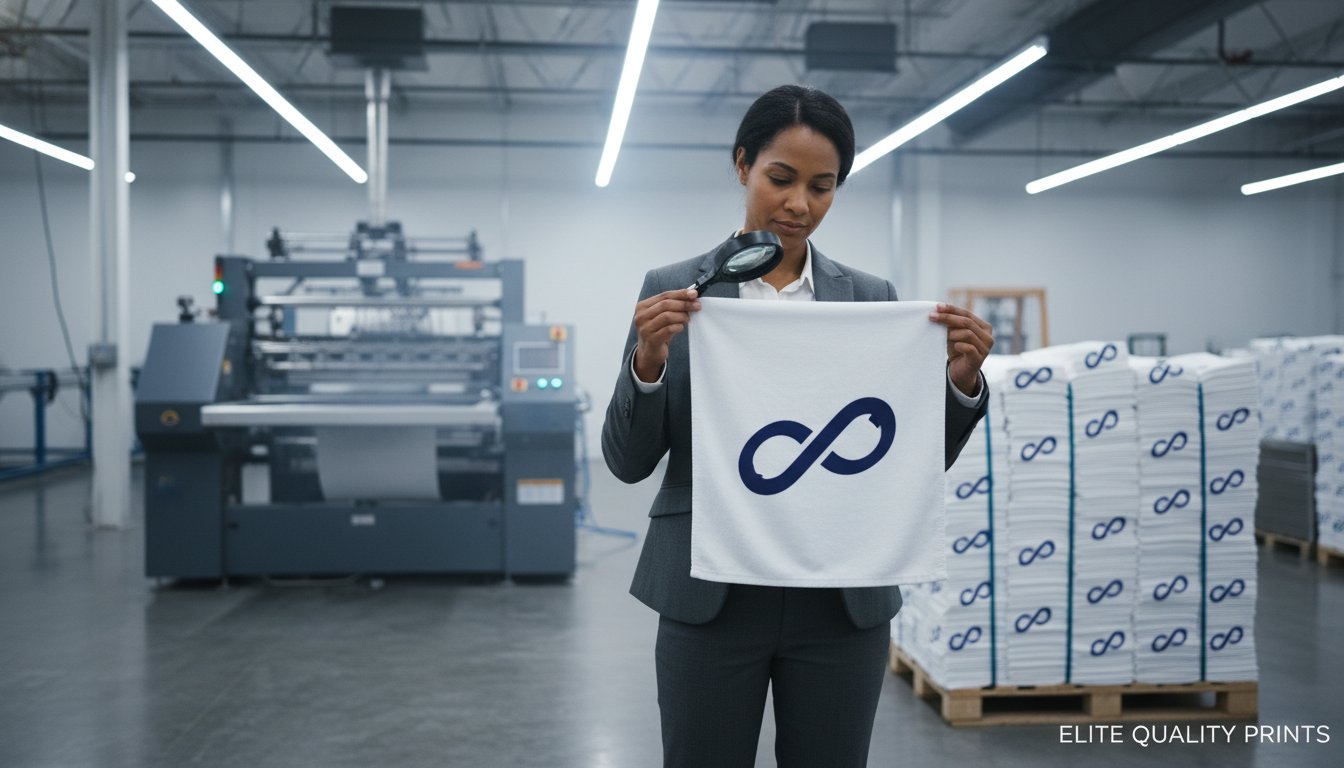
Selecting a partner for a massive order is a high-stakes decision. You cannot afford to leave your brand reputation to chance. If you want to know how to avoid bad quality screen printing, you must vet your provider with clinical precision. Start by demanding physical samples of previous high-volume work. A single t-shirt sample is easy to get right. Producing 20,000 identical units for a stadium giveaway is a different game entirely. Look for consistency in ink opacity and registration across multiple samples from the same run. If they cannot show you a bulk order they have already completed, they are not ready for your business.
Verify their capacity before you sign a contract. Ask specifically if they can handle 10,000 or 50,000 units with total consistency. High-volume manufacturing requires industrial-grade equipment. In 2026, fully automatic screen printing machines account for approximately 45% of total market revenue because they eliminate human error. Manual presses are fine for a local 5K run, but they cannot compete with the speed and precision of an automatic press. Demand a partner that invests in the latest technology to ensure your order arrives on time and looks perfect. See why we are the #1 custom towel producer in the USA by reviewing our high-capacity production standards.
Questions Every Buyer Should Ask
Don’t be afraid to grill your potential printer. Ask if they use automatic presses for all bulk orders. Inquire about their process for color matching using the Pantone Matching System. You need to know how they handle quality control for orders over 1,000 units. A professional shop will have a documented QC process that includes multi-point inspections during the print run and before final packaging. If their answers are vague, walk away.
Evaluating Social Proof and Industry Authority
The company they keep tells you everything you need to know. Working with a printer that serves the NBA, NFL, or Fortune 500 corporations matters. These organizations have the most rigorous quality audits in the world. If a printer can meet their standards, they can meet yours. There is a massive difference between a local shop and a national wholesale manufacturer. A national leader has the infrastructure, the specialized ink formulas, and the logistics network to handle complex distribution. SECURE YOUR BRAND REPUTATION BY CHOOSING A PROVEN LEADER. Contact our team today for a quote on your next high-volume project and experience the difference that elite manufacturing makes.
The Rally Towels Standard: High-Volume Precision
You have seen the technical pitfalls and the visual red flags that ruin bulk orders. Now you need a partner that executes at the highest level without excuses. Our bespoke manufacturing process is built for the high-pressure environment of professional sports and elite corporate gatherings. When you are looking for how to avoid bad quality screen printing, the answer is found in scale and automation. We don’t just print towels. We manufacture brand legacies. Our facility is designed to handle the complexity of massive distribution while maintaining the surgical precision of a boutique shop.
Consistency is the ultimate test of a wholesale partner. It is easy to make one towel look great, but making towel #50,000 look identical to towel #1 requires industrial-grade discipline. Our high-speed automatic presses eliminate the human error that plagues smaller shops. In 2026, fully automatic machines account for 45% of the global market revenue because they are the only way to guarantee professional-grade results at scale. We leverage this technology to provide the “Rally Towels Promise.” This means your logos won’t peel, your colors won’t fade, and your gear will survive both the stadium and the laundry. GET THE ELITE RESULTS YOU DESERVE.
Pro-Grade Equipment for Every Order
Our state-of-the-art facility is the engine behind our success. We maintain strict color accuracy for iconic brands like the NFL and global Fortune 500 companies. These organizations demand perfection, and so should you. We use calibrated curing systems to ensure every print achieves a permanent molecular bond with the fabric. This prevents the cracking and fading issues discussed earlier in this guide. Don’t settle for “good enough” when you can have stadium-ready quality. Get an instant quote for your custom rally towels today and see our precision in action.
Beyond Towels: Quality Across All Promotional Gear
We apply our high-volume quality control standards to everything we produce. Whether you need custom t-shirts or stadium giveaways, our process remains the same. Sourcing all your promotional swag from one high-standard manufacturer saves you time and ensures brand consistency. You won’t have to worry about your t-shirt logo looking different from your rally towel logo. We handle the technical heavy lifting so you can focus on your event. SECURE YOUR BRAND REPUTATION TODAY. For more strategies on maximizing your impact, check out our Promotional Products: The Ultimate Guide to Boosting Your Brand. We are ready to handle your next 50,000-unit order with the speed and excellence your brand demands.
Demand Elite Standards for Your Next Event
Your brand deserves to be seen in the best light possible. You now have the expertise to identify technical failures like under-curing and poor registration before they hit the stadium floor. You understand why material matters and how to vet a wholesale partner for high-volume capacity. Mastering how to avoid bad quality screen printing means you never have to settle for budget results that compromise your reputation. Take the guesswork out of your next promotion and choose a leader with a proven track record.
Rally Towels brings over 20 years of high-volume manufacturing excellence to every project. We are the trusted choice for the NFL, NBA, and NHL because we deliver USA-made quality with lightning-fast shipping. Our state-of-the-art automatic presses ensure that every custom rally towel or promotional giveaway meets professional standards. Don’t risk your event on amateur shops that can’t handle the pressure. SECURE YOUR BRAND REPUTATION TODAY.
GET YOUR INSTANT QUOTE NOW – EXPERIENCE PRO-GRADE QUALITY
Take control of your brand image and deliver the vibrant, durable results your fans expect. We are ready to help you dominate your next giveaway with precision and speed.
Frequently Asked Questions
How can I tell if screen printing ink was cured properly?
Perform the stretch test by gently pulling the fabric; the ink should move with the material and return to its original shape without cracking. If the ink breaks apart or feels brittle, it was likely over-cured or under-cured. You can also run a single unit through a heavy laundry cycle to see if the logo fades or peels immediately. Proper curing creates a permanent bond that survives hundreds of washes.
Why does my screen-printed logo look blurry or have fuzzy edges?
Blurry edges usually stem from poor screen tension or “ghosting” during the production run. When the mesh is loose, it shifts slightly as the squeegee passes over it, which smears the ink. This is a common sign of amateur production. Professional shops use rigid frames to ensure every line remains sharp and every detail stays crisp across your entire order.
What is the difference between screen printing and dye sublimation for towels?
Screen printing applies a layer of ink onto the surface of the loops, while dye sublimation uses heat to turn ink into gas that penetrates the fibers. Use screen printing for bold, simple logos on stadium giveaways. Choose dye sublimation for full-color, edge-to-edge designs where you want a soft hand feel. Both methods offer elite results when handled by an experienced manufacturer.
Can I avoid cracking in my screen-printed designs?
You can avoid cracking by ensuring your printer uses the correct ink formula and curing temperature for the specific fabric. Brittle ink often results from over-curing, which dries the plastisol until it loses all flexibility. High-quality prints remain supple. This is a key part of how to avoid bad quality screen printing when ordering for high-energy events where gear gets stretched and used.
Is it possible to screen print fine details on a textured towel?
Achieving fine details on textured terry cloth is difficult but possible with the right equipment. You should opt for velour towels because the sheared surface provides a flatter area for the ink to settle. If you must use standard loops, the printer needs high-tension screens and specialized squeegee pressure to prevent the ink from sinking too deep into the pile and disappearing.
How do I ensure my brand colors match exactly on a bulk order?
Demand a Pantone Matching System (PMS) verification for every multi-color order. This international standard ensures that your brand’s specific blue or red is reproduced exactly across 50,000 units. Always request a digital proof or a pre-production sample for large-scale promotional giveaways. This step eliminates guesswork and guarantees that your branding remains consistent across different product types.
What should I do if my bulk order of shirts or towels arrives with bad prints?
Document the defects with clear photos and contact your wholesale partner immediately to discuss reprints or credits. Professional manufacturers stand by their work and have quality control logs for every run. If you find consistent errors across a significant portion of the shipment, it indicates a systemic failure in their production line. Fast communication is vital to meeting your event deadlines.
Why is automatic screen printing better than manual printing for large orders?
Automatic presses provide 100% consistency in pressure and speed, which manual printing simply cannot match. For large orders, human fatigue leads to variations in ink thickness and alignment. Learning how to avoid bad quality screen printing involves choosing partners that invest in automation. This technology ensures that the last towel in your order looks just as perfect as the first one.