
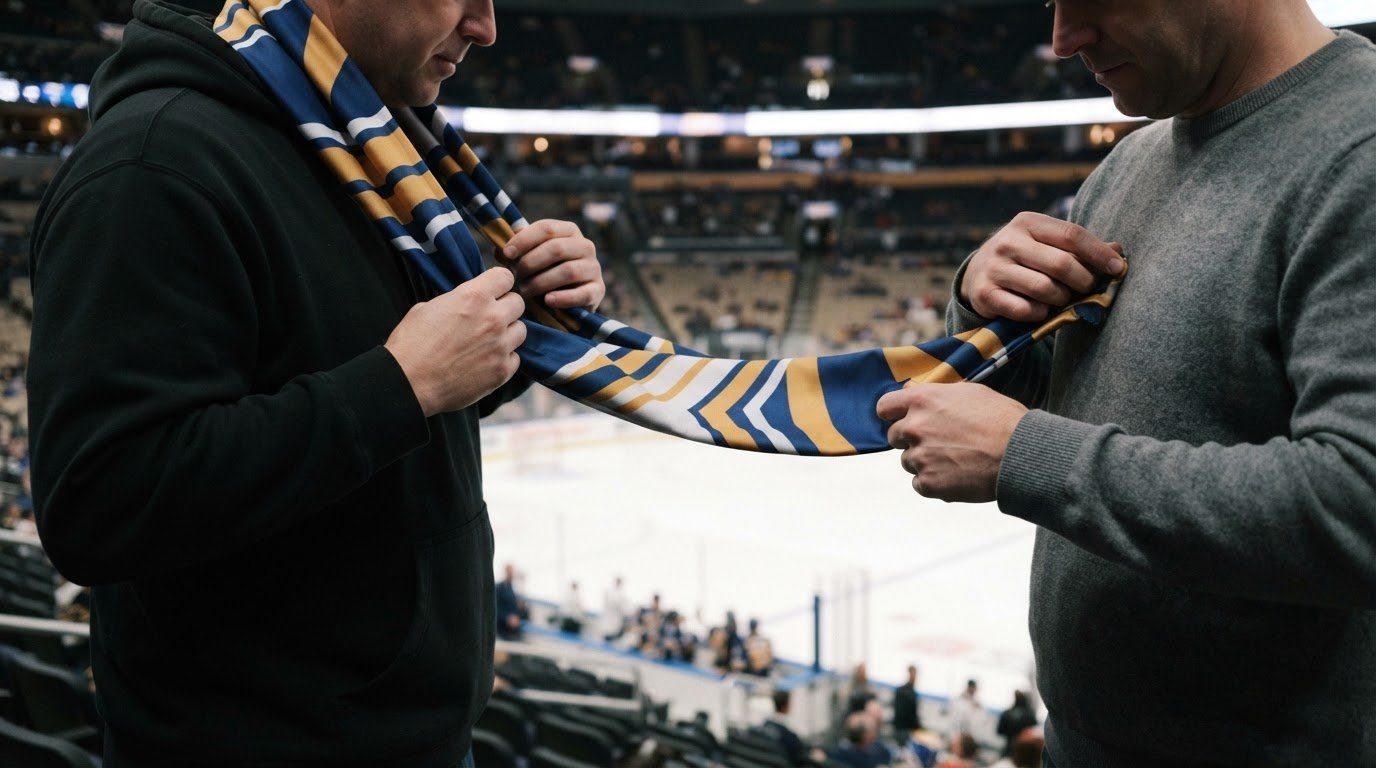
A coordinated scarf giveaway can turn the stands into a visible show of team spirit. Custom hockey fan scarves measure 60×10 and use dye sublimation printing, giving you room to bring team artwork and colors together in one standout design.
Choose artwork that suits your team and game night, from bold graphics to supporter-focused designs. Rally Towels offers unlimited colors at no extra cost, a 25-piece minimum, and turnaround as fast as 1 day. Get a free quote based on your quantity and plans.
This guide covers artwork and scarf styles, plus practical ways hockey fan scarves can work as a giveaway. You’ll also learn what to consider when planning a custom design for your next game night.
Key Takeaways
- Plan artwork around clear team colors, readable lettering, and graphics that work across the scarf’s full design.
- Choose a scarf style and design direction that suit the audience, event, and way you plan to distribute the giveaway.
- Learn what professional scarf design can contribute to a coordinated game-night atmosphere.
- Understand how to look for licensing information and distinguish officially licensed merchandise from custom fan designs.
- Explore how custom scarves can fit into a wider stadium giveaway plan.
Custom scarf design and artwork
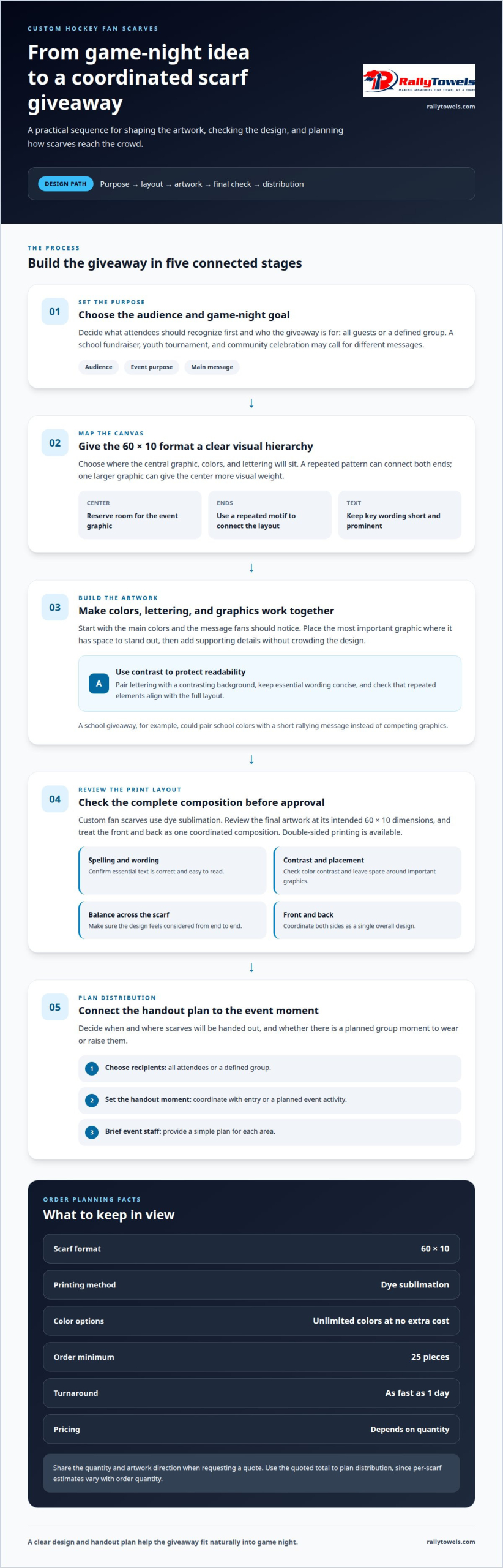
Artwork choices shape how a scarf stands out across a crowded rink. Start by matching the design, construction, and quantity to your giveaway plan. A clear direction helps the artwork feel connected to the event instead of crowded with competing graphics.
Knit and Printed Styles
Knit scarves form patterns through yarn and stitches, while printed scarves carry artwork on the fabric. That difference affects how you plan a design. A repeating motif may suit a stitch-based pattern, while layered graphics and detailed lettering work well in print. Rally Towels’ custom fan scarves use dye sublimation, so plan artwork for a printed finish.
Fan Scarf Product Styles
The custom fan scarf format measures 60×10. Use that canvas to plan the layout: reserve a central area for an event graphic, then balance it with colors and lettering. A repeated pattern can connect both ends, while one large graphic gives the center more visual weight. Keep key text readable at a glance.
Build the artwork in deliberate steps. First, choose the main colors and the message fans should notice. Next, place the most important graphic where it has room to stand out. Then add supporting details, such as a season reference or game-night phrase, without crowding the design. For example, a school giveaway could pair school colors with a short rallying message instead of competing graphics.
- Use high-contrast colors for lettering and background areas.
- Keep essential wording short and prominent.
- Check that repeated elements align with the overall layout.
Dye sublimation is the printing method for these custom scarves. It allows artwork to use unlimited colors at no extra cost, so your design can include a full palette. Plan the front and back as one coordinated composition, with double-sided printing available. Leave enough space around important logos or graphics to keep them clear and legible.
Pricing depends on quantity, making order size the key budget input. Share the quantity and artwork direction when requesting a quote, then use the quoted total to plan distribution. Per-scarf estimates vary with order quantity, so compare budgets using the same quantity. Retail listings may describe different products and order conditions.
Before submitting artwork, review the final layout at its intended 60×10 dimensions. Check spelling, color contrast, and graphic placement. Confirm that the main design remains balanced from end to end. A clean, readable composition gives fans a scarf they can wave at the rink and keep as a reminder of game night.
Hockey fan scarves
At a hockey game, scarves can help fans show shared support and make a giveaway feel tied to the event. Their value depends on how well they suit the audience and game-night plan. A school fundraiser, youth tournament, and community celebration each call for a different message. Start with the event’s purpose, then decide what attendees should recognize first.
Hockey fan scarves can serve different roles at the same event. Some attendees may wear them, others may raise them during a group moment, and some may keep them afterward. A design featuring the event name can work as a keepsake, while a bold, simple graphic may be easier to spot in the stands. Decide the purpose before settling the layout.
Distribution affects whether scarves become part of the crowd’s shared look. Organizers can coordinate handouts with ticket entry, seating sections, or a planned announcement. Sorting bundles by section, for example, can help event staff distribute them efficiently. A clear handout plan also prevents confusion about who receives a scarf and when.
- Set the audience: Decide whether the giveaway is for all attendees or a defined group.
- Choose the moment: Coordinate handout timing with entry or a planned event activity.
- Keep instructions clear: Give staff a simple distribution plan for each area.
- Match the message: Connect the artwork to the purpose of the game night.
Consider the event’s visual setting, too. If the rink presentation already features signs, banners, or a themed backdrop, the scarf can complement those elements without copying every detail. A consistent color approach makes the giveaway feel intentional. Keep the central message distinct so it remains recognizable among other event visuals.
Well-planned hockey fan scarves can also help establish a recurring event identity. A tournament committee might carry one design element forward each year while updating the wording for each edition. This creates continuity without making every giveaway identical. Keep lasting visual features separate from details that change, such as the event title or season reference.
Before approving a giveaway plan, consider how distribution, artwork, and audience work together. A scarf handed to a selected student section serves a different purpose from one offered to every guest. Clear decisions help organizers coordinate staff and explain the giveaway. With the event goal defined, hockey fan scarves can become a visible part of game night.
A past example places scarf-waving within a specific game setting: Fans waved scarves at an ice hockey game at British Columbia Stadium in Vancouver on April 20, 2004. Organizers can use that kind of shared visual moment as a planning reference, while tailoring their own giveaway to the audience and event purpose. The design and distribution plan should make it easy for attendees to understand when scarves are meant to be worn or raised.
Before game night, make sure staff know where scarves will be handed out and whether a group moment is planned. Keep the design legible in the rink and ensure recurring visual features support, rather than obscure, the event message. These choices help the giveaway fit naturally into the gathering.
Professional hockey scarves
A professional-looking scarf starts with a consistent visual system. Select the team’s primary and supporting colors, along with the lettering style, before arranging the artwork. A school, for example, can use its established colors and one concise rallying phrase. Repeating those choices makes the scarf feel cohesive rather than assembled from unrelated graphics.
Plan the artwork for how fans will see it in a US arena. A scarf raised above the crowd is viewed from a distance, so large shapes and strong contrast matter. Keep small details secondary. A bold central emblem paired with readable lettering can communicate clearly, while tiny marks may disappear in the stands.
A balanced layout also gives a scarf a professional look. Give the main graphic room, then use the ends for supporting details such as a school name or event phrase. Keep lettering aligned and avoid squeezing long wording into a narrow area. A simple “Senior Night” design can give the occasion a clear identity without crowding the artwork.
Before production, review the artwork as a complete composition. Check spelling, color contrast, graphic placement, and whether both ends look intentional. If the design includes a year, confirm that it matches the event. A final review can catch avoidable errors before scarves are distributed.
- Define the identity: Set the color palette and lettering approach.
- Prioritize visibility: Make the main graphic clear at a distance.
- Balance the layout: Use supporting details without crowding the design.
- Proof the final art: Review names, dates, and placement before approval.
Scarf construction also influences the visual result. Knit designs build patterns through stitches, while printed designs place artwork on the fabric. Choose the method that suits the artwork’s detail and style. A repeating geometric motif may work well as a knit pattern, while layered graphics are better suited to printing.
Consider how the scarf fits the event’s overall presentation. Echoing the colors used on arena signs can create a coordinated look. At a youth tournament in the United States, for example, a clear event name can distinguish the keepsake from general fan merchandise.
Professional hockey scarves can represent a team, school, or special event without complicated artwork. At a local US tournament, fans might raise scarves in matching colors during a team introduction. For your event, define the audience and purpose first, then keep the design focused on that identity.
How can I tell if a hockey scarf is officially licensed?
Start by distinguishing licensed merchandise from custom fan designs. “Officially licensed” indicates that a product is presented as authorized by the rights holder. A scarf’s colors or hockey imagery alone don’t establish that status. Generic stripes, for example, can show support without claiming an affiliation with a specific club.
Inspect the product label, packaging, and description for a clear licensing statement. Look for the named rights holder and consistent product details instead of relying on a familiar color scheme. A label that says “official” without naming the rights holder provides less context than one that identifies the organization behind the license.
Use these checks when reviewing a scarf listing or its physical packaging:
- Read the label: Find a direct statement that the scarf is officially licensed.
- Identify the rights holder: Note which organization the licensing statement names.
- Compare product details: Check that the label and listing describe the same scarf.
- Separate design from status: Team colors or hockey graphics don’t prove licensing.
Artwork and licensing are separate questions. A custom design can use original colors, phrases, and graphics without presenting itself as official merchandise. A scarf displaying a specific club’s protected identity, by contrast, should not be assumed to be licensed based only on visual similarity. For a school giveaway, original artwork built around school colors and an event phrase keeps the design distinct.
Be careful with phrases such as “inspired by” or “fan style.” They describe a look, not necessarily a licensing status. Likewise, a polished design, woven appearance, or professional presentation doesn’t establish authorization. Evaluate the licensing statement itself, not the scarf’s quality or resemblance to merchandise seen at a game.
For a giveaway, decide whether official merchandise or a custom event keepsake is the goal. If official status is essential, make that requirement explicit in the purchasing documentation and retain the product description and packaging details. If you want a custom fan giveaway, focus on original artwork and avoid presenting it as officially affiliated.
A clear review process helps prevent confusion. Record the exact product name, stated rights holder, and licensing language before distributing scarves. A game-night organizer, for example, can keep packaging information with the event records. This makes it easier to distinguish licensed merchandise from custom fan designs later.
A scarf can be visible in a hockey setting without that appearance confirming its licensing status. A fan waved her scarf during the first period of a game in Raleigh on October 31, 2024. Slovakian hockey fans were photographed with a scarf during a preliminary-round game at the 2006 Winter Olympics. A supporter’s scarf was featured at the London 2012 Olympic Games.
A Russian fan waved a scarf during a U18 international ice hockey championship semifinal in Sochi on April 26, 2013. These examples show scarves in use at sporting events, but the event or fan context alone does not identify a scarf’s rights holder. Whether a scarf is personalized or seen at a game, check its own licensing statement and named rights holder before describing it as officially licensed.
Scarves perfect
The right giveaway scarf fits the event, audience, and moment of distribution. Start with one decision: should fans wear it, wave it, or keep it as a memento? A school tournament may call for school colors and an event name, while a themed game night may center on a shared cause.
Match the design to the audience’s connection with the event. Students may recognize a school phrase, while families may value a clear tournament title. For a returning annual event, consistent colors can help connect this year’s giveaway with earlier editions. Keep each design focused on one main identity, rather than combining unrelated messages.
Timing shapes how a scarf contributes to the game-night atmosphere. Handing scarves out before a planned opening moment gives attendees time to display them together. A distribution table near the entrance can make pickup straightforward. If the giveaway is tied to a specific period or announcement, coordinate handouts with the event schedule.
- For a school game: Feature school identity and a short rally phrase.
- For a themed night: Make the cause or event name easy to recognize.
- For an annual tournament: Carry a consistent visual element across editions.
- For a coordinated moment: Distribute scarves before the planned activity.
A game-night promotion shows how a scarf can carry an event theme. On November 18, 2017, fans received scarves before a game as part of a themed promotion. The example links a giveaway to a defined occasion. For your event, decide whether the scarf should represent the team, the game, or a broader community message.
Set the giveaway quantity according to the distribution plan. Estimate how many attendees the promotion is intended to reach, then decide whether scarves go to every guest or a specific group. A student-section giveaway, for example, reaches a different audience than a tournament-wide handout. A clear plan keeps ordering, pickup, and event messaging aligned.
Review the finished concept against the event details before approving it. Confirm the event name, school identity, and any date in the artwork. If the scarf is meant for one game night, avoid wording that suggests another event. A final proof can catch mismatched details before production begins.
Use these decisions to shape a giveaway that feels connected to the night, not like a generic handout. Plan a scarf giveaway for your next game night.
Rally Towels: Custom fan scarves 60×10, dye sublimated
Rally Towels helps teams plan custom scarves for promotional and stadium giveaways. Its custom fan scarves measure 60×10 and are printed with dye sublimation. Use the format to bring team colors, event artwork, and a clear game-night message together.
Share your artwork, quantity, and event plans to get a quote tailored to your order. For another giveaway format, custom rally towels are also available in screen-printed and full-color dye-sublimated options.
Contact Rally Towels to discuss scarves for your next game-night giveaway.
Turn Your Game-Night Idea Into a Giveaway Plan
Give your scarf design a clear purpose: bring fans together, mark a special game, or create a keepsake tied to the event. Choose the audience and the moment when you want the scarves to appear, then let those decisions guide the artwork. A focused concept helps your hockey fan scarves feel connected to the night rather than like a generic handout.
Rally Towels supports promotional and stadium giveaways, with custom rally towels available in screen-printed and full-color dye-sublimated options. Event organizers can consider them as another format for a coordinated fan experience. Keep the purpose clear, align the design with your event, and plan distribution around the moment you want fans to show their support.
Ready to move from concept to artwork? Contact Rally Towels about your scarves and share what you have in mind. A clear starting point can help shape a giveaway that brings your game night to life.
Frequently Asked Questions
What types of hockey fan scarves are available?
Knit and printed scarves are common options, and Rally Towels offers custom fan scarves printed using dye sublimation. This method suits artwork with multiple colors, event wording, or detailed graphics. For a school tournament, for example, the design could pair a school identity with the event title. Choose the construction based on the artwork and the look you want for the giveaway.
How much do hockey fan scarves typically cost?
Custom scarf pricing depends on the quantity ordered, so there’s no single typical price for every giveaway. A quote gives you a project-specific total. To make a useful request, provide the planned quantity and describe the artwork or event concept. Then you can assess the scarf cost against your giveaway budget. Retail listings may reflect different products and order conditions, so they aren’t a reliable estimate for a custom order.
How do I choose a hockey scarf as a gift?
Choose a scarf that suits the recipient and occasion. A clear event message, team colors, and a bold graphic can make it a fitting keepsake or something fans can wave during a game.
What materials are hockey fan scarves made from?
Knit scarves form patterns through yarn and stitches, while printed scarves carry artwork on the fabric. Rally Towels’ custom fan scarves use dye sublimation printing.