
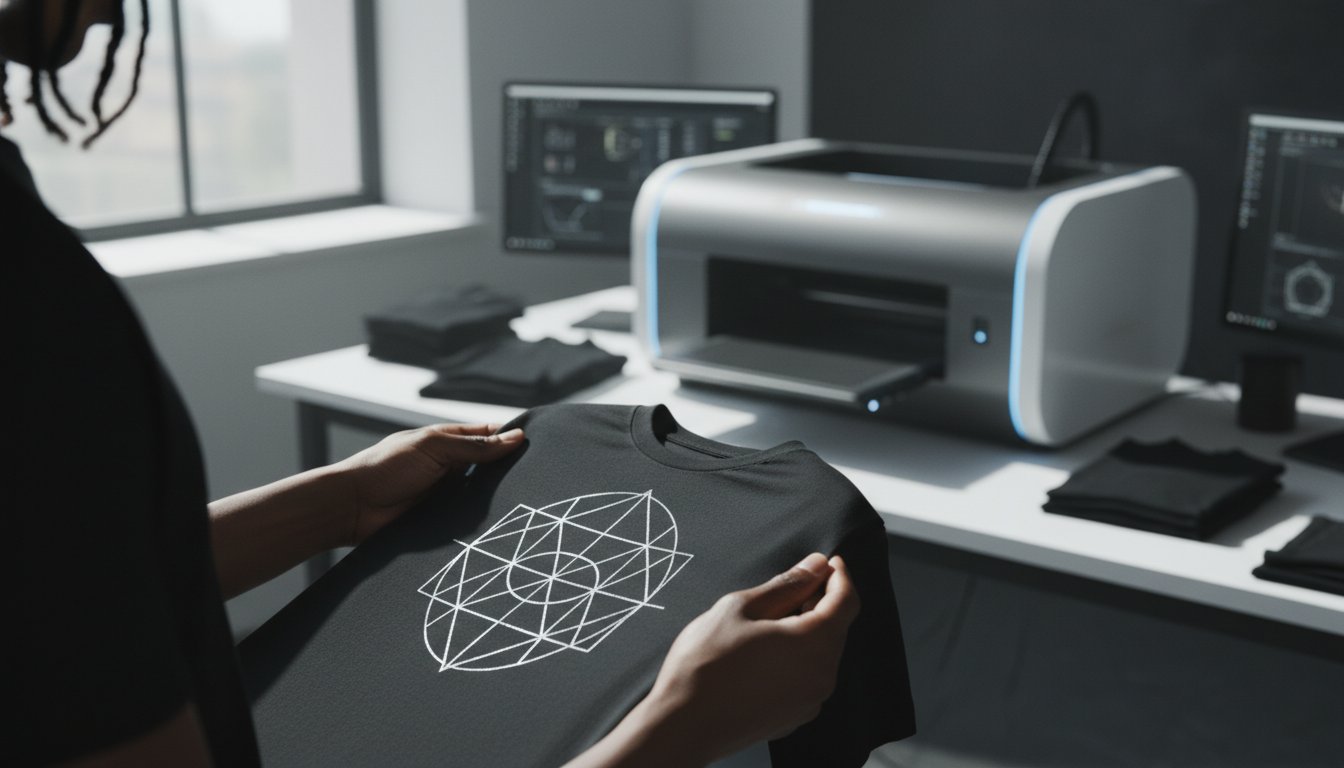
What if the reason your brand looks amateur isn’t the design itself, but a printing method that’s literally swallowing your fine lines? You’ve likely felt the frustration of seeing your intricate, high-definition artwork turn into a bleeding, cracked disaster once it hits the fabric. It’s exhausting to pay high setup costs only to receive a product that doesn’t represent your high standards. Finding the best t-shirt printing for detailed logos is the difference between a retail-quality masterpiece and a blurry mess that fades after three washes.
Stop settling for subpar results. This guide promises to show you exactly how to capture every fine line and secure high-definition results for your brand. We’ll explore the latest 2026 advancements in Direct-to-Garment and Direct-to-Film technologies that are currently driving the market toward a projected $20 billion valuation. Get ready for expert guidance on choosing durable methods that won’t crack or fade. We’ll help you ensure your bulk promotional orders always look elite, professional, and sharp. Discover the precision your brand deserves today.
Key Takeaways
- Learn why Direct-to-Garment (DTG) technology serves as the ultimate high-definition inkjet for your apparel to preserve every pixel of your design.
- Discover why 100% ringspun cotton is the essential canvas for intricate branding and how to avoid the fuzziness found in other fabrics.
- Master the technical side of the best t-shirt printing for detailed logos by applying the 2026 Minimum Line Weight rule to your vector files.
- Identify the specific design elements, like serif fonts and thin borders, that are most likely to bleed and learn the professional secrets to keep them crisp.
- Understand how to scale your brand from small batches to massive stadium giveaways while maintaining retail-quality precision across every unit.
The Challenge of Fine Lines: Why Some T-Shirt Printing Fails Detailed Logos
Your logo is your brand’s handshake. If it’s blurry or distorted, you’re sending a weak signal to your audience. Traditional printing often suffers from the “bleeding” effect. This happens when ink spreads into fabric fibers during the liquid phase, turning sharp edges into fuzzy shadows. It’s a frustrating hurdle for anyone seeking the best t-shirt printing for detailed logos. You need precision that stays exactly where it’s placed, especially as designs become more complex.
To better understand how modern technology is solving these clarity issues, watch this helpful video breakdown:

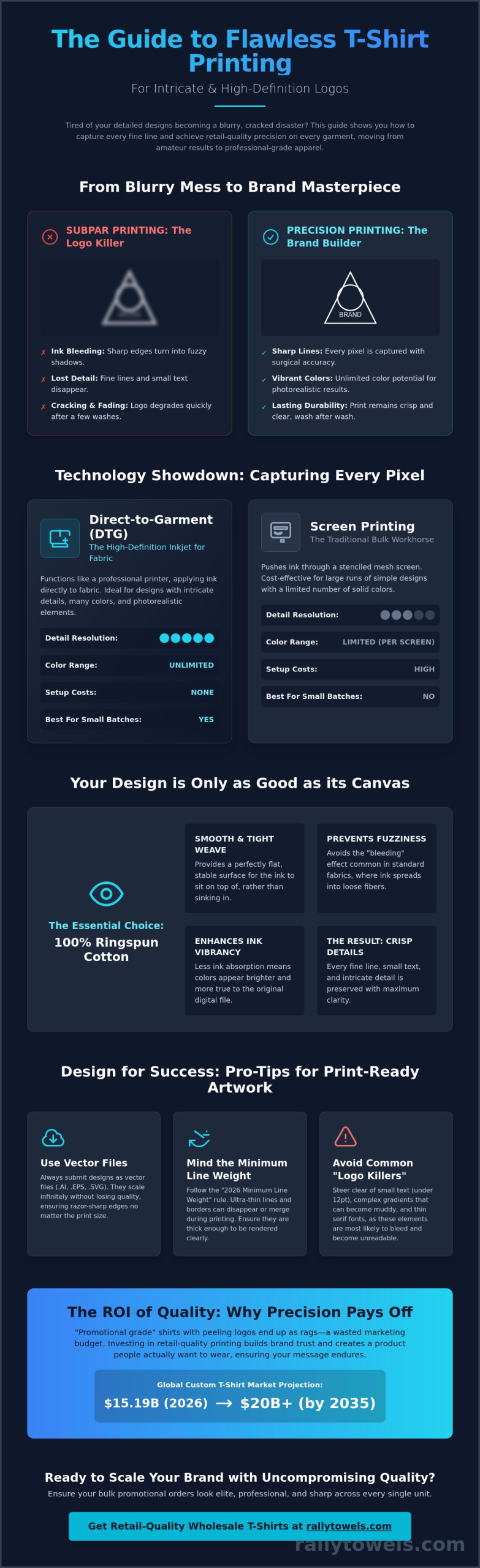
The rules of the game have changed significantly in 2026. With the global custom t-shirt market projected to hit $20 billion by 2035, the demand for high-standard manufacturing is skyrocketing. New regulations in the EU and California are also forcing a shift toward more stable, high-quality inks. These advancements allow for high-definition results that weren’t possible a decade ago. Achieving this level of detail often requires Direct-to-Garment (DTG) printing, which functions like a professional inkjet printer for fabric, capturing every pixel with surgical accuracy.
Common ‘Logo Killers’ in Apparel Printing
Some design choices are doomed from the start if you don’t pick the right printing partner. Heavy cotton fabrics can swallow small details if the ink isn’t managed correctly. Look out for these specific elements that often fail during the production process:
- Small text: Anything under 12pt font often disappears or becomes unreadable in heavy fabric weaves.
- Complex gradients: These can turn into muddy, solid blocks of color if the printer lacks high-resolution capabilities.
- Intricate line art: Very thin borders or serif fonts can merge during the heat-curing process, ruining the logo’s geometry.
The Cost of Low-Resolution Branding
Think about the last time you received a promotional shirt with a peeling, cracked, or blurry logo. You probably used it as a rag or threw it away. That’s a wasted marketing budget. Blurry branding isn’t just an aesthetic problem; it’s a direct hit to your reputation. There’s a massive gap between “promotional grade” and “retail grade” results. Fortune 500 companies and professional sports leagues don’t compromise on this. They demand custom wholesale t-shirts that maintain crisp lines across thousands of units. When you prioritize the best t-shirt printing for detailed logos, you’re investing in a product people actually want to wear. Retail-quality reproduction builds trust and tells the world that your brand cares about every single detail.
DTG vs. Screen Printing: Which Method Captures Every Pixel?
Choosing between Direct-to-Garment (DTG) and Screen Printing isn’t just about price. It’s about resolution. In textile printing, we measure clarity in dots per inch (DPI), much like a digital photograph. If your logo has razor-thin lines or complex color transitions, the method you choose determines whether those details pop or disappear. You need a partner that understands the technical “DPI” equivalent of fabric to deliver the best t-shirt printing for detailed logos. Don’t let a low-resolution process ruin your high-standard branding.
The global print-on-demand market is exploding, hitting $15.19 billion in 2026. This growth is driven by machines that can now replicate every single pixel of a digital file. Whether you’re ordering a small batch for a tech startup or thousands of custom wholesale t-shirts for a stadium event, the tech matters. Modern 2026 equipment ensures that even the most microscopic design elements remain sharp after 50 washes. Quality isn’t an accident; it’s a result of choosing the right tech for the job.
Direct-to-Garment: The King of Intricacy
DTG is essentially a high-end inkjet printer for your clothes. It sprays specialized aqueous inks directly into the fibers, allowing for unlimited color combinations and photographic precision. This method excels at capturing “micro-details” that traditional screens might miss. Direct-to-Garment serves as the primary choice for any logo requiring smooth gradients, intricate shading, or photorealistic textures. It’s the go-to solution for small runs where every pixel counts. If your brand relies on a complex, multi-colored mascot or fine-line illustrative art, DTG is your definitive answer.
Screen Printing: When Volume Meets Detail
Don’t dismiss screen printing as “old school.” For bulk orders of 100 units or more, it remains a powerhouse of efficiency and durability. The secret to detail in screen printing lies in the mesh count. While standard prints use lower mesh, high-mesh screens (230 to 305 threads per inch) can capture surprisingly fine lines and sharp text. It’s incredibly cost-effective for high-volume distribution without sacrificing the integrity of your logo. This is why major sports leagues still rely on high-mesh screen printing for their massive promotional campaigns. It delivers a bold, saturated look that stands the test of time. Reach out to our experts to find the best t-shirt printing for detailed logos at a scale that fits your massive event needs.
Durability is the final piece of the puzzle. In 2026, advancements in curing technology mean that both DTG and high-mesh screen prints are built to last. Your detailed logo won’t crack or peel after a few cycles in the laundry. We use high-standard manufacturing processes to ensure that the “retail grade” finish you see on day one is exactly what your customers see a year later. Demand excellence for your brand. Choose a method that captures every pixel and a partner that delivers results with speed and confidence.
Beyond the Ink: How Fabric Choice Impacts Logo Clarity
Even the most advanced printer can’t fix a bad canvas. If you want the best t-shirt printing for detailed logos, you must start with the right fabric. Think of 100% ringspun cotton as your high-definition screen. It’s smooth. It’s consistent. It’s the only way to ensure your intricate designs don’t get lost in the weave. Don’t let a cheap, rough fabric swallow your brand’s fine details. Your logo deserves a surface that showcases every line with surgical precision.
Fabric weight, measured in GSM (Grams per Square Meter), also plays a massive role in print stability. A flimsy, lightweight shirt shifts during the printing process. This leads to registration errors where colors don’t align perfectly. Heavier fabrics provide a stable base for complex, multi-layered ink applications. If you’re looking for retail-quality results, prioritize stability and smoothness over everything else. Demand excellence from your materials. GET THE RESULTS YOU DESERVE by matching your high-detail art with a high-standard fabric.
The Best Shirt Materials for High-Detail Logos
Ringspun cotton is the elite choice for branding. The manufacturing process combs out impurities and aligns the fibers to create a flat, superior surface. This is essential for Direct-to-Garment (DTG) precision. Tri-blends are popular for their soft feel, but their varied texture can make fine lines look “distressed” or broken. While this works for vintage styles, it’s a disaster for sharp, corporate branding. If you need a stable, flat printing surface, choose a mid-to-heavyweight cotton. It provides the density required to keep ink from spreading too far into the fibers.
Surface Texture and the ‘Hill and Valley’ Problem
Texture is the enemy of detail. Piqué or ribbed fabrics create a “hill and valley” effect across the surface. When ink hits these fabrics, it settles into the lower grooves, which physically breaks the visual continuity of your design. This distortion makes small text unreadable and ruins thin borders. Always select a tight, fine weave to prevent ink from sinking too deep into the garment. This is why choosing the right custom wholesale t-shirts is vital for your brand’s image. A smooth surface ensures every pixel of your branding remains sharp, professional, and bold. Don’t settle for “good enough” when you can have retail-grade perfection. Pick a tight weave and watch your logo pop like never before.
Pro Tips for Designing Apparel with Intricate Branding
Precision starts on your screen, not on the press. Even the best t-shirt printing for detailed logos can’t save a poorly prepared file. You need to provide a foundation that allows modern 2026 technology to shine. High-standard manufacturing requires high-standard assets. If you want your brand to look elite, you must treat your design phase with the same urgency as your production phase. Don’t gamble with your image by sending low-resolution files and hoping for the best.
Vector files are the undisputed gold standard for apparel design. Unlike raster images, which are made of pixels, vector art uses mathematical paths. This means you can scale your logo from a tiny chest hit to a massive stadium giveaway without losing a single ounce of clarity. If you’re serious about capturing every fine line, work in Adobe Illustrator or similar professional software. Demand vector formats like .AI, .EPS, or .SVG from your design team to ensure your branding remains sharp across every medium.
The 2026 minimum line weight rule is a vital technical standard you cannot ignore. For high-definition DTG and high-mesh screen printing, keep your thinnest lines at 0.5 points or thicker. Anything thinner risks disappearing into the fabric weave or “closing up” during the ink curing process. You also need to prioritize color contrast. A dark navy logo on a black shirt might look sleek on your monitor, but it will vanish in real-world lighting. Choose high-contrast pairings to make your branding pop and command attention from across the room.
Optimizing Your Logo for Textile Printing
rendering errors are a common pitfall that can ruin a bulk order. Always convert your fonts to outlines. This locks the typography into a shape, so the printer doesn’t need to have your specific brand font installed. For color accuracy that spans thousands of units, use Pantone matching. It’s the only way to ensure your brand’s specific “red” is the same on a t-shirt as it is on your website. 300 DPI is the absolute minimum for raster-based logo files to prevent pixelation and maintain professional-grade sharpness.
Avoiding the ‘Muddy’ Look
Negative space is your best friend when designing for fabric. Small, intricate logos need room to breathe so the ink doesn’t bleed together. If your design is too crowded, it will look like a solid block of color from a distance. Remember that “less is more” for small chest hits. If your logo is complex, consider a simplified “icon-only” version for smaller prints. You can find similar logic applied to other promotional items in our guide to Towel Printing: A Complete Guide to Customization Methods. Ready to see your vision come to life? Request a quote for your high-detail project today and let our experts handle the precision for you.
Scale Your Brand with Precision: Wholesale Custom T-Shirts from Rally Towels
Your brand deserves more than just a print. It deserves a legacy of precision. When you’re searching for the best t-shirt printing for detailed logos, you aren’t just looking for ink on fabric. You’re looking for a partner that understands the high-stakes environment of professional branding. Rally Towels is that partner. We’ve built our reputation by delivering high-definition results for the biggest names in sports and business. Don’t settle for anything less than elite quality for your next big event. SECURE YOUR BRAND INTEGRITY TODAY.
We’ve mastered the art of high-standard manufacturing at an incredible scale. Whether you need thousands of promotional giveaways or high-impact stadium giveaways, our production lines are optimized for speed and accuracy. You don’t have to choose between volume and detail anymore. Our 2026 facility uses the latest technology to ensure every shirt in your order looks as sharp as the first one off the press. It’s time to streamline your supply chain. Source your custom shirts, beach towels, and cooling towels from one definitive expert to ensure color consistency across your entire marketing arsenal.
The Rally Towels Difference in 2026
Experience is our greatest asset. We’ve spent years managing the branding requirements for the NFL, NBA, and Fortune 500 giants. These leagues demand absolute perfection because their logos are seen by millions of fans. We bring that same level of scrutiny to your business, regardless of your industry. Our focus on bulk distribution efficiency means your order arrives on time and exactly on brand. You can see how we handle spirit branding on our custom rally towels page. We apply those same elite standards to every t-shirt we produce for our clients. Trust the experts who handle the world’s most valuable logos.
Ready to Print? Get Your High-Detail Quote
Stop waiting for “good enough” results from amateur shops that can’t handle intricate art. Secure your brand’s future with USA-based manufacturing that prioritizes your specific vision. We offer fast turnaround times without compromising on the best t-shirt printing for detailed logos. Our team is ready to handle your most complex artwork and largest volume needs with total confidence. Take action now. Elevate your promotional strategy with retail-quality apparel that your customers will actually want to wear. Our commitment to excellence ensures that your investment translates into long-term brand loyalty. DOMINATE YOUR MARKET WITH PRECISION.
GET AN INSTANT QUOTE FOR YOUR DETAILED LOGO TEES
Dominate Your Market with High-Definition Branding
Precision isn’t just a goal; it’s a requirement for elite brands. You’ve learned that capturing every fine line requires a combination of high-mesh screen printing or DTG technology and a smooth, stable canvas like ringspun cotton. Don’t let your branding get lost in a blurry, low-quality print. By prioritizing vector-based designs and 2026 minimum line weight standards, you ensure your logo remains sharp across every unit in your bulk order. Securing the best t-shirt printing for detailed logos is about choosing a partner that refuses to compromise on quality.
Rally Towels is the definitive choice for high-volume, high-detail promotional products. We’re trusted by the NFL, NBA, and Fortune 500 companies to deliver retail-quality results every single time. Our USA-made manufacturing process is built for speed and absolute accuracy. It’s time to stop settling for subpar apparel and start demanding the precision your brand deserves. Take the first step toward a professional, high-standard image today. Our experts are ready to handle your most intricate designs with total confidence.
GET AN INSTANT QUOTE FOR YOUR DETAILED LOGO TEES
Frequently Asked Questions
What is the best printing method for a logo with many colors and small details?
Direct-to-Garment (DTG) is the premier choice for logos featuring complex color palettes and microscopic details. It works exactly like a professional inkjet printer, allowing for thousands of colors and intricate gradients without the heavy setup costs of screens. For anyone seeking the best t-shirt printing for detailed logos, DTG provides the surgical precision required to keep your branding sharp and professional.
Can I print a photo-realistic logo on a t-shirt?
You can absolutely print photo-realistic logos using modern DTG or Direct-to-Film (DTF) technology. These methods capture high-resolution imagery by injecting specialized inks directly into the fabric fibers or onto a high-definition film. This ensures your photographic elements look crisp and retail-ready rather than muddy or pixelated. It is the standard for 2026 high-standard manufacturing.
Does screen printing work for small, intricate text?
Screen printing works for small text only if you utilize high-mesh screens, specifically those with 230 to 305 threads per inch. While traditional screen printing is better for bold designs, these high-count meshes can capture surprisingly fine lines. However, for extremely tiny text under 12pt, we often recommend DTG to ensure total legibility and prevent the ink from closing up during curing.
What file format do I need for high-detail t-shirt printing?
Vector files like .AI, .EPS, or .SVG are the gold standard because they allow for infinite scaling without losing a single pixel of clarity. If you’re using a raster-based file like a .PNG, it must be at least 300 DPI at the final print size. Providing the right format is the first step to ensuring your detailed logo doesn’t look amateur or blurry on the final product.
How do I prevent my detailed logo from cracking after washing?
Prevent cracking by choosing a partner that uses high-standard curing processes and premium, flexible inks. Cracking usually happens when ink is under-cured or applied too thickly on a low-quality fabric. Always wash your custom apparel inside out in cold water and avoid high-heat drying to maintain the integrity of those fine lines for 50 washes or more.
Is DTG printing more expensive than screen printing for detailed logos?
DTG is generally more affordable for small runs with complex art, while screen printing becomes the cost-effective leader for bulk orders. For massive stadium giveaways or large promotional campaigns, high-mesh screen printing offers the best t-shirt printing for detailed logos at a much lower price per unit. We help you choose the most efficient method based on your specific volume and design needs.
What is the smallest font size that can be clearly printed on a shirt?
The smallest reliable font size is typically 12pt, provided you maintain a minimum line weight of 0.5 points. Anything smaller risks disappearing into the fabric weave or bleeding together during the production process. If your logo includes fine print, ensure you use high-contrast colors to help the text stand out against the shirt fabric.
Does the color of the t-shirt affect the clarity of the logo?
T-shirt color definitely impacts clarity because dark garments require a white “underbase” layer of ink to make colors pop. This extra layer can sometimes make very fine lines appear slightly thicker than they would on a white shirt. Our experts calibrate every press to account for these fabric variables, ensuring your high-detail branding remains sharp on any background you choose.