Your high-resolution logo is only as good as the chemical bond between the ink and the fabric. If you’ve ever opened a wholesale order to find your intricate design looks like a blurry smudge, you know the frustration of wasted marketing dollars. Finding the best printing method for detailed logos on towels and shirts is the only way to ensure small text stays readable after 50 washes. Most printers treat your brand like a generic sticker application, but precision apparel is actually a chemistry problem. You need the exact match between ink viscosity and mesh tension to protect your brand identity. No order is too large for a firm that understands these technical demands.
You want retail-quality results that mirror your vision perfectly. It’s time to stop settling for colors that miss your Pantone requirements or prints that crack. This 2026 guide reveals how to preserve every fine line and gradient in your complex logo for professional results. We’ll explore why hybrid printing is revolutionizing the industry with 300 DPI resolution and how Direct-to-Film (DTF) keeps costs between $1.05 and $1.95 per piece for full-color designs. Discover how to choose a reliable wholesale partner and get the high-impact results your event deserves right now.
Key Takeaways
- Understand the science behind the “bleeding effect” and how to choose surface-curing methods that prevent fine lines from blurring into fabric fibers.
- Compare the performance of DTG, DTF, and sublimation to identify the best printing method for detailed logos on towels and high-precision apparel.
- Learn which advanced techniques preserve 6pt font legibility and hairline strokes for over 50 industrial wash cycles without cracking.
- Master the design requirements for professional-grade results, including why vector files and simplified palettes are non-negotiable for detail retention.
- Discover how to maintain retail-quality standards at scale by partnering with a firm trusted by the NBA, NFL, and Fortune 500 companies.
Why Detailed Logos Often Fail on Standard T-Shirts
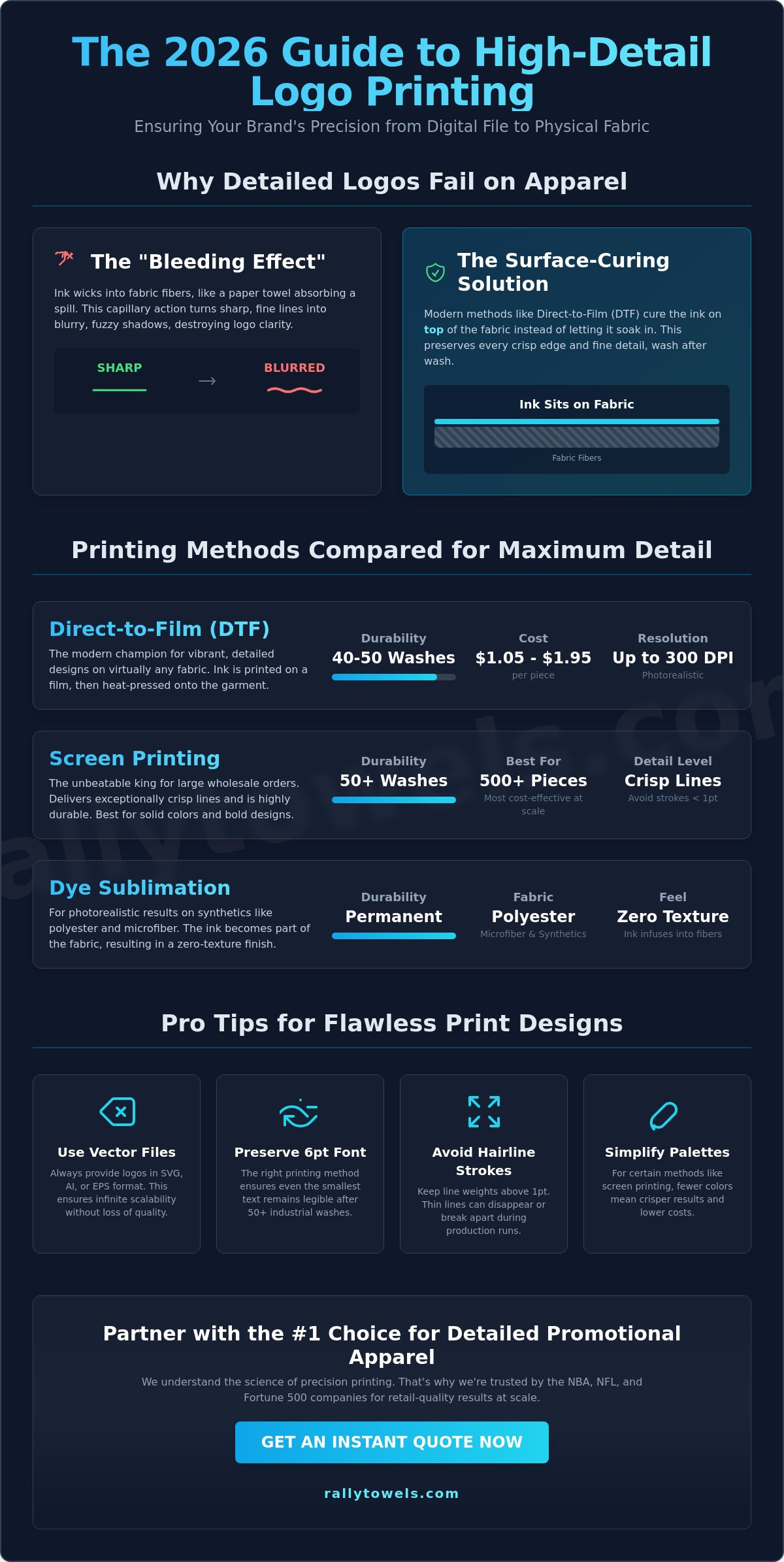
Precision printing is a high-stakes battle between ink and fiber. Most promotional orders fail because the buyer ignores the “bleeding effect,” where ink wicks into fabric like a paper towel absorbing a spill. This capillary action turns sharp hairlines into fuzzy shadows. When you are looking for the best printing method for detailed logos on towels or apparel, you must understand the difference between ink absorption and surface curing. Absorption is great for a soft feel, but it’s the enemy of crisp edges. Surface-curing methods like Direct-to-Film (DTF) sit on top of the fabric, ensuring your logo stays sharp through 40 to 50 washes.
To better understand this concept, watch this helpful video:

Color muddying is another silent killer for complex designs. Without professional halftone management, your expensive gradients turn into flat, solid blocks of ink. This is especially true on dark garments that require under-basing. Under-basing adds a layer of white ink beneath your colors to make them pop, but it also adds thickness. If your printer isn’t precise, that extra layer can choke out fine details and make your text unreadable. The evolution of printmaking techniques has provided solutions, but you need an expert to execute them correctly. Order with confidence by choosing a partner that understands these technical hurdles.
The Problem with Low-Resolution Printing
Dots Per Inch (DPI) measures the density of ink droplets. While a 300 DPI digital file is the industry standard for custom wholesale t-shirts, it doesn’t guarantee a 300 DPI physical result. Physical factors like garment texture and machine calibration often degrade the final image. Dot gain is the expansion of ink droplets during curing. This expansion can increase the size of your printed dots by 10% to 30%, effectively closing up small gaps in your logo and ruining the clarity of your brand identity.
Common Mistakes in Detailed Logo Design
Designers often create logos that look great on a 27-inch monitor but fail on a small left-chest placement. Using thin strokes below 1pt is a recipe for disaster in screen printing. These hairlines often disappear or break apart during the production run. Over-complicating small-scale prints leads to a “heavy” hand, where the thick layer of ink feels like a plastic shield. This weight can distort the fabric and the fine details of your logo. When selecting the best printing method for detailed logos on towels, you must consider the weave of the fabric to avoid these pitfalls. Simplify your palette and stick to bold, clear lines to ensure your promotional giveaway looks premium. Get an INSTANT Quote NOW to see how we handle your most complex designs!
Top Methods for High-Detail T-Shirt Printing in 2026
Technology has moved past basic ink applications. In 2026, precision is the standard, not a luxury. If you’re searching for the best printing method for detailed logos on towels or shirts, you have four heavy hitters to consider. Direct-to-Garment (DTG) and Direct-to-Film (DTF) dominate small to medium runs. For massive wholesale orders, high-mesh screen printing remains the unbeatable king of crisp lines. When you need photorealistic results on microfiber or polyester, dye sublimation is the only choice that infuses ink directly into the fibers for a zero-texture finish. We handle these complex requirements every day for the NBA and Fortune 500 companies because we know exactly how to match the method to your logo’s complexity.
Choosing the right tech isn’t just about the look; it’s about the math. Research from Khmelnitskyi National University on evaluating print quality shows that durability varies wildly between these methods. DTF transfers are now rated to last 40 to 50 washes, while screen prints often exceed 50 washes. For orders over 500 pieces, screen printing becomes 30% to 50% more cost-effective than digital alternatives. This makes it the logical choice for stadium giveaways where scale and budget must align without sacrificing your brand’s sharp edges.
Direct-to-Garment (DTG) for Photographic Detail
DTG functions like a high-end inkjet printer for your clothes. It achieves a staggering 1200 DPI resolution, which is essential for complex brand gradients and detailed portraits. It’s the perfect solution for small batches or multi-color logos that would be too expensive to set up for screen printing. However, it’s best suited for 100% cotton or high-cotton blends. If you’re printing on dark fabrics, the cost typically ranges from $15 to $30 per shirt due to the necessary pre-treatment and white under-base layers. It’s an investment in quality for premium retail lines.
High-Mesh Screen Printing for Crisp Vectors
Most competitors treat screen printing like a relic, but they’re missing the power of high-mesh counts. While standard shops use 110 to 160 mesh, we utilize 230 to 305 mesh screens to capture every hairline stroke in your vector art. This high-density mesh allows for simulated process printing, which recreates detailed artwork on dark shirts with incredible clarity. It’s the ultimate way to maintain detail at a massive scale. If you’re ready to see your vision on a grand scale, check out our custom options and see why we’re the industry leader. For those specifically focused on polyester gear, our dye sublimated towels offer the best printing method for detailed logos on towels by bonding the ink at a molecular level. Order Now to secure the best precision apparel for your next event!
Comparing Detail Retention: DTG vs. Screen Printing vs. DTF
Detail retention isn’t just a buzzword; it’s the difference between a legible 6pt font and an unreadable blob. Identifying the best printing method for detailed logos on towels or shirts requires looking past the digital file. DTG provides 1200 DPI resolution, but the ink often wicks into the fiber, which can soften the edges of hairline strokes. DTF solves this by curing the ink on a specialized film first. This ensures that every 1pt line stays exactly where you placed it. If your logo features tiny legal text or complex geometric patterns, DTF and high-mesh screen printing are your strongest allies for maintaining clarity at scale.
Longevity is where the real winners emerge. A detailed print is worthless if it fades after three cycles in the laundry. DTF transfers are rated to last 40 to 50 washes, while high-quality screen prints often exceed 50 washes without losing their edge. Color accuracy is another critical factor. Achieving a perfect Pantone match is easiest with screen printing because we mix the inks manually to your exact specifications. DTG and DTF use CMYK processes, which can occasionally struggle with ultra-vibrant brand colors. We’ve mastered these technologies to serve the NFL and NBA, ensuring every logo meets strict brand guidelines every single time.
The Fabric Factor: How Material Affects Your Logo
Your choice of garment is the foundation of your print. Ringspun cotton offers a much smoother canvas than carded open-end cotton because the fibers are tightly twisted and thinned. This smoothness prevents the ink from “falling” into the gaps of the weave. Tri-blends and heathers are popular for their soft feel, but they can be tricky for high-detail screen prints due to their uneven surface. Always match your printing method to the garment weave density. For towels, we recommend dye sublimation on polyester to achieve a zero-texture finish that preserves every pixel of your artwork. Order Now to get the perfect fabric and print combination!
Cost vs. Quality Trade-offs for Bulk Orders
Production speed must balance with the magnifying glass. While DTG is great for one-off samples, it’s too slow for massive stadium giveaways. You should switch from DTG to screen printing when your order exceeds 50 to 100 pieces to save on wholesale costs. Screen printing setup fees for high-detail jobs might seem higher upfront, but the per-piece price drops significantly at scale. For orders over 500 pieces, screen printing costs drop to $0.60 to $1.20 per unit. Check out our custom wholesale t-shirts for bulk pricing that doesn’t compromise on precision. We’re the #1 choice because we handle the scale that others can’t. Get an INSTANT Quote NOW and see the difference experience makes!
Pro Tips for Designing Logos for Maximum Print Detail
Design is the foundation of precision. You can’t expect a retail-quality finish from a low-res file. Vector files like AI, EPS, or PDF are non-negotiable for high-detail printing in 2026. Unlike raster JPEGs that pixelate when enlarged, vectors remain mathematically perfect at any scale. This is essential for the best printing method for detailed logos on towels to produce crisp results that represent your brand properly. If you start with a blurry image, you’ll end up with a blurry print. No amount of advanced machinery can fix a poor-quality source file. Start your project right by ensuring your artwork is vector-based from day one.
Simplify your palette to boost clarity and impact. Reducing colors isn’t just about saving money on screen setups; it actually increases perceived detail. A three-color logo often looks sharper than a ten-color design because there is less ink overlap and less risk of color bleeding. Contrast is your best friend here. Ensure your logo pops against the garment color by using high-contrast shades. A dark navy logo on a black shirt is a waste of your marketing budget. Use the thumbnail test to verify your design: if your logo isn’t readable at 2 inches on your monitor, it won’t be readable on a promotional shirt or towel. We’ve seen thousands of designs, and the simplest ones always win the crowd.
Mastering Halftones and Gradients
Gradients can look grainy if you don’t handle them with technical expertise. In screen printing, Lines Per Inch (LPI) is the spec that determines how fine those halftone dots appear. A higher LPI means a smoother transition, which is vital for photorealistic designs. Vectorizing all fonts prevents blurry text in 2026. Don’t let your brand’s message get lost in a cloud of fuzzy pixels. We use high-mesh counts to ensure your gradients look smooth and professional, mirroring the quality of a high-end retail shop. Order Now and let our experts review your files for maximum precision!
Left-Chest vs. Full-Back: Scaling Your Detail
Scaling matters more than most buyers realize. A line weight that looks perfect on a full-back print will often vanish or “choke” on a small left-chest logo. You must adjust your stroke widths based on the physical size of the print. Small-scale designs require thicker lines and more breathing room between elements to stay legible. See how scaling works for custom rally towels compared to apparel. Less is more for small-scale prints or embroidery. If you’re ready to create promotional gear that stands out, get an INSTANT Quote NOW and see why the NBA and Fortune 500 companies trust our firm with their most detailed logos!
Why Rally Towels is the #1 Choice for Detailed Promotional Apparel
Precision isn’t just a goal; it’s our standard. We’ve spent decades perfecting the chemistry of ink on fabric for the biggest names in sports and business. We are the #1 Custom Towel producer in the United States because we handle the technical demands that leave other shops in the dust. While competitors offer generic B2B services, we provide the high-stakes branding precision required by the NBA, NFL, NCAA, and Fortune 500 Companies. They trust us because they know their multi-million dollar brand identities are safe in our hands. Our “No Order Too Large” philosophy means we maintain microscopic detail even when producing tens of thousands of units for stadium giveaways. Finding the best printing method for detailed logos on towels is easy when you have access to our high-mesh and digital hybrid systems. We can deliver sharp logos, vibrant colors, and the fastest turnaround times in the industry. Get an INSTANT Quote NOW!
Our High-Volume Precision Process
Consistency is the hallmark of a professional firm. We maintain strict quality control across every unit we produce for professional sports teams. Our automated workflows in 2026 connect orders directly to production, slashing turnaround times and eliminating human error. This process targets logo legibility at every stage, from initial file prep to the final curing oven. We know your detailed prints must survive the real world, which is why our hybrid and screen prints are rated for 50+ washes without losing clarity. Don’t risk your brand with an unproven printer. Get an instant quote for your detailed logo project right now!
The Advantage of a Single-Source Supplier
Your brand identity shouldn’t change when you switch products. As a single-source supplier, we coordinate your complex logo across custom shirts and promotional beach towels with total consistency. Our team ensures that the 1pt lines in your logo look identical on a cotton tee as they do on a microfiber towel. We utilize 300 DPI hybrid printing to bridge the gap between digital detail and screen-printed durability. For a deep dive into how we achieve these results through advanced technology, check out our towel printing guide. We can create a set of quality, decorative towels or high-performance gear that showcases your brand perfectly. Order Now and see why Rally Towels is the definitive choice for precision apparel!
Secure Your Brand Identity with Precision Apparel
Your logo is the heartbeat of your brand. Don’t let low-quality printing methods turn your vision into a blurry smudge. You’ve learned that precision is a technical challenge requiring the right mesh tension and ink viscosity. Whether you choose high-mesh screen printing for bulk orders or DTF for vibrant detail, the goal is a retail-quality finish that survives 50+ washes. For those looking for the best printing method for detailed logos on towels, dye sublimation is the definitive choice for 2026. It infuses ink at a molecular level for zero-texture results. We provide free design assistance for complex logos to ensure your vector files are ready for production.
Rally Towels is the #1 Custom Towel and Apparel Producer in the USA. We’ve earned the trust of the NBA, NFL, and MLB because we never compromise on clarity. No order is too large for our firm. We maintain microscopic detail across thousands of units with our advanced hybrid systems. It’s time to elevate your promotional gear and stadium giveaways with the industry leader. Order Your Custom High-Detail T-Shirts Now! Get an INSTANT Quote NOW and see your brand in high-definition!
Frequently Asked Questions
What is the best t-shirt printing method for high-detail logos?
Direct-to-Garment (DTG) is the best t-shirt printing method for high-detail logos because it achieves 1200 DPI resolution. This technology functions like a high-end inkjet printer for apparel, allowing for photorealistic images and unlimited color gradients. It’s the standard for premium retail lines where every pixel matters. For smaller batches, this method ensures your complex brand identity remains perfectly sharp without the setup fees required for traditional methods.
Can you screen print a logo with gradients and small text?
We can screen print logos with gradients and small text by using high-mesh counts between 230 and 305. Most standard shops stop at 160 mesh, which causes small details to blur. Our precision process uses simulated process printing to recreate complex artwork on thousands of units. This method is the #1 choice for massive stadium giveaways where you need both high-volume speed and crisp vector lines.
Is DTG or screen printing better for detailed designs on dark shirts?
High-mesh screen printing is better for detailed designs on dark shirts when ordering in bulk. Dark fabrics require a white under-base layer to prevent colors from looking dull. While DTG costs between $15 and $30 per shirt on dark garments, screen printing becomes 30% to 50% more cost-effective for orders over 500 pieces. This ensures your logo pops against the dark fabric without breaking your marketing budget.
What file format is best for printing a detailed logo on a t-shirt?
Vector files such as AI, EPS, or PDF are the absolute best formats for printing detailed logos. Unlike raster JPEGs, vector files are based on mathematical paths that stay perfectly sharp at any size. This prevents the blurry text and jagged edges that ruin professional apparel. We provide free design assistance to ensure your files meet the technical specs required for our high-precision machinery.
How small can text be on a t-shirt before it becomes unreadable?
Text usually becomes unreadable if it drops below a 6pt font size on standard garments. For the best printing method for detailed logos on towels, you must maintain at least a 1pt line weight to prevent the ink from “choking” or closing up. Our 2026 hybrid printing systems can handle finer details than traditional shops, but sticking to these minimums guarantees your message stays legible after 50 washes.
Does high-detail printing cost more for bulk wholesale orders?
High-detail printing doesn’t cost more for bulk wholesale orders because our high-mesh screens are designed for efficiency. In fact, screen printing costs drop to $0.60 to $1.20 per piece for orders exceeding 500 units. We handle the scale that others can’t, maintaining microscopic detail across tens of thousands of items for the NBA and NFL. Get an INSTANT Quote NOW to see your bulk pricing!
Will a detailed logo print crack or peel over time?
A professionally detailed logo won’t crack or peel when cured at the correct temperature and pressure. Our DTF transfers are rated to last 40 to 50 washes, while our high-mesh screen prints often exceed 50 cycles without losing clarity. We use industrial-grade curing ovens to ensure the ink bonds permanently with the fabric fibers. This reliability is why we’re the definitive solution provider for Fortune 500 companies.
Which t-shirt fabric is best for holding fine logo details?
100% ringspun cotton is the best fabric for holding fine logo details because it provides a smooth, tight weave. Unlike carded open-end cotton, ringspun fibers are thinned and twisted to create a flat surface that prevents ink from wicking into gaps. This smooth foundation is critical for the best printing method for detailed logos on towels and apparel to achieve retail-quality results. Order Now to secure the highest quality fabric for your next event!