
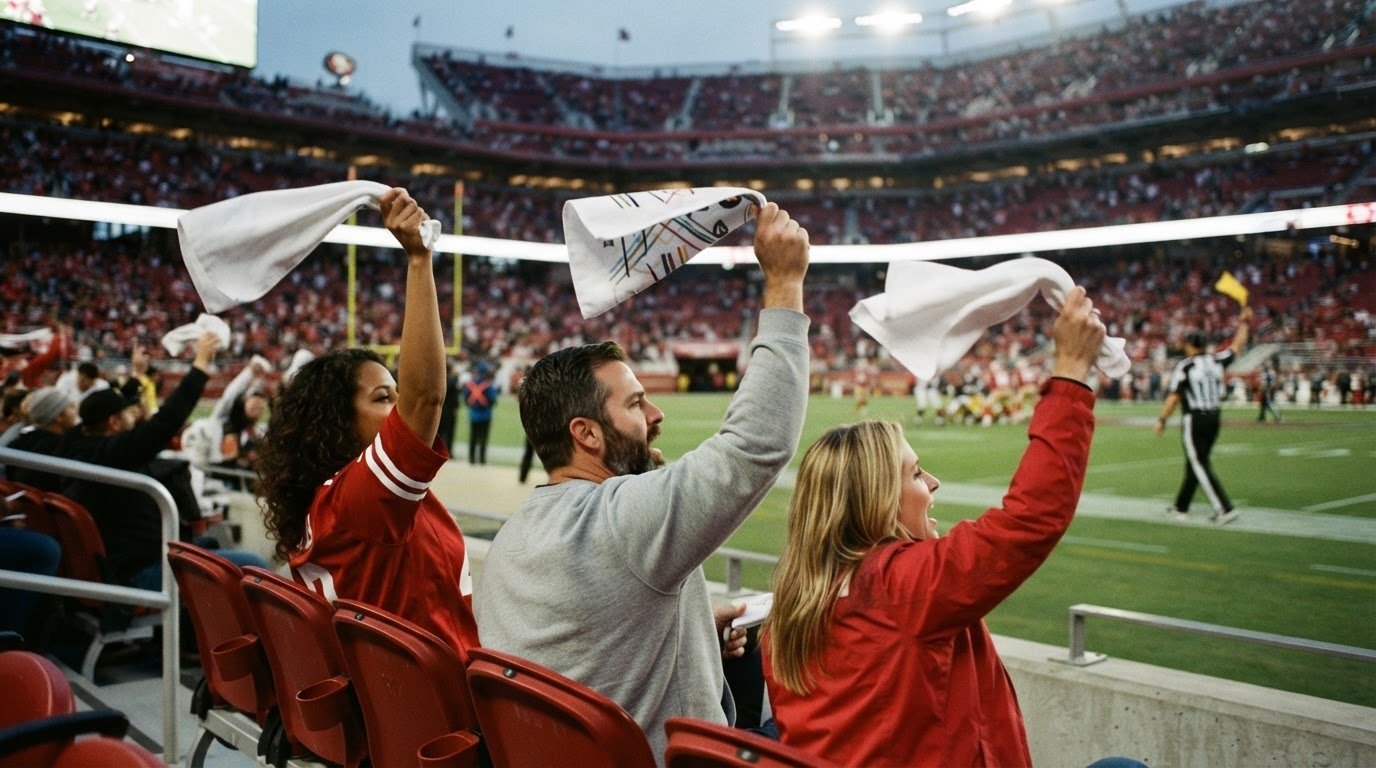
Get a free quote for custom towels.
The Ice out towels turned the walk to Levi’s Stadium into a visible statement: a coalition distributed more than 25,000 towels outside the stadium as fans headed to Super Bowl 60 on February 8, 2026. Organizers asked fans to raise them whenever a referee threw a penalty flag and during Bad Bunny’s halftime performance.
A coordinated towel giveaway can do more than mark a seat or show support for a team. Here, towels gave fans a simple way to take part in a peaceful protest against the Trump administration and its immigration enforcement operations.
Volunteers handed out the towels around the stadium and encouraged fans to raise them during the game and halftime show. The two-sided design also helped communicate the message.
Key Takeaways
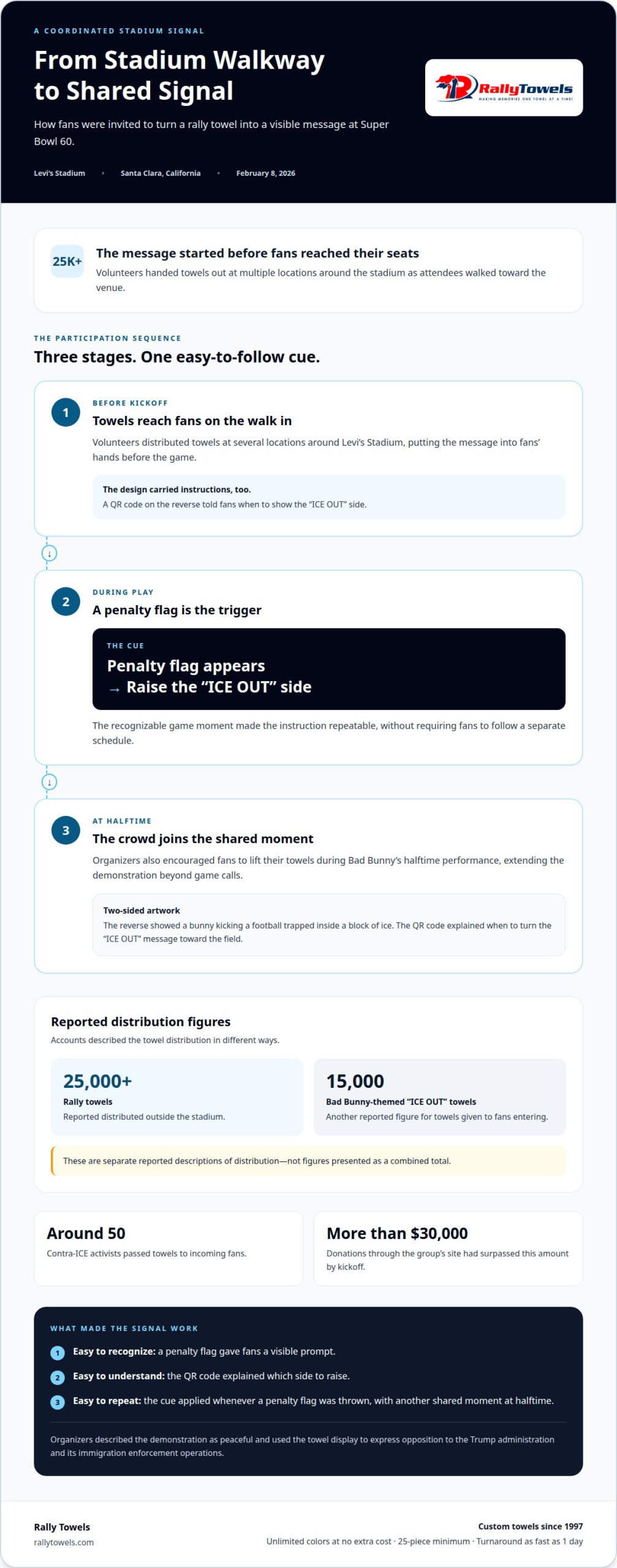
- Volunteers handed out the towels at multiple locations around Levi’s Stadium as fans arrived.
- A QR code on the reverse shared the signal: raise the “ICE OUT” side when a referee threw a penalty flag.
- Organizers also invited fans to lift their towels during the halftime performance as part of a peaceful demonstration.
- Learn what to consider about comfort and skin sensitivity when deciding whether a towel is suitable for a child.
- See how a clear design and coordinated giveaway can help a crowd take part in a shared message.
Plans for fans to raise towels during the game and halftime show
At Super Bowl 60 on February 8, 2026, fans were invited to use their towels as a coordinated visual protest. The game took place at Levi’s Stadium in Santa Clara, California, with kickoff at 3:30 p.m. The planned signal had two moments: lift the towel when a referee threw a penalty flag, then raise it again during Bad Bunny’s halftime performance. Each cue connected the audience to the same public message, whether fans were watching the action or the show.
Distribution began before fans reached their seats. Volunteers handed towels out at multiple locations around Levi’s Stadium as attendees walked toward the venue. Accounts described more than 25,000 rally towels distributed outside the stadium, while another reported figure was 15,000 Bad Bunny-themed “ICE OUT” towels for fans entering. These figures describe reported distributions in different ways. Together, they show how organizers used several points around a major venue to put the message into fans’ hands before kickoff.
The instructions were designed to make participation easy to understand. A QR code on the reverse asked fans to turn the “ICE OUT” side outward whenever a referee threw a penalty flag. That cue tied the display to a recognizable moment in the game, rather than requiring fans to follow a separate schedule. A flag on the field became a prompt: notice the call, raise the towel, and make the message visible from the stands.
The design added another visual element. The reverse showed a bunny kicking a football trapped inside a block of ice, connecting Bad Bunny’s performance with the protest message. The two-sided format let the towel show more than one image, while the QR code explained when to turn the message toward the field. In a crowd display, the image draws attention, and the code clarifies when to show the message.
- Before kickoff: Volunteers distribute towels around Levi’s Stadium as fans approach.
- During play: A penalty flag is the stated signal to raise the “ICE OUT” side.
- At halftime: Organizers encourage fans to lift towels during Bad Bunny’s performance.
The halftime plan broadened the demonstration beyond game calls. Organizers hoped fans would raise towels during play and Bad Bunny’s set to protest the Trump administration and immigration enforcement operations across the United States. Community members organized the peaceful demonstration through the “Flags in the Stands” initiative. The stadium-wide display could connect a repeated game cue with a performance watched by the same crowd.
Contra-ICE, an organization led by musicians and artists, distributed the towels at Levi’s Stadium. Around 50 Contra-ICE activists passed towels to incoming fans, while donations through the group’s site had surpassed $30,000 by kickoff. Those details show the event’s organizing context, but the fan instruction stayed simple: raise the towel when a penalty flag appears, and join the display during halftime. The message depended on visible participation, not on each fan carrying out a complicated sequence.
The plan unfolded amid public discussion about immigration enforcement. The NFL said it had no planned ICE enforcement activities at Levi’s Stadium. DHS adviser Corey Lewandowski and DHS Secretary Kristi Noem had made statements about ICE presence at the Super Bowl. Against that backdrop, the towels gave fans a coordinated way to express opposition. The game cue made the gesture repeatable, while halftime offered a shared moment beyond the field.
The Contra-ICE site called for fans to raise their towels every time a penalty flag was thrown. The instruction makes the flag the specific trigger, linking a visible moment in play to the display. It gives the request a repeated form: the cue applies whenever that event occurs, rather than at just one preselected moment. The proposed action is easy to connect to what is happening on the field.
The cue’s meaning comes from the contrast between an ordinary game signal and a public message in the stands. Fans following the instruction would turn a referee’s penalty flag into a prompt for collective visibility, without needing a separate announcement each time. Repeating the action could keep the message present throughout the game, while leaving each fan free to participate or not. The plan sets out a simple relationship: flag, then towel.
Are Ice Out towels safe for children and people with sensitive skin?
The words “ICE OUT” describe a message, not a towel’s material or skin-contact properties. A protest design alone can’t establish whether a particular towel suits a child or someone with sensitive skin. That depends on the individual towel’s fabric, surface, printing, and care information. Those details matter more than its slogan or image.
Separate the visual design from the item itself. A graphic can show colors, words, and illustrations, but it doesn’t identify every material used in the towel. A two-sided message, for example, tells you what appears on each side. It doesn’t tell you how the fabric feels, how it was finished, or whether someone has reacted to similar textiles before.
For a child, consider how they’ll use the towel at the event. Holding it above their head during a crowd display involves different contact than wearing it around the neck or pressing it against the face. If skin contact is a concern, an adult can have the child hold the towel as a sign rather than use it as a wrap or face covering.
People with sensitive skin can also take part without direct contact. A fan can raise a towel without placing it against their face or neck. Someone who prefers not to handle the fabric can still join the display by standing with the group or following the shared cue. These options preserve the visual message without requiring everyone to use the towel in the same way.
- Read the item’s care information: Look for fabric and washing details on the towel’s label or accompanying information.
- Consider the intended use: Holding a towel as a sign differs from wearing it against skin.
- Use an alternative gesture: A child or adult can participate without wrapping the towel around their body.
- Respond to discomfort: Stop direct contact if the person finds the fabric uncomfortable.
Care instructions explain how an item should be handled after use. They may also help distinguish a towel intended for repeated washing from one used as a sign for a single event. Follow the instructions attached to that specific towel. Don’t assume a bright print, a soft-looking surface, or a familiar shape answers questions about fabric or personal sensitivity.
A child’s comfort can change during a long event. A child might happily hold a towel during a short display but dislike wearing it around the neck while moving through a crowded venue. Keep it accessible as a hand-held sign instead. That gives the child a simple way to participate without making skin contact part of the activity.
For an adult with known sensitivities, the key distinction is between a visual prop and a personal-use textile. Raising a towel briefly for a crowd moment doesn’t require using it as clothing, bedding, or a face covering. If direct contact is unwelcome, hold it by an edge or let another attendee carry it. The message can remain visible without changing how the person manages contact.
In short, don’t judge skin suitability from the “ICE OUT” graphic. Use the specific towel’s care information, consider how it will touch the person, and choose a hands-only display if that feels more comfortable. A child can raise a towel beside an adult, while someone with sensitive skin can join the same moment without wearing it. The message and each person’s way of participating are separate choices.
For an event-specific decision, keep questions about skin contact separate from why people are gathering. DHS adviser Corey Lewandowski said ICE would find, apprehend, detain, and deport people in the country illegally, including at the Super Bowl. That statement says nothing about a towel’s fabric, printing, or suitability for a particular person. It doesn’t change the value of choosing a way to participate that avoids unwanted contact.
Before using a towel, decide whether to hold it, carry it, or place it against the skin, then choose the option that feels comfortable. If a child or adult would rather not touch it, participation need not depend on handling it. If direct contact becomes uncomfortable, stop using the towel that way. The item’s care information remains the relevant guide to handling and washing it; the event message can’t answer questions about its materials or an individual’s sensitivity.
Rally Towels
Rally Towels helps teams turn a shared message into a coordinated stadium giveaway. Custom rally towels can be screen printed or full-color dye sublimated, with unlimited colors at no extra cost. Choose artwork that makes the event message easy to spot and the cue clear from the stands. Orders start at a 25-piece minimum, with turnaround as fast as 1 day.
For a distinct fan look, jersey-shaped rally towels are available in 17×18, with long sleeve, short sleeve, and tank top designs. The right format depends on the artwork and how fans will display it. Explore custom rally towel options for an event giveaway or stadium moment.
Contact Rally Towels to discuss your event towels.
Turn a shared idea into a crowd moment
An Ice Out towels campaign shows how a clear visual cue can help turn individual fans into a coordinated, visible crowd. For your next event, start with the message you want people to recognize, then plan the design and distribution around how attendees will participate. For campaigns that complement handheld giveaways with stadium signage and grand format banners, Monster Media Inc. provides large-scale printing solutions to reinforce visibility. A simple instruction can make the moment easy to understand from the stands.
Rally Towels supports promotional and stadium giveaways with custom rally towels printed by screen printing or full-color dye sublimation. The right approach depends on your artwork, event setting, and how fans will use the towels. Build your plan around those decisions to make the message unmistakable.
Give your next event a distinctive crowd moment. Get a free quote from Rally Towels and take the next step toward a coordinated giveaway.
Frequently Asked Questions
What does “ice out towels” mean?
“Ice out towels” refers to rally towels printed with the “ICE OUT” message, used to make a protest visible in a stadium crowd. At Super Bowl 60, the message expressed opposition to the Trump administration and its immigration enforcement operations. Fans could display the printed side as a shared statement, turning an ordinary game-day giveaway into a symbol of collective participation.
What are Ice Out towels made of, and how do they work?
Fans raise the “ICE OUT” side when a referee throws a penalty flag and during Bad Bunny’s halftime performance.